
Author: BI Body Intelligence
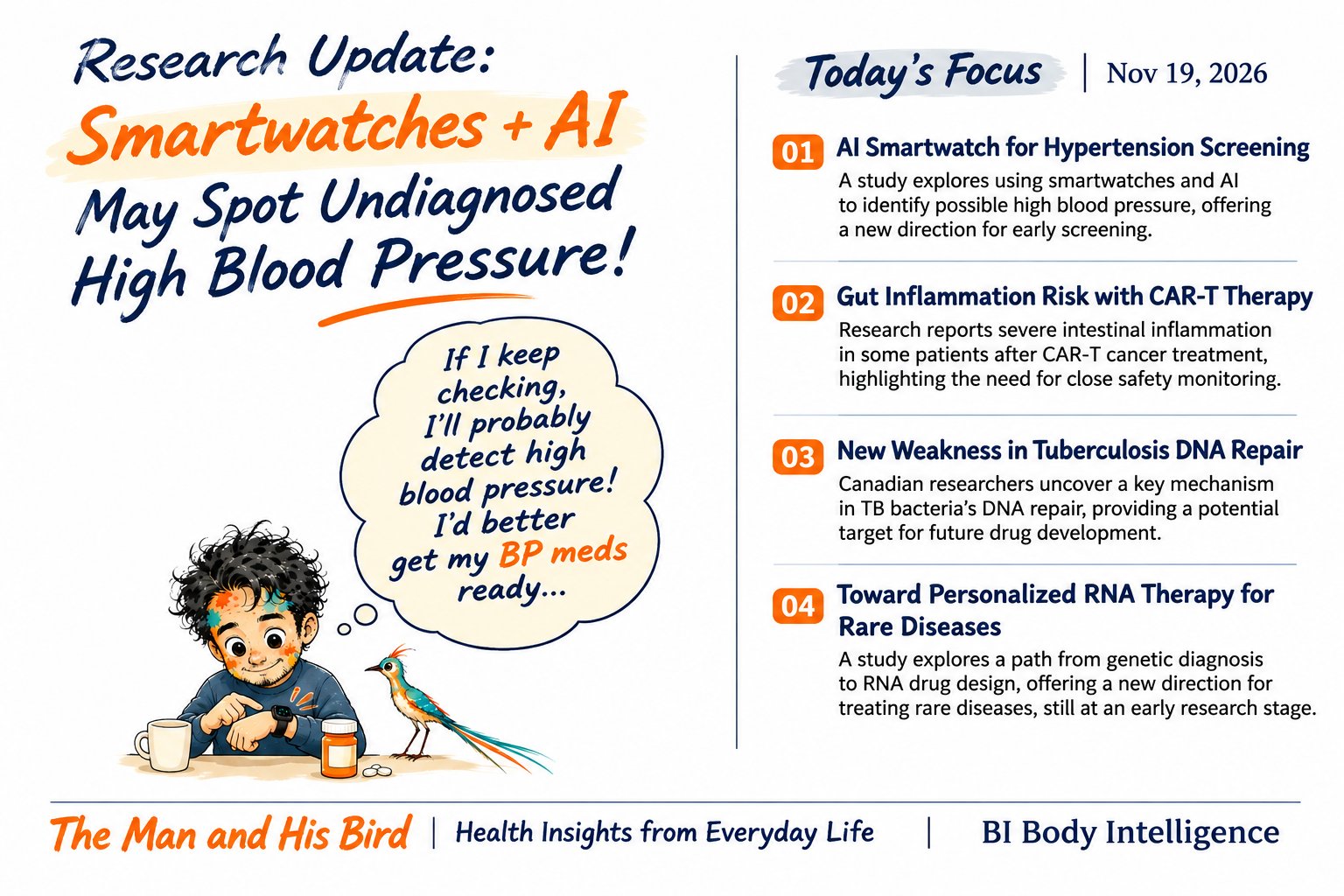
Today’s Health & Science Highlights | November 19, 2026
Scientific research suggests that smartwatches combined with artificial intelligence (AI) may help identify people with previously undiagnosed high blood pressure.
Hearing this, our man looks carefully at his smartwatch and thinks:
“If I keep checking long enough, I’m bound to discover high blood pressure! I’d better get my blood pressure medication ready…”
His little bird watches quietly.
Of course, the purpose of early detection is to identify potential health risks—not to turn everyone into a patient.
Today, we explore four developments in medical research.
01 | AI Smartwatches May Help Screen for Hypertension
High blood pressure often develops without noticeable symptoms. Many people remain unaware of it until a routine examination or a health complication reveals the problem.
Researchers are exploring whether physiological data collected by smartwatches, combined with AI algorithms, can help identify individuals who may have hypertension.
The potential benefit is earlier screening and greater awareness of cardiovascular risk.
However, an AI-generated risk alert is not a medical diagnosis. Confirming hypertension still requires appropriate blood pressure measurements and clinical evaluation.
02 | CAR-T Cancer Therapy: Researchers Investigate Serious Intestinal Inflammation
CAR-T cell therapy represents a major advance in cancer immunotherapy, particularly for certain blood cancers.
However, innovative treatments can also introduce unexpected safety challenges.
Recent research has examined severe intestinal inflammation occurring in some patients following BCMA-targeted CAR-T therapy.
These findings highlight the importance of monitoring adverse effects alongside treatment effectiveness.
Medical progress is not only about developing more powerful treatments. It is also about making those treatments safer.
03 | Canadian Researchers Identify a Potential Weakness in Tuberculosis DNA Repair
Tuberculosis remains a significant global infectious disease, and drug-resistant tuberculosis presents additional treatment challenges.
Canadian researchers are investigating how tuberculosis bacteria repair damaged DNA, focusing on proteins involved in this process.
Understanding these mechanisms may eventually help scientists develop drugs that interfere with bacterial DNA repair or increase susceptibility to existing treatments.
For now, this remains early-stage laboratory research rather than an established clinical treatment.
04 | Rare Diseases: Moving from Genetic Diagnosis Toward Personalized RNA Therapies
For people living with extremely rare genetic disorders, treatment options can be limited.
Small patient populations and complex disease mechanisms often make conventional drug development difficult.
Researchers are exploring a more personalized approach: identifying genetic abnormalities, studying patient-derived cells, and designing experimental RNA-based therapies targeting specific molecular problems.
This approach offers a promising direction for future precision medicine.
However, laboratory success does not establish clinical effectiveness. Further testing and careful evaluation remain essential.
Today’s Reflection | As Technology Gets Smarter, Must People Become More Anxious?
From AI-powered smartwatches to cancer immunotherapy, bacterial DNA repair, and personalized RNA medicines, medical science continues to reveal increasingly detailed information about the human body.
We can measure more, detect more, and identify potential risks earlier than ever before.
But better health management does not mean finding as many abnormalities as possible.
Nor does every potential risk require immediate treatment.
Testing requires interpretation. Risk requires assessment. Intervention requires evidence.
The true value of technology is helping people understand their bodies—not making them live in constant fear of disease.
Our world is already filled with noise, uncertainty, and competing demands for attention.
Perhaps the greatest contribution of science is not simply giving us more information, but helping us live with greater understanding, confidence, and peace of mind.
The Man and the Bird | Caring for Health in Everyday Life
Science & Education: BI Body Intelligence
Professional Review: Thomas Lin
Professional Community: ACPN — The Association of Certified Professional Nutritionists
Disclaimer: This article is for health education purposes only and does not constitute medical diagnosis or treatment advice.