
Author: BI Body Intelligence
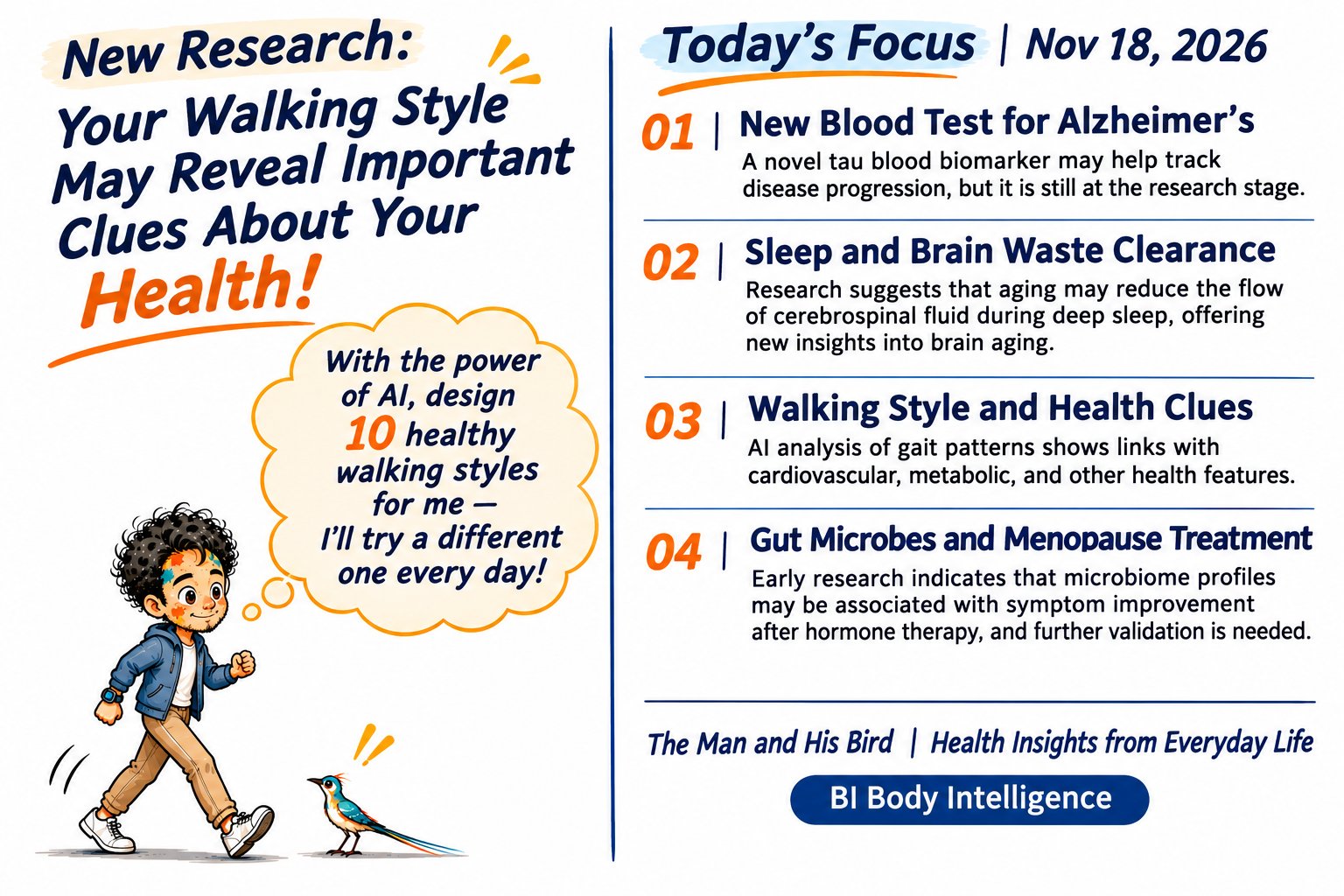
Today’s Health Highlights | November 18, 2026
Medical science is discovering new ways to understand the human body.
From a simple blood sample to sleep patterns, walking movements, and even the microorganisms living in our gut, researchers are exploring new sources of information about human health.
Today’s four research highlights show how our understanding of the body continues to evolve.
01 | New Progress in Alzheimer’s Blood Testing
Researchers are investigating a new blood biomarker related to tau protein, which may help monitor Alzheimer’s disease progression.
If validated, this approach could eventually help clinicians assess disease stages, guide treatment decisions, and monitor therapeutic responses.
However, the technology remains under investigation and is not yet a replacement for established clinical diagnostic methods.
02 | Sleep and the Brain’s Waste Clearance System
Sleep is more than a period of rest. It plays an important role in maintaining normal brain function.
Recent research suggests that aging may affect cerebrospinal fluid movement during deep sleep, potentially influencing processes associated with brain waste clearance.
These findings offer new insights into the relationships among sleep, brain aging, and neurodegenerative diseases.
However, poor sleep does not automatically indicate impaired brain waste clearance or predict dementia.
03 | Walking Patterns May Reveal Clues About Multiple Body Systems
Walking may appear simple, but it requires coordination among the nervous system, muscles, bones, balance mechanisms, and cardiovascular system.
Researchers are using artificial intelligence to analyze gait patterns and explore their associations with cardiovascular, metabolic, and other health characteristics.
In the future, gait analysis may become a useful supplementary tool for health assessment.
Importantly, identifying associations between walking patterns and health does not mean that deliberately changing how we walk will automatically improve our health.
04 | Gut Microbes and Menopause Hormone Therapy
Recent research suggests that microbial characteristics before menopause hormone therapy may be associated with improvements in symptoms following treatment.
These findings raise interesting questions about how the gut and other microbial communities may interact with hormonal changes and therapeutic responses.
However, the evidence remains preliminary. Microbiome testing cannot yet reliably predict individual treatment outcomes.
Health Science Is Changing How We Observe the Human Body.
Traditionally, health assessment has relied heavily on symptoms, physical examinations, and laboratory measurements.
Today, molecular biomarkers, sleep physiology, AI-powered gait analysis, and microbiome research are opening additional windows into human biology.
These developments do not replace established medical assessment. Instead, they may help us understand the same individual from multiple perspectives.
For professional health management, the real value is not simply having more tests or collecting more data.
It is understanding what the information means, recognizing its limitations, and determining how it can support better health decisions.
After all, the human body is not merely a collection of isolated measurements. It is a complex, interconnected living system that continuously responds and adapts to its environment.
The Man and the Bird | Caring for Health in Everyday Life
Science & Education: BI Body Intelligence
Professional Review: Thomas Lin
Professional Community: ACPN — The Association of Certified Professional Nutritionists
Disclaimer: This article is for health education purposes only and does not constitute medical diagnosis or treatment advice.