
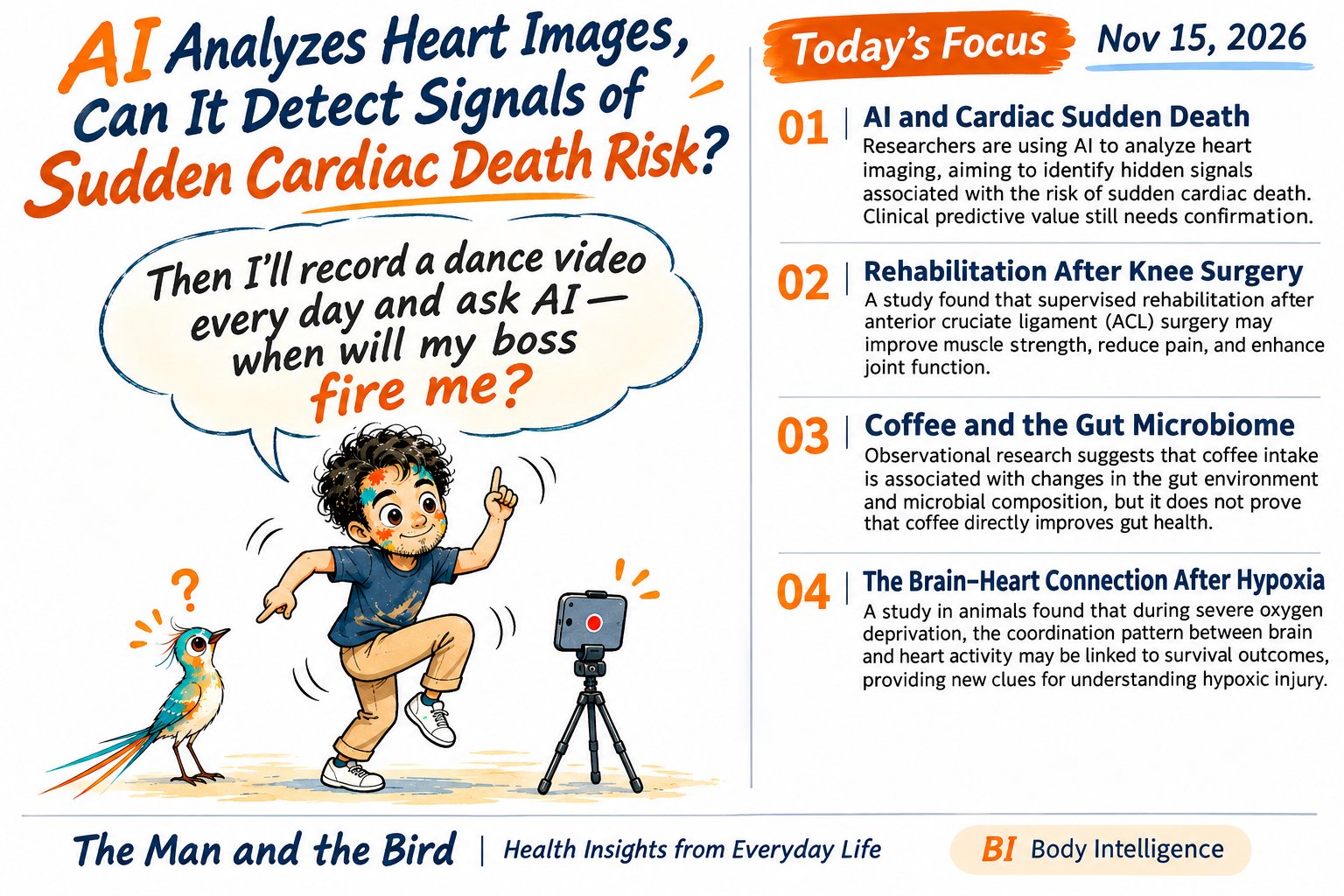
Can AI Detect Hidden Heart Risks? Four Developments in Health Science
Today’s edition of The Man and the Bird explores four developments in health science: artificial intelligence and sudden cardiac death risk, rehabilitation after knee surgery, coffee and the gut microbiome, and the connection between the brain and heart during severe oxygen deprivation.
These studies span artificial intelligence, sports medicine, nutritional metabolism, and neuroscience.
Together, they highlight an important direction in modern health research: understanding the complex physiological information that may remain hidden within conventional measurements.
01 | AI and Sudden Cardiac Death: What Can Heart Images Reveal?
Cardiac imaging is commonly used to evaluate heart structure, cardiac function, and abnormalities associated with cardiovascular disease.
Recent research has explored whether artificial intelligence can identify subtle imaging patterns associated with an increased risk of sudden cardiac death.
Traditional image interpretation relies on established measurements and clinical expertise. AI systems can analyze large amounts of imaging data and potentially detect complex patterns that may not be readily apparent through conventional assessment.
This raises an important possibility: medical images obtained for routine cardiac evaluation may eventually provide additional information about future cardiovascular risks.
However, identifying a statistical risk signal is not the same as accurately predicting when an individual will experience sudden cardiac death.
Before an AI prediction model can become a reliable clinical tool, it must undergo independent validation and demonstrate that its use improves medical decision-making and patient outcomes.
AI may help identify risk, but a probability estimate is not a prediction of an individual’s destiny.
02 | Rehabilitation After Knee Surgery: Why Is Exercise So Important?
The anterior cruciate ligament (ACL) plays an essential role in maintaining knee stability.
ACL injuries are common in sports involving sudden changes in direction, jumping, and rotational movements.
Surgical reconstruction can help restore structural stability, but surgery alone does not automatically restore muscle strength, neuromuscular coordination, or functional movement.
Recent rehabilitation research suggests that supervised exercise programs following ACL surgery may improve muscle strength, reduce pain, and enhance joint function.
Strengthening the quadriceps, hamstrings, and hip muscles is particularly important during rehabilitation.
Balance training, proprioceptive exercises, and movement-control activities may also help restore the body’s ability to recognize and regulate knee position.
These findings reinforce a fundamental principle of musculoskeletal health:
Joint function depends not only on bones and ligaments, but also on coordinated interactions among muscles, nerves, and connective tissues.
Rehabilitation programs should be individualized according to surgical procedures, tissue healing, functional capacity, and clinical guidance.
The goal is not simply to increase exercise intensity, but to restore safe and effective movement.
03 | Coffee and the Gut Microbiome: Beyond Caffeine and Alertness
For many people, coffee is part of a daily routine, primarily associated with increased alertness and reduced feelings of fatigue.
However, coffee contains much more than caffeine.
It also provides polyphenols and other biologically active compounds that may interact with gastrointestinal physiology and microbial metabolism.
Recent observational research has reported associations between coffee consumption, intestinal conditions, and the composition of gut microbial communities.
Researchers are investigating whether specific coffee components may influence the growth and metabolic activities of certain microorganisms.
This expands the scientific discussion of coffee beyond its effects on the central nervous system.
However, changes in microbial composition do not necessarily indicate improved health.
An increase or decrease in particular bacterial populations cannot automatically be interpreted as beneficial or harmful without understanding their functions and the broader physiological context.
Individual responses to coffee also vary considerably.
Caffeine metabolism, gastrointestinal sensitivity, sleep quality, medication use, and overall dietary patterns may influence whether coffee consumption is appropriate for a particular person.
For individuals who experience palpitations, gastrointestinal discomfort, or sleep disturbances, increasing coffee intake may not be advisable.
Understanding the health effects of coffee requires considering both its biological components and individual physiological responses.
04 | The Brain–Heart Connection After Severe Hypoxia
The brain and heart are two organs with particularly high demands for a continuous oxygen supply.
When the body experiences severe hypoxia, or insufficient oxygen availability, both neurological and cardiovascular functions may be affected.
Recent animal research suggests that certain patterns of coordination between brain activity and cardiac activity during severe oxygen deprivation may be associated with survival outcomes.
This coordination is sometimes described as physiological coupling.
The brain influences heart rate, vascular tone, and circulatory regulation through the autonomic nervous system.
At the same time, cardiac pumping function and blood circulation determine how effectively oxygen and nutrients reach the brain.
These relationships create a continuous feedback system.
During severe physiological stress, changes in one organ may influence the function of the other.
Studying these interactions may provide new insights into the body’s response to oxygen deprivation and the mechanisms involved in recovery.
However, these findings remain based on animal experiments.
They do not establish a clinically validated method for predicting survival or neurological recovery in human patients.
Today’s Health Perspective | From Isolated Measurements to Integrated Physiology
Although today’s four studies focus on different aspects of health, they share a common scientific theme:
Human physiology cannot be fully understood by examining organs, measurements, or biological pathways in isolation.
Cardiac images may contain information beyond conventional measurements.
Recovery after knee surgery requires coordination among muscles, nerves, and joints.
Coffee may interact with gut microorganisms through multiple biologically active compounds.
And the physiological response to severe oxygen deprivation involves dynamic communication between the brain and heart.
Modern health science is increasingly moving toward understanding these interconnected biological systems.
At the same time, responsible interpretation requires distinguishing scientific possibilities from established clinical applications.
Three principles remain essential:
Association does not establish causation.
A predictive model does not guarantee accurate predictions for an individual.
Findings from animal experiments do not automatically translate into proven human clinical benefits.
The future of health management will involve increasingly sophisticated technologies, biological measurements, and analytical tools.
But collecting more information is not enough.
The real challenge is understanding what the information means, recognizing its limitations, and determining how validated evidence can support meaningful health decisions.
Better health management requires not only better technology, but also better scientific judgment.
That is the foundation of Body Intelligence.
—
Science & Education: BI Body Intelligence
Professional Review: Thomas Lin
Professional Community: ACPN — The Association of Certified Professional Nutritionists
Disclaimer: This article is for health education purposes only and does not constitute medical diagnosis or treatment advice.