
From the Blood–Brain Barrier to Food Labels: Discovering the Hidden Connections in Human Health
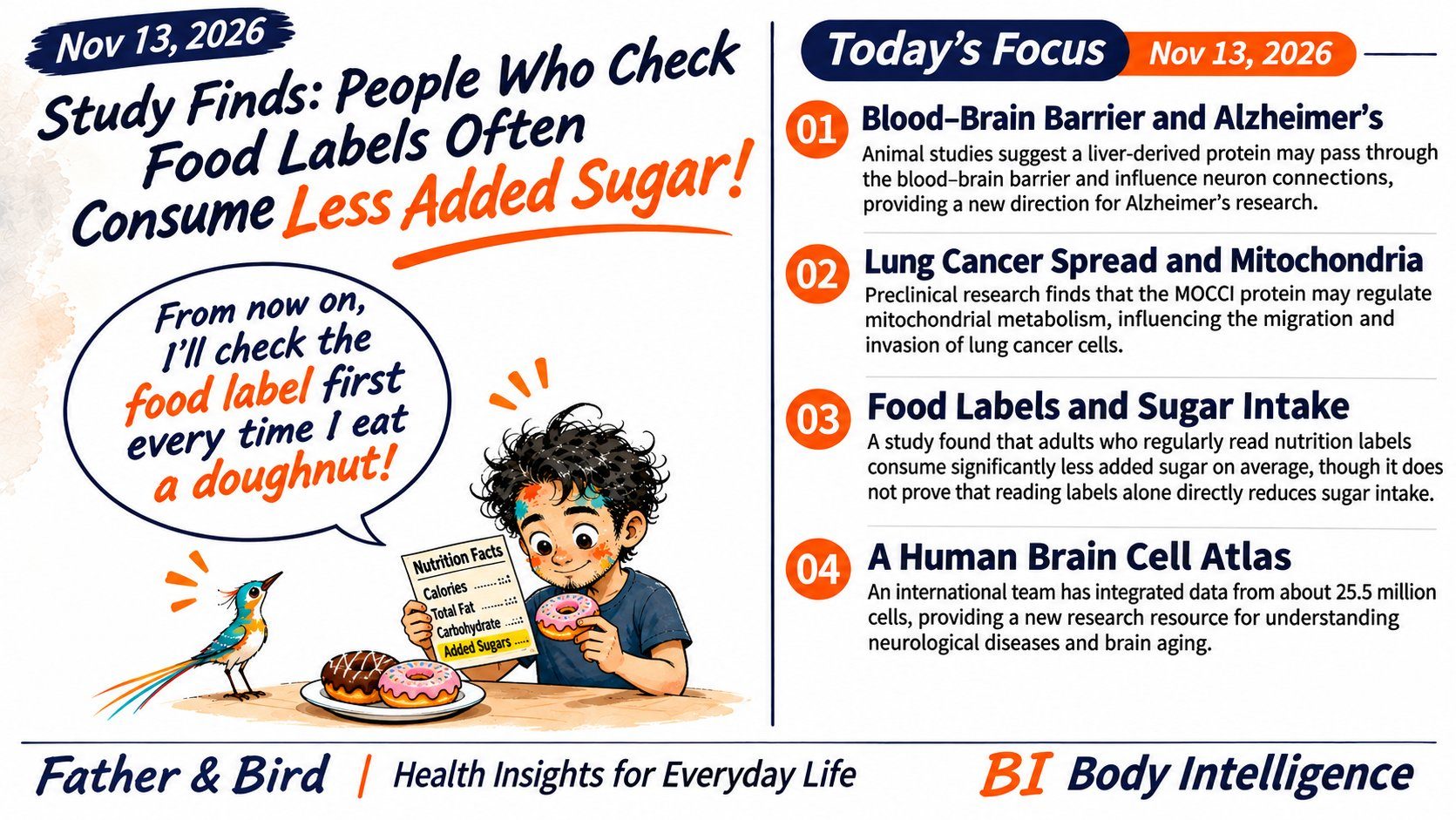
Today’s health highlights explore four areas of research: Alzheimer’s disease, lung cancer metastasis, food labeling and sugar consumption, and a large-scale map of human brain cells.
These studies represent different levels of scientific evidence, ranging from animal and cellular experiments to population-based observational research.
Understanding their findings also means recognizing what has—and has not—been established.
01 | The Blood–Brain Barrier and Alzheimer’s Disease: A Possible Liver–Brain Connection
The blood–brain barrier (BBB) is an essential protective system that regulates which substances can enter brain tissue from the bloodstream.
Recent animal research suggests that apolipoprotein A1 (APOA1), a protein produced primarily by the liver and intestine, may reach the brain through specific transport mechanisms and help maintain connections between neurons.
In mouse models of Alzheimer’s disease, increasing the availability of this protein within the brain was associated with improvements in certain disease-related changes.
The findings suggest that brain health may depend not only on processes within the brain itself but also on proteins produced elsewhere in the body and transported across physiological barriers.
This is an interesting direction for studying communication between organs.
However, these findings remain preclinical. They do not demonstrate that APOA1 supplementation can prevent or treat Alzheimer’s disease in humans.
02 | Lung Cancer Metastasis and Mitochondria: Beyond Cellular Energy Production
Mitochondria are commonly described as the energy-producing structures of cells.
But their functions extend far beyond ATP production.
They also participate in redox regulation, cellular signaling, programmed cell death, and numerous metabolic processes.
Recent preclinical research suggests that a protein called MOCCI may influence lung cancer cell migration and invasion through changes in mitochondrial oxidative phosphorylation, reactive oxygen species, and associated signaling pathways.
In experimental models, reducing MOCCI expression was associated with decreased migration and invasion of certain cancer cells.
These findings highlight an important concept in cancer biology:
Cancer progression may depend not only on genetic mutations but also on the metabolic state and signaling environment of cancer cells.
Nevertheless, the results are still experimental and cannot yet be translated into clinical treatment recommendations for lung cancer patients.
03 | Food Labels and Sugar Consumption: Why Do Label Readers Consume Less Sugar?
A study analyzing approximately 9,400 American children and adults found that adults who frequently read nutrition labels consumed substantially less added sugar, on average, than those who rarely or never read them.
The reported difference between the groups was approximately 42.8 grams of added sugar per day.
Nutrition labels provide information about sugar, fat, protein, sodium, calories, and other nutritional characteristics of packaged foods.
This information can support more informed food choices.
However, the study identified an association, not a direct cause-and-effect relationship.
People who regularly read nutrition labels may already be more health-conscious. They may also differ in their shopping habits, dietary patterns, education, or other lifestyle factors.
Therefore, the findings do not mean that simply looking at a nutrition label automatically reduces sugar consumption.
The potential benefit comes from understanding the information and applying it to everyday food decisions.
04 | Mapping the Human Brain: Insights From Approximately 25.5 Million Cells
An international research team has developed a large-scale cellular atlas of the basal ganglia by integrating data from approximately 25.5 million cells across humans and several animal species.
The basal ganglia are brain structures involved in movement regulation, behavioral selection, learning, and other neurological functions.
By examining different cell populations and their patterns of gene activity, researchers aim to better understand the biological mechanisms associated with Parkinson’s disease, schizophrenia, autism, and brain aging.
Traditionally, neurological research has often examined changes at the level of entire brain regions.
Advances in single-cell analysis now allow scientists to investigate which specific cell populations may be involved in particular biological processes or disease states.
This provides an important foundation for future research.
However, creating a more detailed brain cell map does not mean that new treatments for these neurological conditions have already been established.
Today’s Health Perspective
These four research developments share an important theme:
Human health cannot be fully understood by examining a single organ, measurement, or biological pathway in isolation.
Proteins produced by the liver may contribute to maintaining neuronal connections in the brain.
Changes in mitochondrial metabolism may influence the behavior of cancer cells.
Information presented on food labels may be associated with dietary choices.
And differences among specialized brain cell populations may help explain neurological function and disease.
Modern health science is moving beyond isolated observations toward a deeper understanding of cells, molecules, metabolic pathways, and communication between organs.
At the same time, there remains an important distinction between discovering a biological mechanism and demonstrating that a particular intervention improves human health.
Laboratory findings require validation.
Observational associations require careful interpretation.
And promising research directions must undergo appropriate clinical testing before becoming established treatments.
Building body intelligence means understanding both the complexity of human physiology and the limitations of scientific evidence.
—
Science & Education: BI Body Intelligence
Professional Review: Thomas Lin
Professional Community: ACPN — The Association of Certified Professional Nutritionists
Disclaimer: This article is for health education purposes only and does not constitute medical diagnosis or treatment advice.