
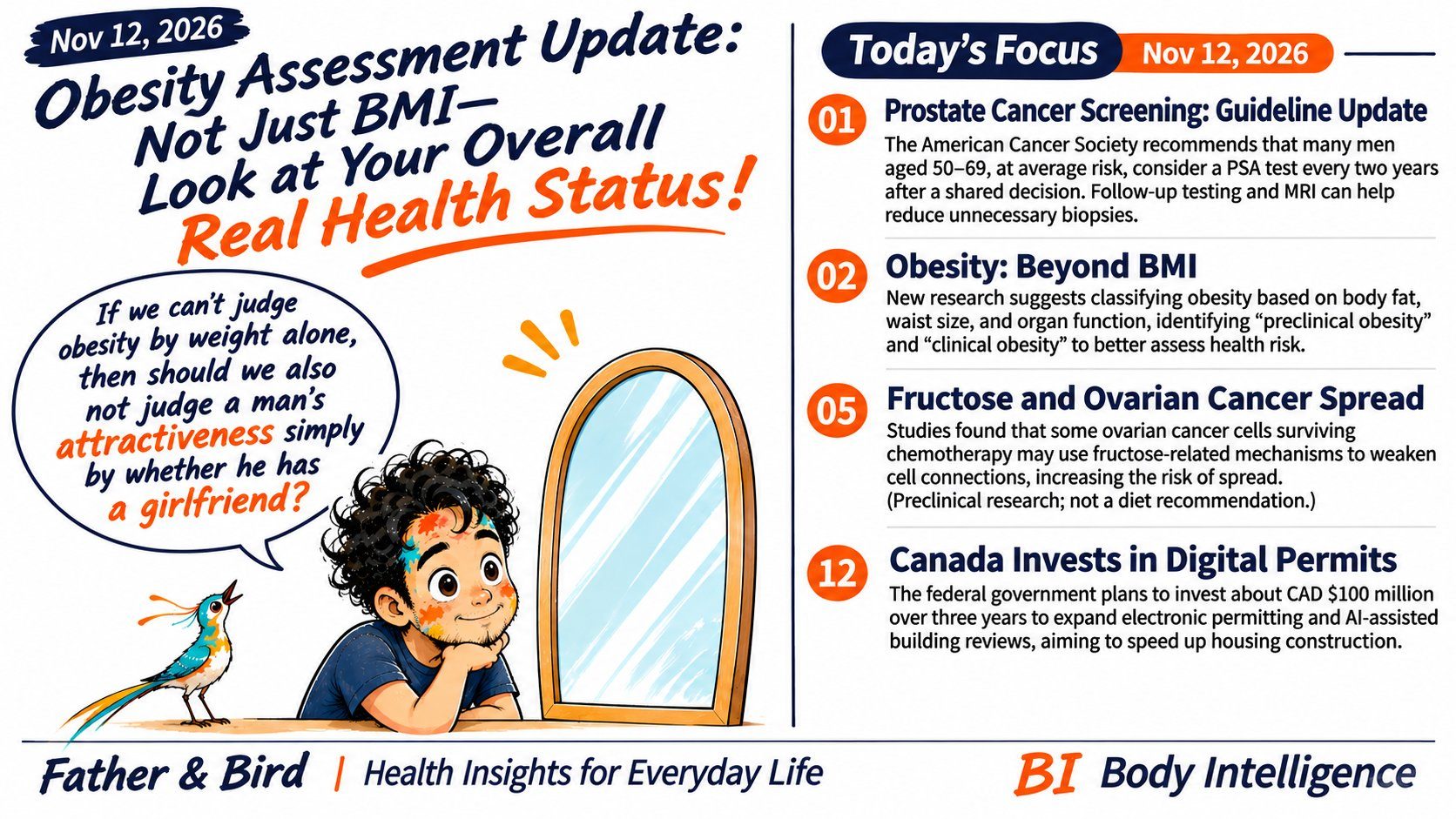
Modern medicine is undergoing an important shift.
Rather than relying on a single number, laboratory result, or symptom, healthcare is increasingly emphasizing overall physiological function, individual risk, and long-term outcomes.
Today, we highlight four developments in medical research and Canadian public policy.
01 | Prostate Cancer Screening: Early Detection Without Unnecessary Testing
Prostate-specific antigen (PSA) blood testing remains an important tool in prostate cancer screening.
Updated guidance from the American Cancer Society emphasizes informed decision-making between patients and healthcare professionals.
For many average-risk men aged 50–69, PSA screening every two years may be considered after discussing potential benefits and harms. Individuals at higher risk may require different screening approaches.
Importantly, an elevated PSA level does not necessarily indicate prostate cancer.
Benign prostate enlargement, inflammation, and other conditions can also influence PSA results.
Modern screening strategies increasingly incorporate individual risk assessment, repeat testing, and magnetic resonance imaging (MRI) when appropriate.
The objective is to identify clinically significant disease while reducing unnecessary biopsies, overdiagnosis, and overtreatment.
Effective screening is not simply about finding abnormalities. It is about identifying who truly benefits from further investigation and treatment.
02 | Obesity Assessment: Moving Beyond BMI
Body mass index (BMI) has long been used as a convenient screening tool for obesity.
However, BMI does not directly measure body fat distribution, muscle mass, metabolic health, or organ function.
Recent research involving nearly 850,000 adults across several countries has examined a broader framework incorporating body fat, waist measurements, and evidence of organ dysfunction.
The framework distinguishes between preclinical obesity, where excess adiposity is associated with potential future health risks, and clinical obesity, where obesity-related functional impairment or disease is already present.
This distinction has important implications for preventive healthcare and functional nutrition.
Two individuals with identical BMI values may have substantially different levels of visceral fat, insulin sensitivity, blood pressure, lipid profiles, muscle mass, and liver metabolic function.
Body weight is a measurement. Health reflects how the entire physiological system functions.
A more comprehensive assessment can help healthcare professionals identify individual risks and develop more appropriate interventions.
03 | Fructose and Ovarian Cancer Spread: A New Direction in Metabolic Research
Recent preclinical cancer research has identified a possible relationship between fructose-related metabolic pathways and the behavior of certain ovarian cancer cells that survive chemotherapy.
Researchers observed mechanisms through which these cells may weaken connections with neighboring cells, potentially facilitating cancer spread.
This finding highlights an increasingly important area of cancer biology: the relationship between cellular metabolism and disease progression.
Cancer cells interact with complex metabolic environments involving glucose, fructose, lipids, and numerous signaling pathways.
However, the findings remain preliminary.
They do not demonstrate that eating fruit causes ovarian cancer to spread, nor do they establish fructose restriction as a cancer treatment.
Further research is required before these mechanisms can inform clinical recommendations.
The broader scientific value lies in understanding how metabolic pathways may influence cancer cell behavior and potentially reveal future therapeutic targets.
04 | Canada Advances Digital Building Permits: AI Enters Public Administration
The Canadian federal government is planning an investment of approximately CAD 100 million over three years to support digital municipal building-permit systems.
The initiative aims to expand electronic applications and AI-assisted permit reviews, potentially reducing administrative delays in housing development.
Although this is not a medical development, it illustrates a broader transformation in how artificial intelligence is being applied.
AI is moving beyond information retrieval and conversational assistance into real-world workflows involving document review, professional judgment, and administrative coordination.
However, effective implementation requires clear accountability, data protection, transparency, and appropriate human oversight.
Technology creates value when it improves decision-making—not merely when it processes information faster.
Today’s Health Perspective
These four developments may appear unrelated, but they share an important theme:
Moving from isolated measurements toward comprehensive assessment, and from simple conclusions toward systems-based understanding.
An elevated PSA level does not automatically mean prostate cancer.
A higher BMI does not necessarily indicate the same degree of metabolic dysfunction in every individual.
Discovering a metabolic mechanism in cancer cells does not immediately justify a dietary treatment recommendation.
And faster AI-assisted processing does not eliminate the need for professional judgment.
Modern health management requires more than additional tests, data, and technologies.
It requires the ability to interpret information within the context of the individual, understand relationships between physiological systems, and make evidence-informed decisions.
Scientific progress is not only about knowing more. It is also about learning to make better judgments.
—
Science & Education: BI Body Intelligence
Professional Review: Thomas Lin
Professional Community: ACPN — The Association of Certified Professional Nutritionists
Disclaimer: This article is for health education purposes only and does not constitute medical diagnosis or treatment advice.