
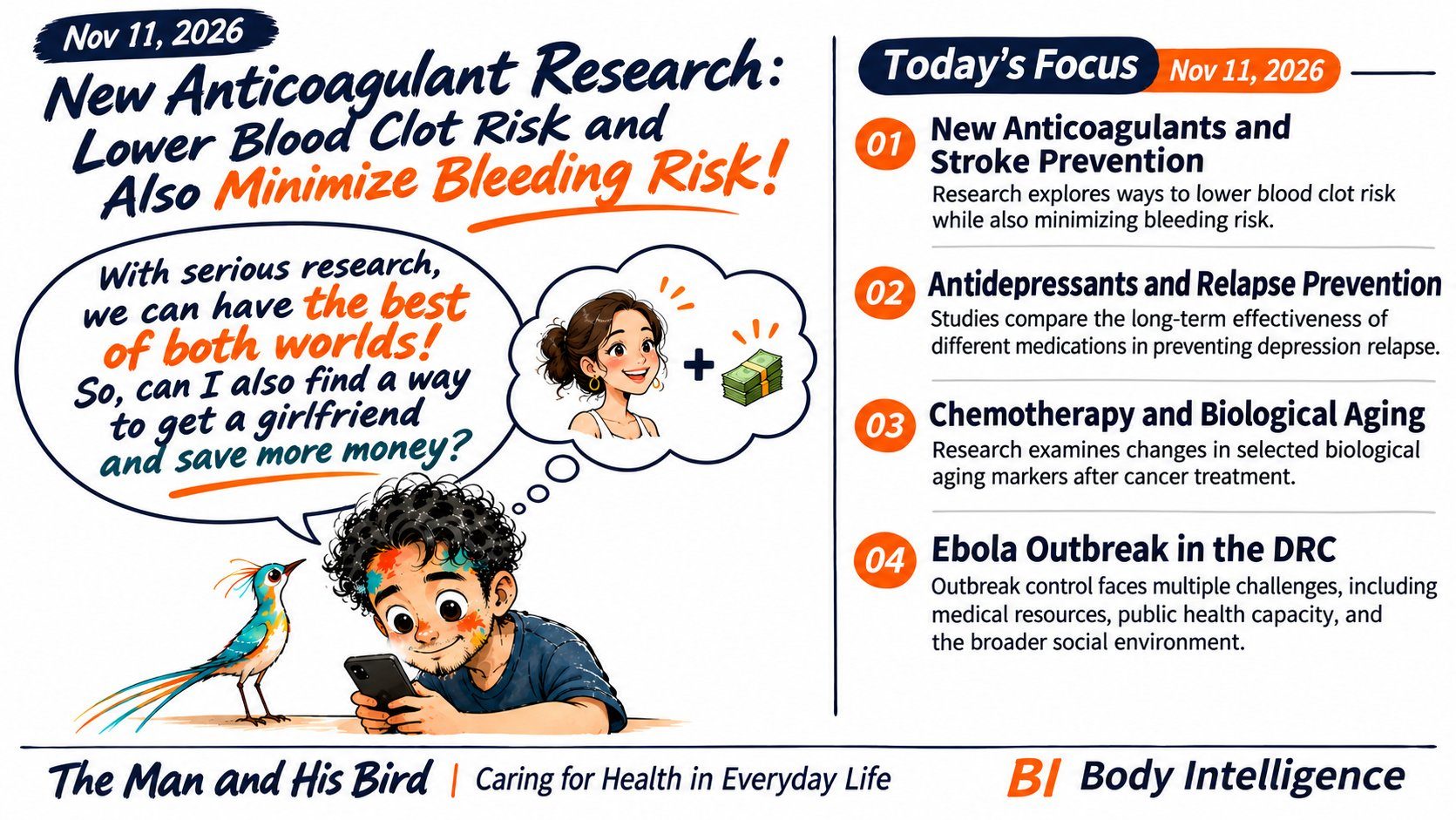
From Blood Clot Prevention to Depression Relapse: Finding a Better Balance in Modern Medicine
Medical research continues to advance—not only through new treatments, but also through a deeper understanding of long-term health, treatment risks, and quality of life.
Today, we highlight four important developments in health and medical science.
01 | New Anticoagulants: Preventing Blood Clots While Managing Bleeding Risk
Blood clots can obstruct blood vessels supplying the brain, potentially causing an ischemic stroke.
However, anticoagulant treatment presents a longstanding challenge: preventing harmful blood clots without excessively increasing the risk of bleeding.
Researchers have increasingly focused on coagulation factor XI, a component of the blood-clotting pathway, as a potential therapeutic target.
The goal is to develop treatments that reduce thrombotic events while maintaining a more favorable bleeding-risk profile.
This represents an important direction in cardiovascular medicine: improving the balance between therapeutic benefits and potential harm.
However, different anticoagulant drugs have different mechanisms, indications, and safety profiles. The benefits of individual treatments must be evaluated through clinical trial evidence rather than assuming that all newer anticoagulants offer the same advantages.
02 | Antidepressants: Why Preventing Relapse Matters
Treating depression involves more than achieving short-term symptom improvement.
Long-term management also considers the risk of recurrence and the ability to maintain recovery.
Recent research has compared antidepressant medications for their effectiveness in maintenance treatment and relapse prevention, suggesting that long-term outcomes may differ among medications.
However, medication effectiveness is only one part of the clinical picture.
Previous depressive episodes, treatment history, medication tolerability, sleep, psychological support, and social circumstances can all influence long-term outcomes.
Importantly, improvement in symptoms does not necessarily mean that medication should be discontinued.
Decisions about continuing, adjusting, or gradually stopping treatment should be made together with a qualified healthcare professional.
03 | Chemotherapy and Biological Aging: Understanding Long-Term Health After Cancer
Advances in cancer treatment have enabled more patients to survive and live longer after their diagnosis.
As a result, researchers are increasingly examining the long-term physiological consequences of cancer treatment.
Recent studies have explored associations between chemotherapy and changes in selected biological aging markers, including measures related to epigenetic aging.
These findings raise an important scientific question:
Could certain cancer treatments influence biological processes associated with aging, even while successfully treating the underlying disease?
Biological aging markers, however, are not equivalent to actual lifespan or clinical aging outcomes.
Changes in these markers do not automatically mean that an individual is aging faster or will live a shorter life.
The significance of this research lies in improving our understanding of survivorship and developing better long-term health monitoring and supportive care.
It does not undermine the importance of medically necessary cancer treatment.
04 | Ebola in the Democratic Republic of the Congo: Public Health Beyond Medical Technology
Ebola virus disease is a serious infectious illness that can cause severe complications and death.
Effective outbreak control depends on early detection, appropriate isolation and treatment, contact tracing, vaccination when indicated, and adequate protection for healthcare workers.
Yet medical technology alone cannot guarantee successful outbreak management.
Healthcare infrastructure, transportation, access to medical resources, community engagement, and regional security conditions all influence the effectiveness of public health responses.
Even when diagnostic tools, treatments, and vaccines are available, the capacity to deliver them consistently remains essential.
This illustrates an important principle:
Population health depends not only on medical discoveries, but also on the strength and resilience of public health systems.
Today’s Health Perspective
These four developments may appear unrelated, but they reflect a shared direction in modern health science.
Medicine is increasingly concerned not only with whether a disease can be treated, but also with treatment safety, long-term outcomes, quality of life, and the sustainability of healthcare interventions.
From balancing clot prevention against bleeding risk, to preventing depression relapse, understanding long-term health after cancer treatment, and strengthening infectious disease control, researchers are addressing a common question:
How can we maximize health benefits while minimizing unnecessary risks and long-term costs?
This question is becoming increasingly important in both modern medicine and proactive health management.
Science & Education: BI 身体智慧 (Body Intelligence)
AI-assisted Research & Illustration: BI × GPT
Professional Review: 林存默 (Thomas Lin)
Professional Community: ACPN — The Association of Certified Professional Nutritionists (加拿大注册执业营养师公会)
Disclaimer: This article is for health education purposes only and does not constitute medical diagnosis or treatment advice.