
Health Science Update | November 10, 2026
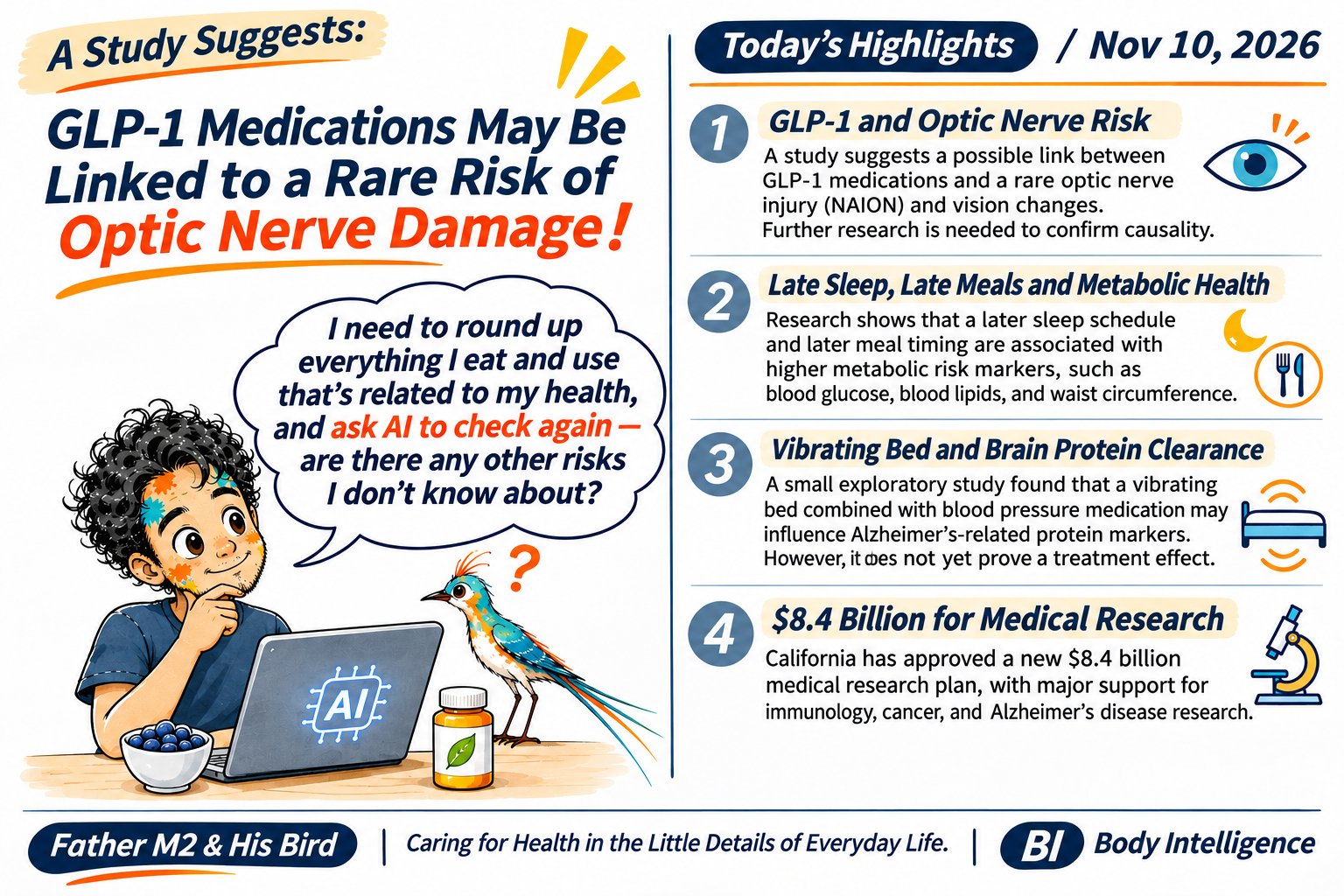
Today’s health science highlights explore four developments: GLP-1 medications and rare optic nerve injury, late sleep and meal timing, experimental approaches to brain protein clearance, and new investments in medical research.
① GLP-1 Medications and Rare Optic Nerve Injury
Recent safety research has raised further questions about the potential relationship between certain GLP-1 receptor agonists and vision health.
Some studies suggest that medications such as semaglutide may be associated with a rare condition called non-arteritic anterior ischemic optic neuropathy (NAION).
NAION involves impaired blood supply to the optic nerve head and can cause sudden, usually painless vision loss.
Importantly, an observed association does not establish that all GLP-1 medications cause optic nerve damage. Evidence varies among individual drugs, and absolute risk, underlying medical conditions, and other risk factors must be considered.
GLP-1 medications have established clinical benefits in diabetes and weight management. Patients should not discontinue prescribed treatment solely because of a news report. Sudden vision loss requires immediate medical attention.
② Late Sleep, Late Meals, and Metabolic Health
A recent study involving adults with obesity found that a later circadian preference, combined with later meal timing, was associated with less favorable metabolic risk markers.
Researchers examined factors including blood glucose, blood lipids, waist circumference, gut microbiota, and intestinal barrier function.
Human metabolism follows circadian rhythms. Insulin sensitivity, gastrointestinal activity, hormone secretion, and energy utilization can vary throughout the day.
These findings suggest that nutritional health may depend not only on what and how much we eat, but also on when we eat.
However, observational associations do not prove that late eating causes metabolic disease. Sleep duration, total calorie intake, physical activity, and individual lifestyle patterns remain important considerations.
③ Can a Vibrating Mattress Help Clear Abnormal Brain Proteins?
A small exploratory study investigated whether a vibrating mattress combined with blood pressure medication could influence biomarkers associated with Alzheimer’s disease.
Researchers observed changes in certain blood amyloid-related markers and proposed that these findings might reflect mechanisms involved in brain waste clearance.
The brain has complex systems involving cerebrospinal fluid circulation and metabolic waste removal. Sleep, vascular pulsation, and fluid movement are important areas of ongoing neuroscience research.
However, changes in blood biomarkers do not directly demonstrate that harmful proteins have been successfully removed from the brain.
They also do not establish that this intervention can prevent or treat Alzheimer’s disease.
The findings remain preliminary and require substantially more research before any clinical application can be considered.
④ $8.4 Billion for Medical Research: Where Is Scientific Investment Heading?
A California medical research funding initiative involving approximately $8.4 billion has attracted attention for its potential support of research in immunology, cancer, Alzheimer’s disease, and other major health conditions.
Medical progress depends not only on individual discoveries but also on sustained investment in basic science, clinical trials, research infrastructure, and professional training.
From immune cell biology to neurodegenerative disease mechanisms, many promising scientific ideas require years of investigation before they can become validated clinical interventions.
Increased research funding creates opportunities for scientific advancement, but it does not mean that effective treatments have already been established.
Today’s Health Perspective
These four developments raise an important question:
As science continues to discover new biological mechanisms, potential treatments, and previously unrecognized risks, how should we approach personal health management?
A medication may provide meaningful therapeutic benefits while also carrying adverse effects that require continued monitoring.
A lifestyle pattern may be associated with metabolic risk without affecting every individual in the same way.
Artificial intelligence can help us search scientific literature, organize information, and identify questions worth investigating.
However, AI cannot replace clinical diagnosis or determine an individual’s actual health risks from search results alone.
Effective health management is not about eliminating every possible risk. It is about understanding benefits, risks, and individual differences through continuously evolving scientific evidence—and making better-informed decisions.
— BI Body Intelligence
Science & Education: BI 身体智慧 (Body Intelligence)
AI-assisted Research & Illustration: BI × GPT
Professional Review: 林存默 (Thomas Lin)
Professional Community: ACPN — The Association of Certified Professional Nutritionists (加拿大注册执业营养师公会)
Disclaimer: This article is for health education purposes only and does not constitute medical diagnosis or treatment advice.