
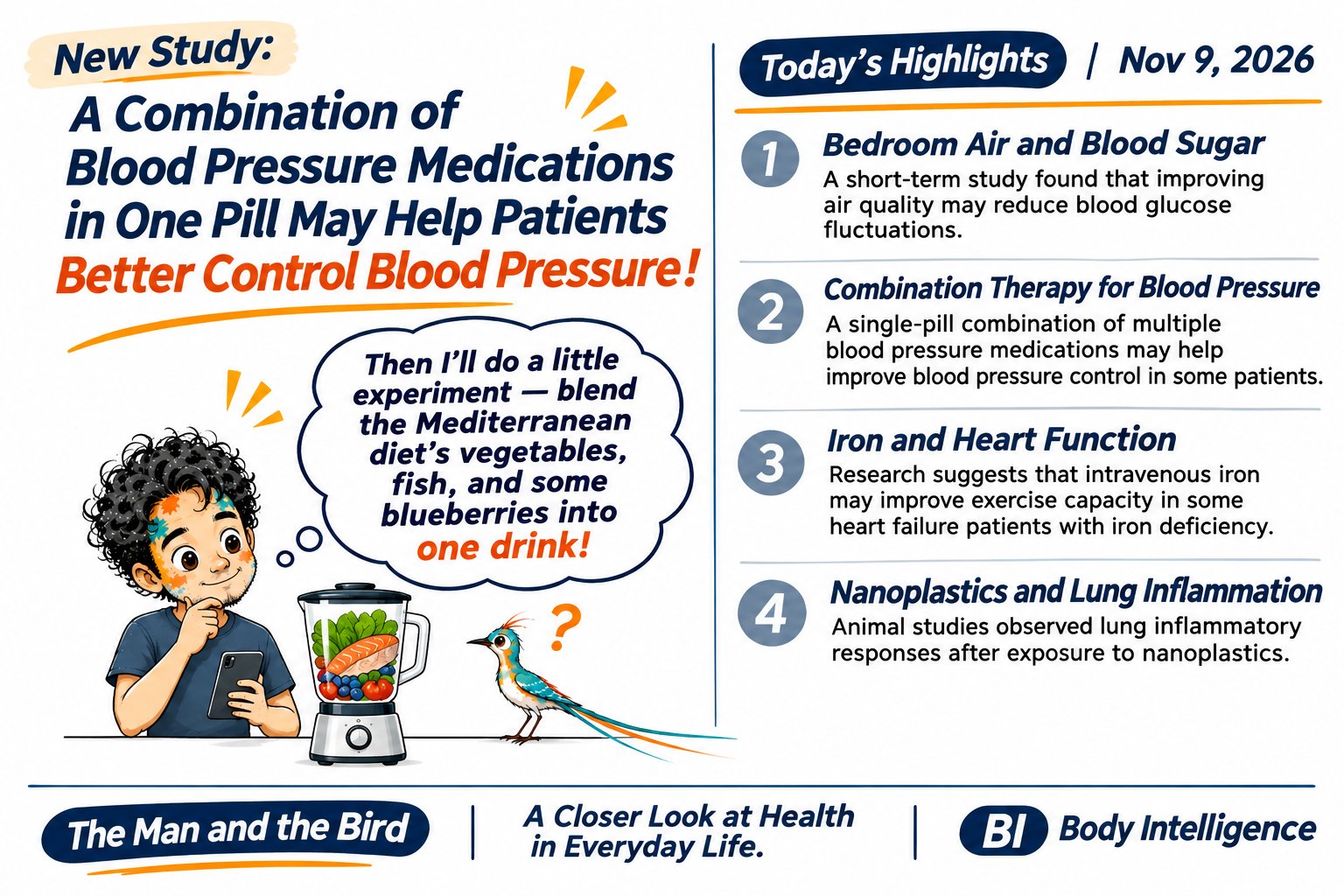
Health Science Update | November 9, 2026
Today’s health science highlights explore four developments involving indoor air quality and blood glucose, combination therapy for hypertension, iron and heart function, and the potential effects of nanoplastics on lung health.
① Bedroom Air Quality and Blood Glucose Regulation
A recent short-term randomized study involving adults with prediabetes found that improving bedroom air quality using high-efficiency particulate air (HEPA) filtration reduced indoor fine particulate matter and was associated with smaller daily blood glucose fluctuations.
These findings suggest that glucose regulation may be influenced not only by diet, exercise, and sleep, but also by environmental exposures.
Researchers are investigating potential connections among air pollution, oxidative stress, inflammation, and glucose metabolism.
However, longer studies are needed to determine whether these improvements translate into sustained metabolic benefits.
② Combination Blood Pressure Medications: Why One Pill May Work Better
A clinical study conducted in Colombia and Jamaica found that combining different classes of blood pressure medications into a single pill may help more patients achieve their blood pressure targets.
Different antihypertensive medications act on distinct physiological mechanisms, including vascular resistance, fluid balance, and kidney sodium regulation.
A carefully designed combination may target several pathways simultaneously while simplifying daily medication routines and potentially improving treatment adherence.
However, this does not mean that arbitrarily combining medications produces better results.
Drug selection, dosage, interactions, and individual medical conditions require clinical evaluation and evidence-based prescribing.
③ Iron and Heart Function: Beyond Hemoglobin
Recent clinical research involving patients with heart failure with preserved ejection fraction and iron deficiency suggests that intravenous iron treatment may improve certain measures of exercise capacity.
Iron is essential not only for hemoglobin production and oxygen transport but also for mitochondrial energy metabolism.
Several proteins involved in the mitochondrial electron transport chain depend on iron-containing structures to support cellular energy production.
Consequently, iron deficiency may affect both oxygen delivery and energy utilization in skeletal and cardiac muscle.
However, these findings apply to a specific clinical population and do not suggest that additional iron improves heart function in otherwise healthy individuals.
Iron supplementation should be guided by appropriate clinical assessment, including iron status and relevant laboratory measurements.
④ Nanoplastics and Lung Inflammation
Recent experimental research examined biological responses to different types of nanoplastic particles following respiratory exposure.
Animal studies observed inflammatory responses, immune cell activation, and oxidative stress associated with certain nanoplastic exposures.
Because nanoplastics are extremely small, researchers are investigating how they interact with cellular surfaces, immune mechanisms, and tissue barriers.
These findings contribute to the growing field of environmental health research.
However, animal experiments cannot directly establish the health risks associated with typical human environmental exposure.
Today’s Health Perspective
Although these four studies address different subjects, they highlight a common principle: human health is regulated through interconnected physiological and environmental mechanisms.
Blood glucose regulation may be influenced by air quality.
Blood pressure depends on multiple interacting regulatory pathways.
Iron supports both oxygen transport and mitochondrial energy production.
Environmental particles may interact with immune and inflammatory processes.
Understanding these mechanisms is an important starting point, but biological plausibility alone does not establish clinical benefit or harm.
Meaningful health management requires asking which changes matter clinically, which interventions improve measurable outcomes, and which findings are supported by sufficiently reliable evidence.
Effective health management is not about combining everything that appears beneficial. It is about understanding how different factors interact and making informed, evidence-based decisions.
— BI Body Intelligence
Science & Education: BI 身体智慧 (Body Intelligence)
AI-assisted Research & Illustration: BI × GPT
Professional Review: 林存默 (Thomas Lin)
Professional Community: ACPN — The Association of Certified Professional Nutritionists (加拿大注册执业营养师公会)
Disclaimer: This article is for health education purposes only and does not constitute medical diagnosis or treatment advice.