
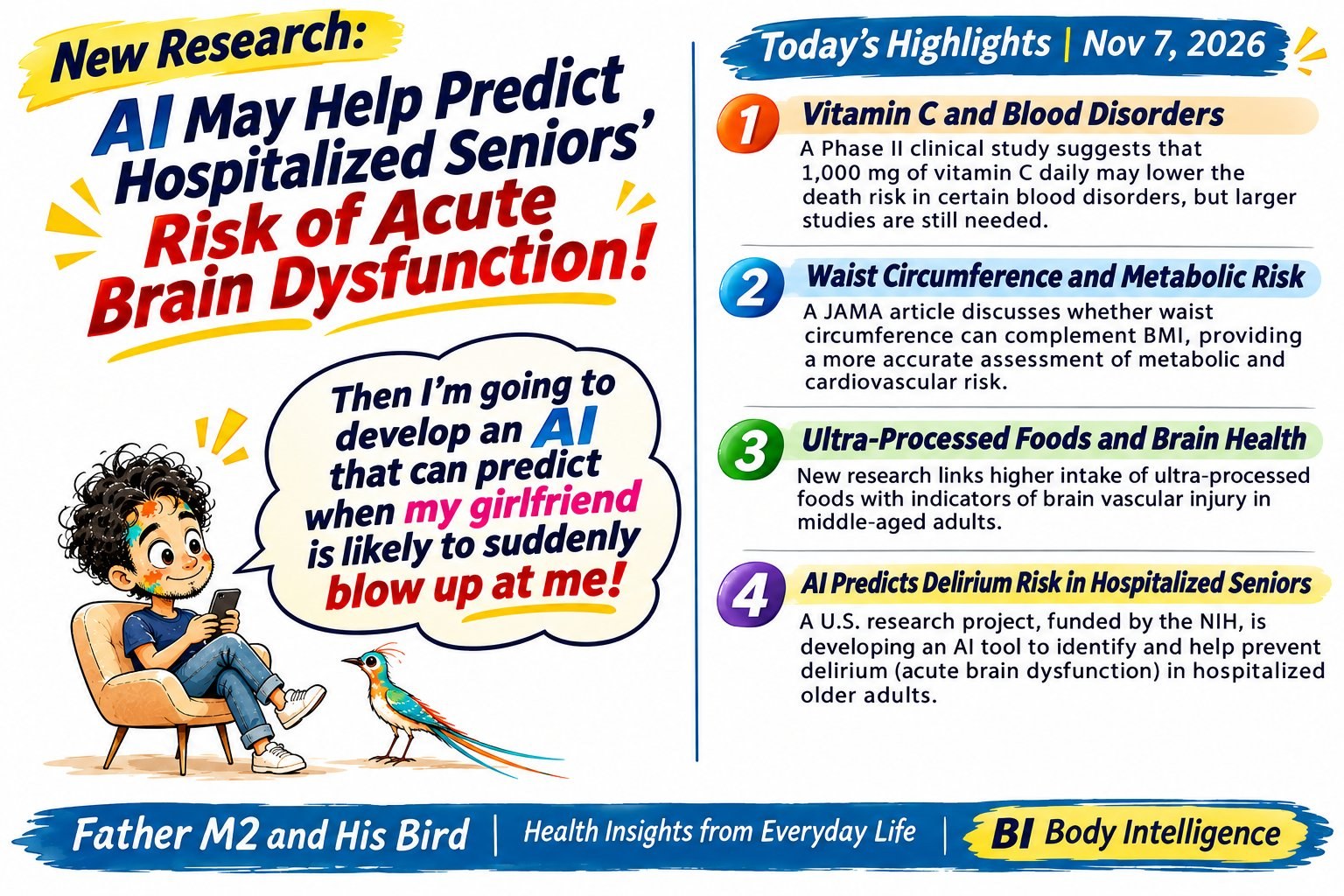
Health Science Update | November 7, 2026
Today’s health science highlights explore four developments involving vitamin C, metabolic risk assessment, diet and brain vascular health, and artificial intelligence in clinical prevention.
① Vitamin C and Certain Blood Disorders
A Phase II clinical study investigated the effects of taking 1,000 mg of vitamin C daily in patients with certain clonal blood disorders and lower-risk myeloid malignancies.
Preliminary analyses suggested a possible survival benefit, but the findings require confirmation through larger clinical trials.
The significance of this research is not that vitamin C has been proven to treat leukemia. Rather, it raises important questions about whether familiar nutrients may have additional biological roles in specific disease settings.
② Waist Circumference and Metabolic Risk Assessment
A recent discussion in the Journal of the American Medical Association (JAMA) examined the clinical value of waist circumference in metabolic risk assessment.
Body mass index (BMI) provides a relationship between weight and height, but it cannot adequately distinguish muscle from fat or directly measure abdominal fat distribution.
Waist circumference offers additional information that may help healthcare professionals assess metabolic and cardiovascular risk.
Effective health management requires more than monitoring body weight. Body composition and fat distribution also matter.
③ Ultra-Processed Foods and Brain Vascular Health
Recent research has examined associations between ultra-processed food consumption and indicators of cerebrovascular injury in middle-aged adults.
Ultra-processed foods undergo various forms of industrial processing, although their nutritional composition can differ considerably.
Researchers are exploring how dietary quality, metabolic health, vascular function, and brain health may be connected.
Importantly, an observed association does not establish causation, and the findings should not be interpreted as evidence that all processed foods damage the brain.
④ AI and Delirium Risk in Hospitalized Older Adults
A U.S. research project funded by the National Institutes of Health (NIH) aims to develop artificial intelligence tools to identify hospitalized older adults at increased risk of delirium.
Delirium is an acute disturbance of brain function that may develop over hours or days. Symptoms can include impaired attention, fluctuating awareness, confused thinking, agitation, or unusual drowsiness.
Infections, surgery, medications, dehydration, sleep disruption, and other physiological stressors may contribute to its development.
Researchers hope that AI can analyze electronic health records, medications, vital signs, and other clinical information to identify high-risk patients earlier and support preventive care.
However, this particular AI application remains under development and should not yet be considered a clinically validated prediction tool.
Today’s Health Perspective
From waist circumference assessment to cerebrovascular health, and from nutrient research to AI-assisted risk prediction, medical science continues to expand our understanding of the human body.
Yet effective health management is not simply about collecting more data.
It is about understanding what the data mean, identifying risks that may be addressed early, and determining which actions are supported by reliable scientific evidence.
Technology provides tools. Science provides evidence. Professional judgment guides their appropriate use.
— BI 身体智慧 (Body Intelligence)
Science & Education: BI 身体智慧 (Body Intelligence)
AI-assisted Research & Illustration: BI × GPT
Professional Review: 林存默 (Thomas Lin)
Professional Community: ACPN — The Association of Certified Professional Nutritionists (加拿大注册执业营养师公会)
Disclaimer: This article is for health education purposes only and does not constitute medical diagnosis or treatment advice.