
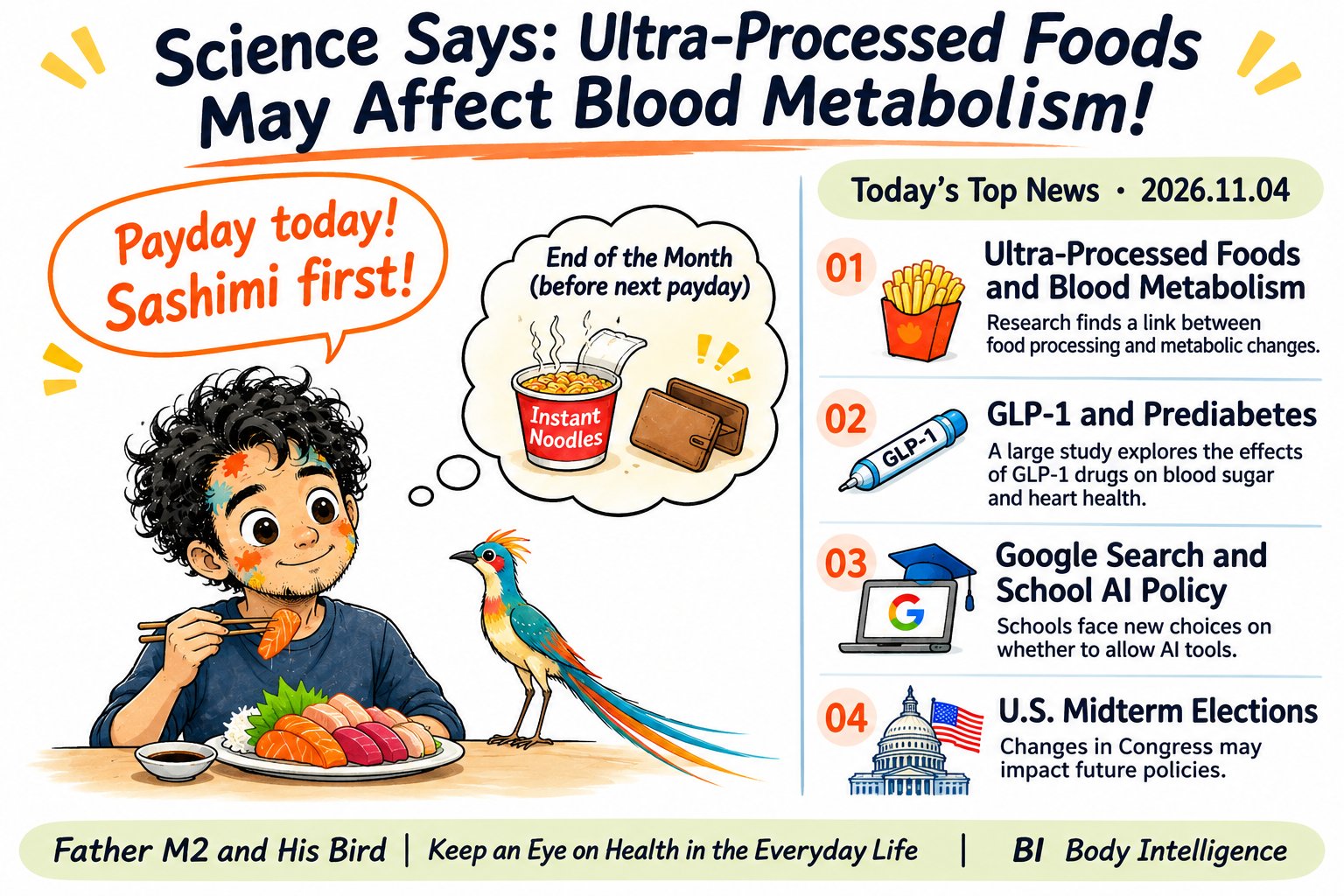
Today’s four stories connect scientific discoveries, healthcare innovation, artificial intelligence, and political developments with the realities of everyday life.
① Ultra-Processed Foods & Blood Metabolism: New Molecular Connections
Researchers at University College London (UCL) reported findings from a study examining blood metabolites and long-term health records from more than 6,000 UK adults.
Using blood-based metabolic profiles, researchers investigated associations between different levels of food processing and metabolic health, including potential links to cardiovascular disease and type 2 diabetes.
The significance of this research lies in its attempt to understand dietary patterns through measurable biological signals rather than relying exclusively on dietary questionnaires.
However, these findings represent statistical associations, not proof that particular processed foods directly cause metabolic diseases.
Food processing is also not the only factor determining nutritional quality. Nutrient composition, consumption frequency, overall dietary patterns, and individual metabolic conditions remain important.
② GLP-1 & Prediabetes: Exploring Metabolic and Cardiovascular Outcomes
A large observational study involving more than 256,000 adults with obesity and prediabetes compared long-term outcomes among people using GLP-1-based medications and those using metformin.
The findings suggested more favorable associations with certain blood glucose and cardiovascular outcomes among GLP-1 medication users.
GLP-1, or glucagon-like peptide-1, is a gut-derived hormone involved in insulin secretion, gastric emptying, and appetite regulation.
Medications targeting this signaling pathway can improve blood glucose regulation and may provide additional weight-management and cardiovascular benefits in appropriate patients.
However, observational findings cannot fully eliminate confounding factors and do not establish that everyone with prediabetes should receive GLP-1 medications.
③ Google Search & School AI Policies: A New Challenge for Education
Google’s approach to managing artificial intelligence features in school accounts has generated debate about educational autonomy and student access to AI-powered tools.
As Gemini and other AI capabilities become increasingly integrated into search and learning platforms, schools face important decisions about how students should interact with these technologies.
The debate extends beyond whether students should use AI.
It also raises questions about independent thinking, learning habits, institutional choice, and the growing influence of technology companies in education.
AI can support research, explain complex concepts, and assist learning. However, excessive dependence on generated answers may reduce opportunities for independent exploration and problem-solving.
The important question may no longer be simply whether AI belongs in education, but how it can be used to strengthen genuine learning.
④ U.S. Midterm Elections: Political Changes and Economic Implications
The November 3 U.S. midterm elections have become a major focus of international political and financial attention.
Changes in congressional control could influence the direction of fiscal policy, international trade, energy regulation, healthcare legislation, and technology oversight over the next two years.
For Canada, developments involving U.S. tariffs, cross-border trade, energy markets, and investment policies are particularly relevant.
However, election results do not automatically translate into immediate policy changes. Legislative negotiations, implementation timelines, and political constraints will continue to shape outcomes.
Short-term financial market reactions should not necessarily be interpreted as established long-term trends.
💡 Today’s Scientific & Social Perspective
These four developments may appear unrelated, but they share an important theme:
Individual choices are increasingly shaped by complex interactions between science, technology, economics, and public policy.
What we eat depends not only on nutritional knowledge but also on food prices, income, and household budgets.
How we manage blood glucose involves more than medication. Nutrition, physical activity, sleep, and long-term metabolic health all matter.
How students learn is increasingly influenced by artificial intelligence.
And political developments can affect healthcare costs, employment, energy prices, and everyday living expenses.
Science helps us understand the body. Technology provides new tools. Real-life circumstances determine which actions people can realistically take.
Effective health management must ultimately return to the individual, their actual living conditions, and choices that can be maintained over time.
A Man and His Bird | Finding Health in Everyday Life
Science & Education: BI 身体智慧 (Body Intelligence)
AI-assisted Research & Illustration: BI × GPT
Professional Review: 林存默 (Thomas Lin)
Professional Community: ACPN — The Association of Certified Professional Nutritionists (加拿大注册执业营养师公会)
Disclaimer: This article is for health education purposes only and does not constitute medical diagnosis or treatment advice.