
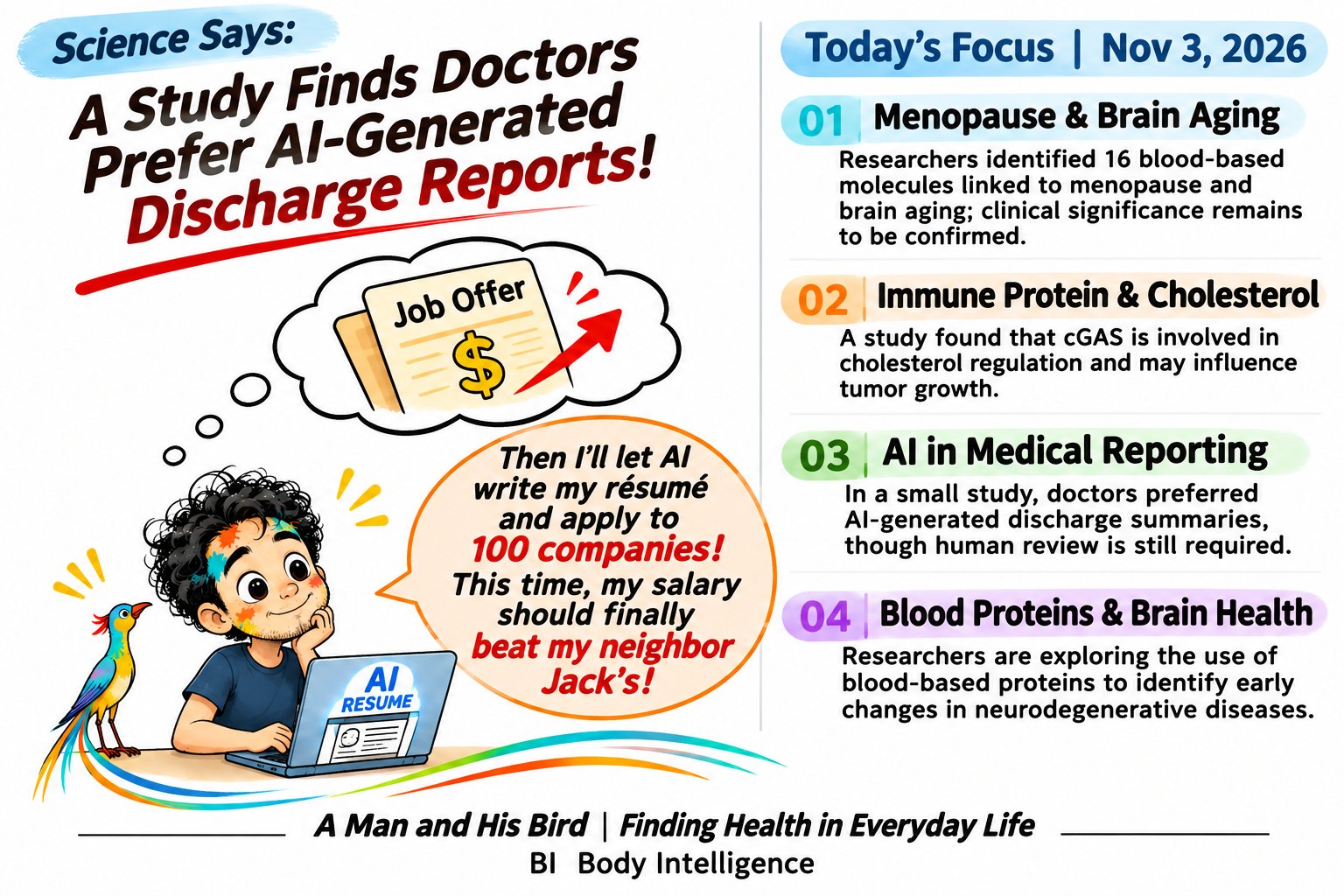
🔬 Today’s Health & Science News | November 3, 2026
Menopause & Brain Aging | Immune Proteins & Cholesterol | AI in Healthcare | Blood Biomarkers & Brain Health
Four recent research developments highlight how scientists are exploring biological changes that may occur long before symptoms become visible.
① Menopause & Brain Aging: 16 Blood Molecules Identified
A recent study published in Nature Medicine identified changes in 16 blood-based molecules associated with menopause and biological processes related to brain aging.
The findings suggest that menopause involves more than changes in reproductive hormones such as estrogen. It may also be associated with broader metabolic, inflammatory, and neurological changes.
However, identifying molecular associations does not establish a reliable test for predicting dementia or prove that these molecules directly cause brain aging.
② Immune Protein cGAS: A New Connection to Cholesterol Metabolism
Research published in the Journal of Clinical Investigation found that cGAS, an innate immune protein best known for detecting abnormal DNA inside cells, also participates in intracellular cholesterol regulation.
The findings suggest that cGAS may influence tumor growth and responses to cancer treatment.
This research connects three important biological fields: immune signaling, lipid metabolism, and cancer biology.
Importantly, these mechanistic findings do not mean that reducing dietary cholesterol can prevent or treat cancer.
③ AI-Generated Hospital Discharge Reports: Do Doctors Prefer Them?
A small study published in npj Digital Medicine compared AI-generated and physician-written discharge summaries for 60 complex hospital cases.
Physician reviewers preferred the AI-generated versions in 95% of the cases, based on evaluations involving completeness, readability, and accuracy.
Hospital discharge summaries contain essential information about diagnoses, treatments, medications, and follow-up care.
AI may help physicians organize complex medical information and reduce documentation workloads. However, AI-generated reports still require professional verification.
These findings demonstrate the potential of AI-assisted medical documentation, not the replacement of clinical judgment or physician responsibility.
④ Blood Proteins: Could They Help Detect Brain Diseases Earlier?
Research involving UK Biobank is exploring whether blood-based proteins can reveal biological changes associated with neurodegenerative diseases, including Alzheimer’s and Parkinson’s disease, before noticeable symptoms develop.
Researchers are investigating molecular signals related to neurological injury, inflammation, and disease progression.
The long-term goal is to improve understanding of early disease processes and potentially support earlier risk assessment.
However, these approaches remain under investigation and should not yet be considered established clinical diagnostic tools.
💡 Today’s Scientific Perspective
These four developments share an important theme:
Science is increasingly exploring biological changes that may begin long before symptoms become visible.
From molecular changes associated with menopause to immune signaling and cholesterol regulation, researchers are uncovering connections within the body’s complex biological networks.
At the same time, artificial intelligence is changing how medical information can be organized and evaluated.
However, three stages must remain clearly distinguished:
Discovering biological associations → Validating clinical significance → Applying evidence in healthcare.
A promising scientific discovery is not automatically a clinically useful intervention.
Science creates possibilities. Evidence guides decisions.
A Man and His Bird | Finding Health in Everyday Life
BI 身体智慧 (Body Intelligence)
Professional Review: Thomas Lin (林存默)
Science & Education: BI 身体智慧 (Body Intelligence)
AI-assisted Research & Illustration: BI × GPT
Professional Review: 林存默 (Thomas Lin)
Professional Community: ACPN — The Association of Certified Professional Nutritionists (加拿大注册执业营养师公会)
Disclaimer: This article is for health education purposes only and does not constitute medical diagnosis or treatment advice.