
November 1, 2026
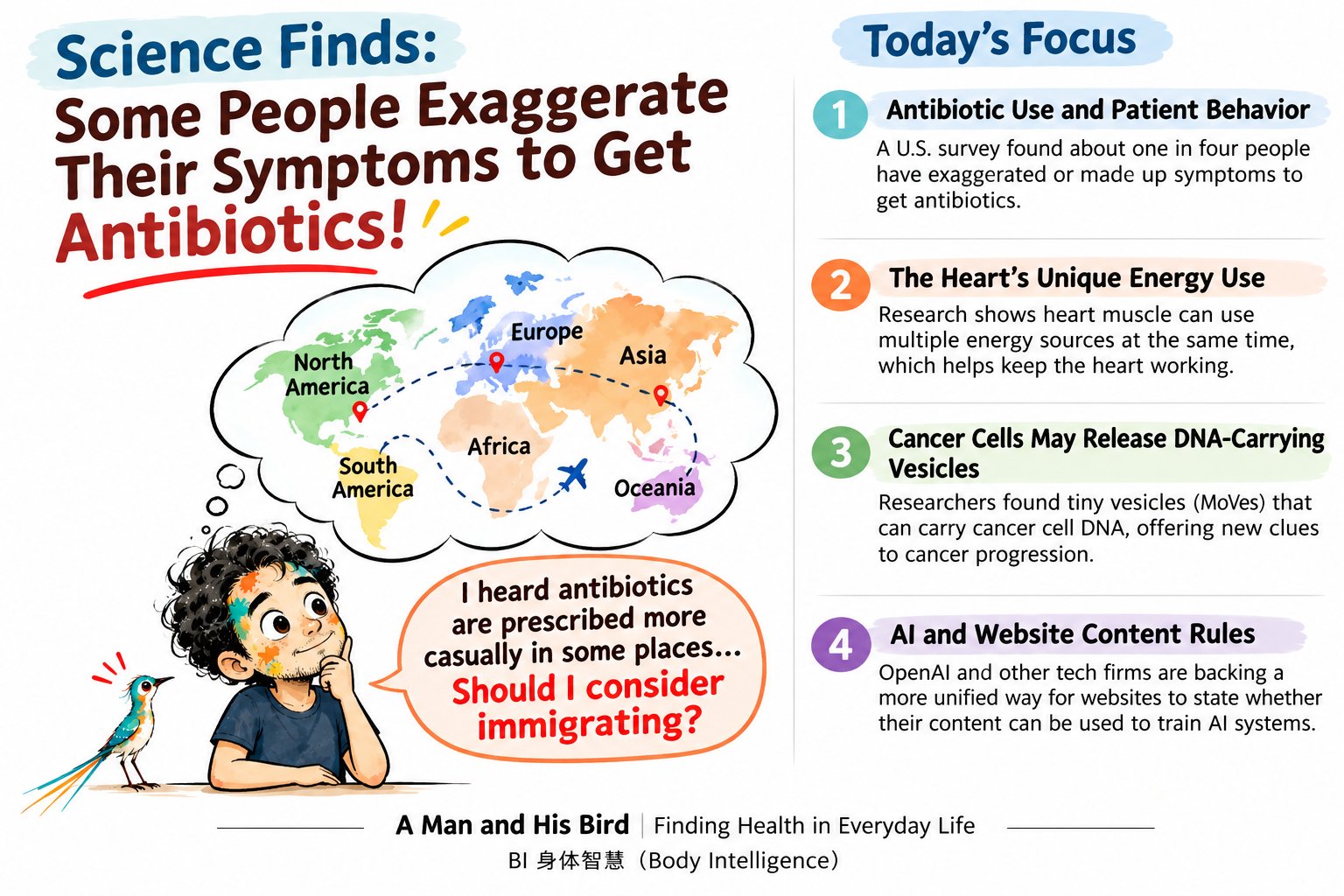
Today’s science and technology update covers four recent developments: antibiotic use, cardiac energy metabolism, cancer cell biology, and emerging rules for AI access to online content.
① Antibiotic Use: Why Do Some Patients Exaggerate Their Symptoms?
On October 30, University of Utah Health highlighted survey findings suggesting that approximately one in four respondents had exaggerated or fabricated symptoms to obtain antibiotics.
The findings raise important questions about public understanding of antibiotics, communication between patients and healthcare professionals, and responsible prescribing practices.
Antibiotics treat certain bacterial infections, not common viral illnesses such as colds. Unnecessary antibiotic use can increase the risk of adverse effects and contribute to antimicrobial resistance.
Importantly, easier access to antibiotics does not necessarily indicate better healthcare. Appropriate prescribing should be guided by clinical evidence and the nature of the infection.
② Cardiac Energy Metabolism: How Does the Heart Keep Working?
Research highlighted by University of Utah Health on October 28 explored how heart muscle cells use different energy sources to sustain continuous activity.
The heart is one of the body’s most energy-demanding organs. Under normal conditions, cardiac muscle can use fatty acids, glucose, lactate, and other substrates to generate ATP through mitochondrial metabolism.
This ability to adjust fuel utilization according to physiological demands is known as metabolic flexibility.
Understanding cardiac energy metabolism may help researchers investigate mechanisms involved in heart dysfunction and heart failure.
However, these findings do not demonstrate that any particular food or nutritional supplement can treat heart disease.
③ Cancer Cells and DNA-Carrying Vesicles: A New Research Direction
On October 28, researchers at the Research Institute of the McGill University Health Centre reported findings involving a type of extracellular vesicle known as MoVes.
These tiny structures can carry DNA originating from cancer cells, potentially including cancer-associated genetic mutations.
The discovery offers new opportunities to investigate cancer cell behavior, the tumor microenvironment, and mechanisms associated with cancer progression.
However, identifying DNA-carrying vesicles does not establish that they directly cause cancer metastasis, nor does it mean that a new clinical test or treatment is already available.
④ AI and Website Content: New Rules for AI Training
Recent developments indicate growing support among OpenAI and other technology companies for more standardized ways to communicate website owners’ preferences regarding AI training.
One approach involves using technical instructions, including “robots.txt”, to indicate whether website content may be accessed or used for certain AI-related purposes.
For publishers, researchers, independent creators, and website operators, these developments raise important questions about content ownership, intellectual property, and control over digital information.
However, technical standards alone cannot resolve every copyright dispute. Their practical implementation and legal implications will require continued attention.
Today’s Scientific Perspective
Although these developments involve different fields, they share an important theme: scientific and technological progress must be accompanied by responsible interpretation and application.
Antibiotics require appropriate prescribing. Cardiac metabolism must be understood as an integrated physiological system. Cancer discoveries must be distinguished from established clinical applications. AI innovation requires clearer boundaries for content use.
Scientific discoveries create new possibilities. Evidence-based judgment determines how those possibilities should be applied in everyday life.
A Man and His Bird | Finding Health in Everyday Life
Science & Education: BI 身体智慧 (Body Intelligence)
AI-assisted Research & Illustration: BI × GPT
Professional Review: 林存默 (Thomas Lin)
Professional Community: ACPN — The Association of Certified Professional Nutritionists (加拿大注册执业营养师公会)
Disclaimer: This article is for health education purposes only and does not constitute medical diagnosis or treatment advice.