
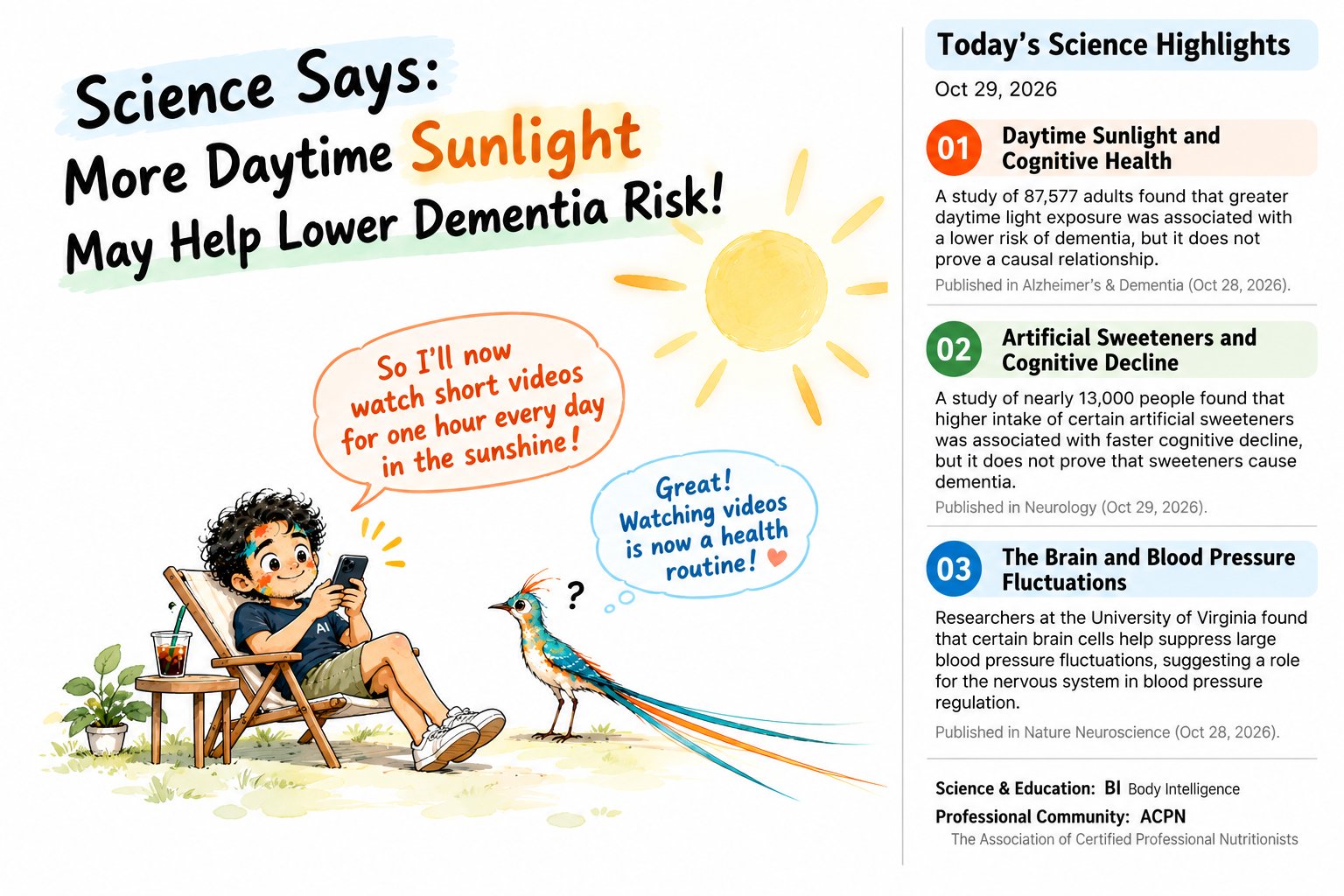
Can daylight exposure help protect cognitive health? Are artificial sweeteners linked to cognitive decline? And how does the brain help stabilize blood pressure?
Today’s three research stories highlight the complex connections between our environment, nutrition, and nervous system.
☀️ 01 | Daylight Exposure and Dementia Risk
A prospective study involving 87,577 adults found that greater daytime light exposure was associated with a lower risk of developing dementia.
Researchers observed an approximately 16% lower dementia risk among participants with higher levels of daytime light exposure.
Why might light matter?
Light signals travel from the retina to the brain, helping regulate our circadian rhythms—the internal biological clock that coordinates sleep, wakefulness, hormone secretion, and metabolic activity.
Consistent daytime light exposure may support cognitive health indirectly through healthier circadian regulation and sleep patterns.
Important limitation: This observational study does not prove that sunlight prevents dementia. Daylight exposure also does not require prolonged direct sun exposure or unnecessary UV exposure.
🥤 02 | Artificial Sweeteners and Cognitive Decline
An observational study involving nearly 13,000 participants found that higher consumption of certain artificial sweeteners was associated with faster cognitive decline.
Artificial sweeteners provide sweetness with little or no sugar, but different compounds have different chemical structures and metabolic characteristics.
Researchers continue to investigate their possible relationships with gut microbiota, glucose metabolism, and neurological function.
Important limitation: An association does not establish that artificial sweeteners cause dementia. These findings also do not suggest that sugar-sweetened beverages are a healthier alternative.
❤️ 03 | How Does the Brain Help Stabilize Blood Pressure?
Researchers at the University of Virginia identified specific brain cells involved in limiting large fluctuations in blood pressure.
Blood pressure is not a fixed number.
It changes continuously with posture, physical activity, emotional responses, and sleep.
The body relies on coordinated interactions between the autonomic nervous system, baroreceptor reflexes, the heart, and blood vessels to maintain adequate circulation.
This research provides further insight into how neural mechanisms contribute to cardiovascular stability.
Important limitation: Mechanistic discoveries do not immediately translate into new diagnostic criteria or clinical treatments.
💡 Today’s Reflection | Health Is More Than a Single Number
Daylight does more than brighten our surroundings—it helps synchronize our biological clock.
Artificial sweeteners raise questions beyond sweetness and calorie reduction.
Blood pressure reflects continuous communication between the brain, heart, and blood vessels.
Human health is a dynamic process involving multiple interconnected systems.
Understanding these connections can help us move beyond isolated measurements toward a more comprehensive approach to health management.
But identifying an association is not the same as proving causation, and discovering a biological mechanism does not automatically establish a clinical solution.
The value of science education is to help people understand evidence—not turn every new discovery into another health promise.
Science & Education: BI 身体智慧 (Body Intelligence)
AI-assisted Research & Illustration: BI × GPT
Professional Review: 林存默 (Thomas Lin)
Professional Community: ACPN — The Association of Certified Professional Nutritionists (加拿大注册执业营养师公会)
Disclaimer: This article is for health education purposes only and does not constitute medical diagnosis or treatment advice.