
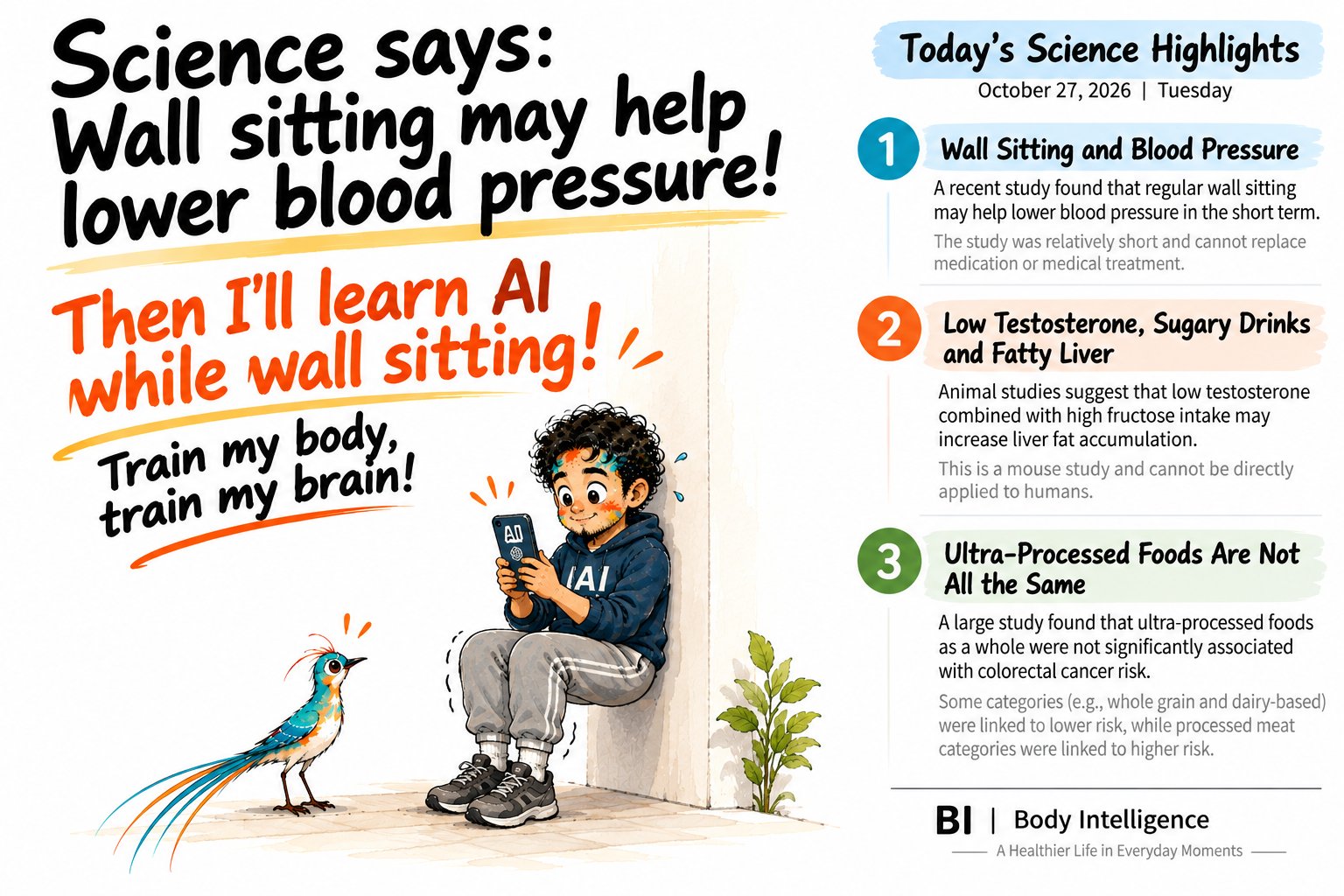
Can wall sits help lower blood pressure? Could low testosterone and high fructose intake contribute to fatty liver? Are all ultra-processed foods equally unhealthy?
Today’s three research stories explore exercise, metabolic health, and nutrition.
01 | Wall Sits and Blood Pressure: Could Once a Week Be Enough?
A randomized controlled study published in BMJ Open Sport & Exercise Medicine examined the effects of wall-sit exercises on blood pressure.
The study involved 100 participants who initially completed four weeks of regular training. They then continued exercising once, twice, or three times weekly—or stopped altogether.
The findings suggested that even one weekly session may help maintain some of the blood pressure improvements achieved through initial training.
Participants who stopped exercising gradually lost those benefits.
What this means: Consistency matters, and effective exercise does not always require expensive equipment.
However, the study was relatively short and did not focus on patients with diagnosed hypertension. Wall sits are not a replacement for prescribed blood pressure medication.
02 | Low Testosterone, Fructose, and Fatty Liver
Researchers at Osaka Metropolitan University investigated how testosterone levels, fructose intake, and gut microbiota may interact in liver metabolism.
In mice, low testosterone combined with high fructose intake was associated with increased liver fat accumulation.
Further experiments suggested that changes in gut microbiota and the metabolite pyruvate may contribute to this process.
The findings highlight a potentially important connection between hormonal regulation, carbohydrate metabolism, gut microorganisms, and liver health.
Important limitation: These findings come primarily from animal and cellular research. They do not establish the same effects in humans or justify testosterone supplementation.
03 | Not All Ultra-Processed Foods Are the Same
A large observational study published in PLOS Medicine analyzed health data from more than 460,000 American adults to examine the relationship between ultra-processed foods and colorectal cancer risk.
Overall ultra-processed food consumption was not significantly associated with colorectal cancer risk in this analysis.
However, results differed across food categories.
Some whole-grain and dairy-related categories were associated with lower risk, while processed meat categories were associated with higher risk.
These findings suggest that evaluating food quality requires more than a simple processed-versus-unprocessed classification.
Nutritional composition, food type, consumption patterns, and overall dietary quality all deserve consideration.
Because this was an observational study, the results cannot establish that any particular food prevents cancer.
Today’s Reflection | Understanding Mechanisms Matters
Wall sits highlight the relationship between muscle contraction and blood pressure regulation.
Fructose metabolism illustrates the possible interaction between hormones, gut microbiota, and liver function.
Ultra-processed food research reminds us that nutritional health cannot always be reduced to a single label.
Good health management is not about following every new scientific headline. It is about understanding the evidence, recognizing its limitations, and making informed decisions over time.
Science & Education: BI 身体智慧 (Body Intelligence)
AI-assisted Research & Illustration: BI × GPT
Professional Review: 林存默 (Thomas Lin)
Professional Community: ACPN — The Association of Certified Professional Nutritionists
#HealthScience #FunctionalNutrition #BloodPressure #ExerciseScience #MetabolicHealth #FattyLiver #GutMicrobiome #NutritionResearch #ACPN