
Health Science Today | October 24, 2026
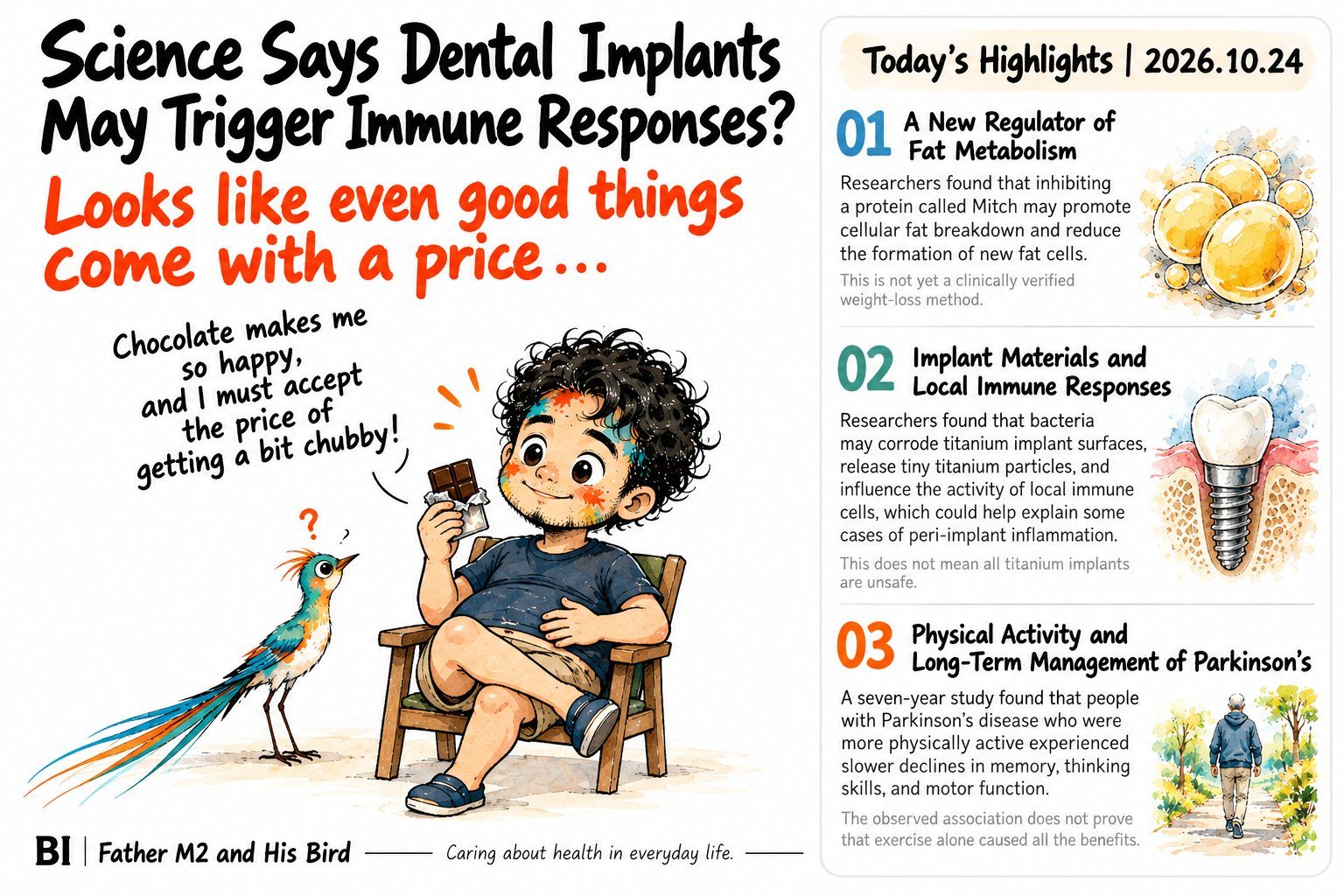
Today, we explore three developments in health science: a newly identified regulator of fat metabolism, the relationship between dental implant materials and local immune responses, and the potential role of physical activity in the long-term management of Parkinson’s disease.
① Scientists Identify a Potential New Regulator of Fat Metabolism
Human adipose tissue does more than store energy. It is an active metabolic and endocrine tissue involved in energy regulation, hormone signaling, and metabolic homeostasis.
Recent experimental research has identified a protein called Mitch that may help regulate cellular fat utilization and the formation of new fat cells.
In laboratory studies, inhibiting this protein appeared to promote fat utilization while reducing the formation of new adipocytes.
These findings suggest that fat metabolism is not simply a matter of calorie intake and expenditure. It is also influenced by complex molecular signaling pathways within cells.
Understanding these pathways could eventually contribute to new approaches for studying obesity and metabolic disorders.
However, the current evidence comes primarily from experimental cell and animal models.
There is no established clinical evidence that inhibiting Mitch is a safe or effective weight-loss strategy in humans.
② Why Might Dental Implants Be Associated with Local Immune Responses?
Dental implants are commonly manufactured from titanium or titanium alloys because of their favorable mechanical properties and biocompatibility.
However, biocompatibility does not mean that implant materials are completely biologically inactive.
Recent research suggests that certain bacteria may affect titanium implant surfaces, potentially contributing to the release of microscopic titanium particles.
These particles may influence the activity of immune cells in surrounding tissues.
Such interactions could help explain some of the biological mechanisms involved in peri-implantitis, an inflammatory condition affecting the tissues surrounding dental implants.
Peri-implantitis is associated with microbial biofilms, host immune responses, and multiple individual risk factors. In some cases, it can lead to progressive loss of supporting bone.
The emerging research highlights the importance of understanding the interaction among implant materials, microorganisms, local tissue conditions, and immune regulation.
Importantly, an immune response is not necessarily harmful. Normal immune activity is essential for defense against microorganisms and for tissue repair.
These findings do not establish that all titanium implants are unsafe or that implant-related inflammation is inevitable.
Good oral hygiene, professional maintenance, regular dental examinations, and management of relevant risk factors remain important for long-term implant health.
③ Physical Activity and the Long-Term Management of Parkinson’s Disease
Parkinson’s disease is a progressive neurodegenerative disorder commonly associated with tremor, slowed movement, muscle rigidity, and balance difficulties.
However, the disease can also affect cognition, sleep, mood, and other non-motor functions.
A seven-year observational study found that people with Parkinson’s disease who maintained higher levels of physical activity tended to experience slower declines in motor performance and certain cognitive functions.
Physical activity may support neurological health through several mechanisms, including improved cardiovascular fitness, maintenance of muscle strength, enhanced neuroplasticity, and changes in inflammatory and metabolic regulation.
These findings contribute to growing scientific interest in the role of exercise as part of comprehensive Parkinson’s disease management.
However, the study identified an association rather than establishing direct causation.
People who remain more physically active may also differ in disease severity, overall health, and other factors that influence long-term outcomes.
Exercise should therefore be considered a potentially valuable component of individualized care, not a cure or replacement for established medical treatment.
Exercise programs should be adapted to each person’s mobility, symptoms, functional capacity, and safety needs.
Today’s Scientific Perspective
Although these studies investigate different aspects of human health, they share an important underlying principle:
Health outcomes emerge from interactions among multiple biological systems rather than from a single isolated factor.
Fat metabolism involves molecular signaling, cellular energy utilization, and the regulation of adipose tissue.
Dental implant health depends on interactions among biomaterials, microorganisms, surrounding tissues, and immune responses.
The long-term management of Parkinson’s disease involves neurological function, physical activity, rehabilitation, and broader lifestyle factors.
From a functional nutrition and health management perspective, understanding these interactions is essential.
It is not enough to identify a nutrient, material, or intervention and describe its potential benefits.
We must also understand where it acts within the body’s physiological systems, what evidence supports its use, and whether the observed biological effects translate into meaningful health outcomes.
Effective health management is not about finding one universal solution. It is about understanding how the body functions and making individualized decisions based on reliable scientific evidence.
Science & Education: BI 身体智慧 (Body Intelligence)
AI-assisted Research & Illustration: BI × GPT
Professional Review: 林存默 (Thomas Lin)
Professional Community: ACPN — The Association of Certified Professional Nutritionists (加拿大注册执业营养师公会)
Disclaimer: This article is for health education purposes only and does not constitute medical diagnosis or treatment advice.