
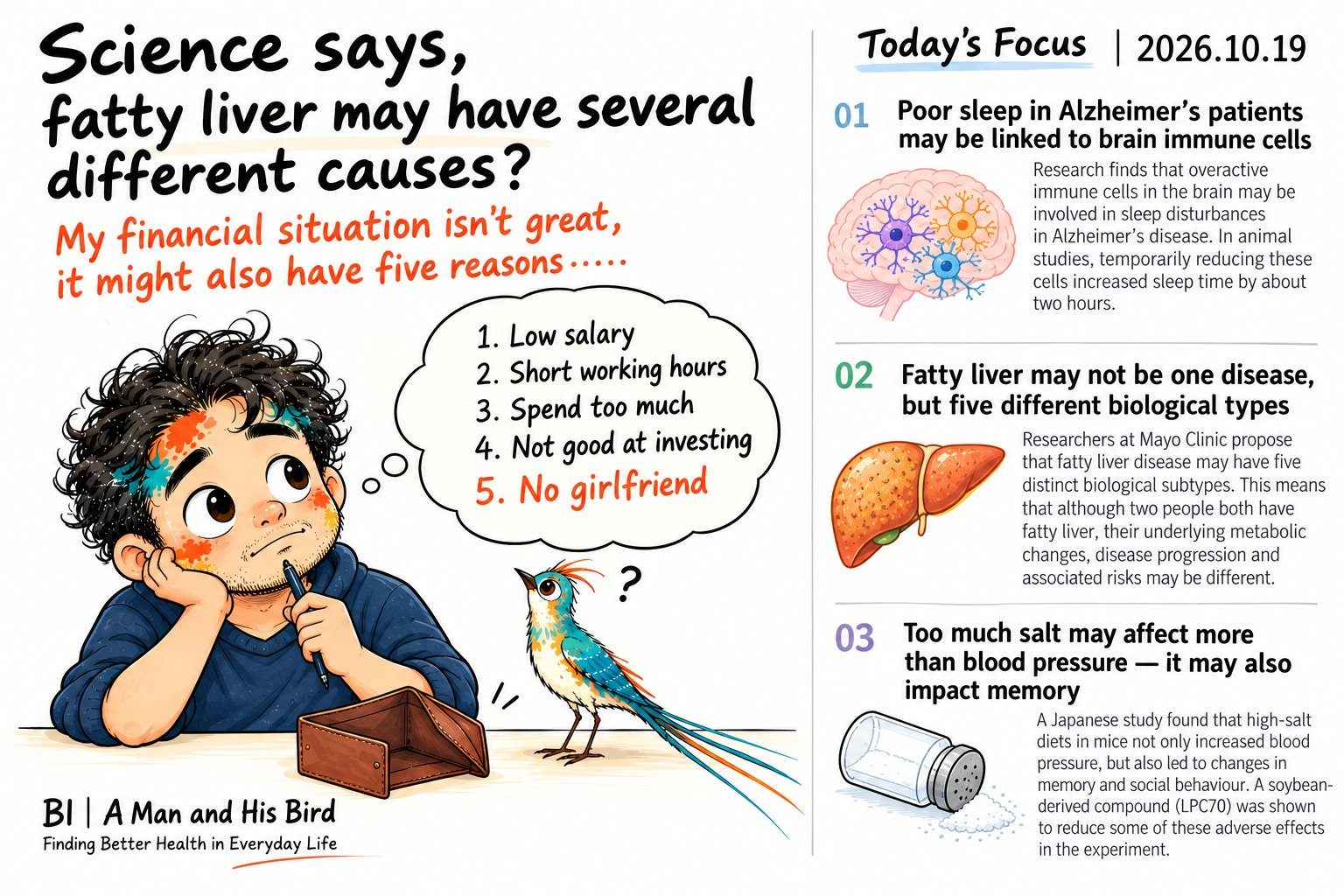
Today, we highlight three research developments involving Alzheimer’s disease and sleep, the biological diversity of fatty liver disease, and the potential effects of excessive salt consumption on brain function.
① Poor Sleep in Alzheimer’s Disease May Be Linked to Brain Immune Cells
Sleep disturbances are common among people with Alzheimer’s disease. Traditionally, researchers have focused on factors such as amyloid accumulation and neuronal damage.
Recent research suggests that microglia, the brain’s resident immune cells, may also play an important role in sleep regulation.
In experimental animal models, temporarily reducing certain overactive immune cells increased sleep duration by approximately two hours, even without removing amyloid plaques.
These findings suggest that immune activity in the brain may represent another important pathway for understanding sleep disturbances associated with Alzheimer’s disease.
However, the findings remain experimental and cannot yet be directly applied to patients.
② Fatty Liver Disease May Include Five Distinct Biological Subtypes
Why do some people with fatty liver disease remain relatively stable, while others develop liver inflammation, fibrosis, or more advanced liver disease?
Researchers at Mayo Clinic have proposed that fatty liver disease may consist of five distinct biological subtypes.
These subtypes may differ in their underlying metabolic abnormalities, mechanisms of disease progression, and associated health risks.
The findings suggest that evaluating fatty liver disease requires more than simply measuring fat accumulation in the liver.
Understanding the broader metabolic condition of each individual may become increasingly important for personalized risk assessment and health management.
However, this proposed classification is not yet a replacement for established clinical diagnostic and risk assessment methods.
③ Excessive Salt Intake May Affect More Than Blood Pressure — It May Also Influence Memory
The relationship between high dietary salt intake and elevated blood pressure is well established.
However, excessive salt consumption may also influence other physiological systems, including brain function.
Researchers at Fujita Health University in Japan found that mice consuming a high-salt diet exhibited not only increased blood pressure but also changes in memory and social behavior.
The researchers further investigated signaling pathways connecting the kidneys and brain.
A soybean-derived lysophosphatidylcholine compound, LPC70, reduced some of the adverse changes observed in the experimental models.
However, these findings come from animal research. They do not establish that eating soybeans or taking LPC70 supplements can reverse the harmful effects of excessive salt intake in humans.
Today’s Scientific Perspective
These three research developments highlight an important principle: similar symptoms or disease presentations may arise from different underlying biological mechanisms.
Sleep disturbances may involve multiple neurological and immune pathways.
Fatty liver disease may reflect different metabolic conditions.
And dietary factors may influence several organ systems simultaneously.
Understanding these differences is an important foundation for personalized, evidence-based health management.
Science & Education: BI 身体智慧 (Body Intelligence)
AI-assisted Research & Illustration: BI × GPT
Professional Review: 林存默 (Thomas Lin)
Professional Community: ACPN — The Association of Certified Professional Nutritionists
This article is for science and health education only and does not replace professional medical advice, diagnosis, or treatment.