
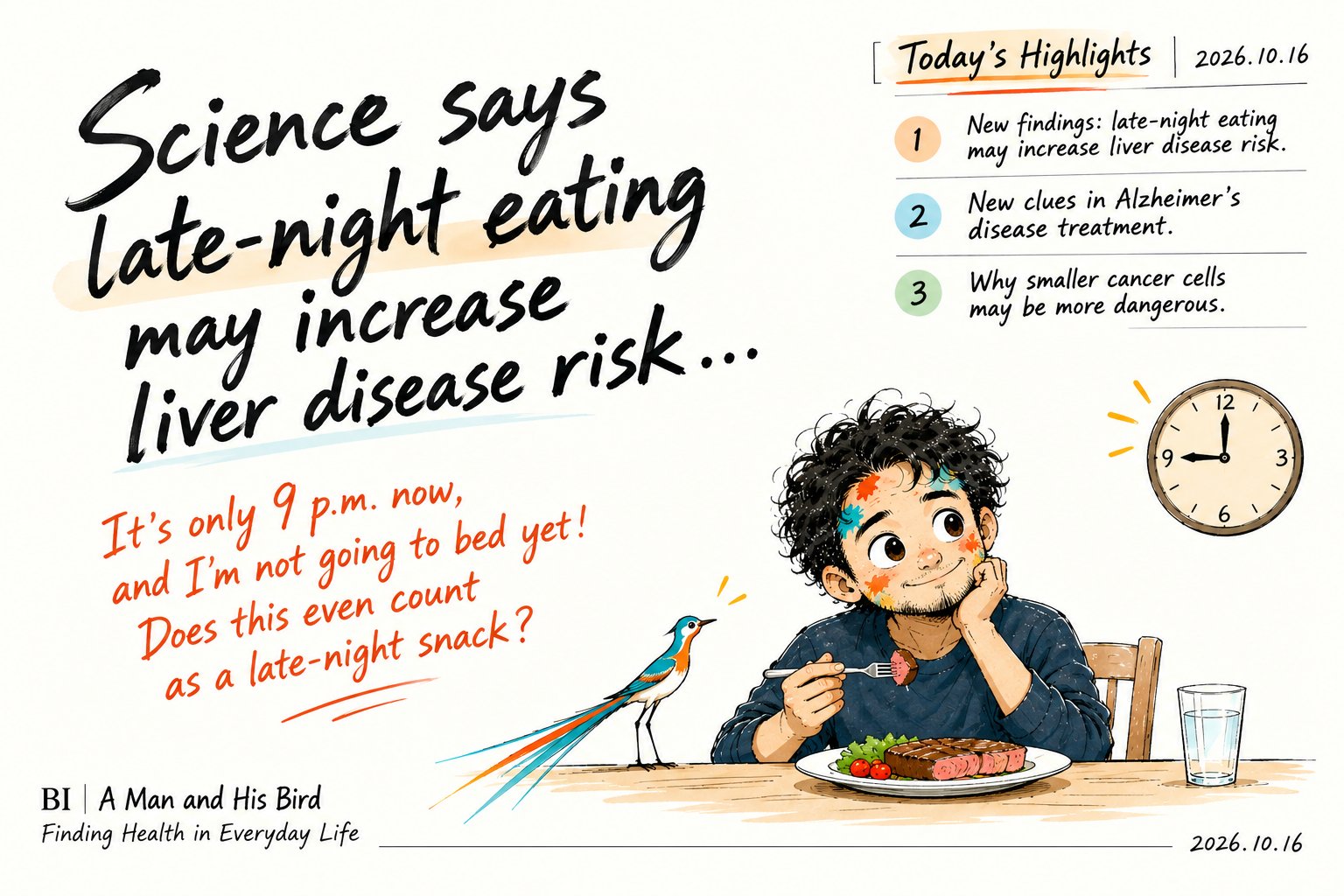
Today’s Health Science News | October 16, 2026
1. Study of Nearly 200,000 People Links Late-Night Eating to Higher Liver Disease Risk
A large cohort study published on October 9 in Clinical Gastroenterology and Hepatology examined long-term health data from 199,155 participants.
Researchers found that people who regularly ate after dinner or close to bedtime had a higher risk of metabolic dysfunction-associated steatotic liver disease (MASLD) and cirrhosis.
The findings suggest that meal timing, particularly its relationship with the body’s circadian rhythms, may play an important role in liver health.
However, this was an observational study. It does not establish that late-night eating directly causes liver disease.
2. Alzheimer’s Research: New Molecules May Help Prevent Amyloid Plaque Formation
On October 13, Indiana University School of Medicine announced findings from a new study exploring a potential approach to Alzheimer’s disease.
Researchers developed molecular glue degraders designed to promote the breakdown of amyloid precursor protein through the lysosomal pathway in laboratory-grown human neurons.
This approach may offer a new strategy for reducing the formation of amyloid plaques associated with Alzheimer’s disease.
The research remains at an early experimental stage. Its ability to improve memory or cognitive function in patients has not yet been established.
3. Cancer Research: Some Smaller Cancer Cells May Be More Aggressive
On October 15, Virginia Tech highlighted new findings concerning the relationship between cancer cell size and tumor aggressiveness.
Researchers discovered that some cancer cells undergoing whole-genome doubling were approximately 25–30% smaller than expected, yet demonstrated faster growth, greater invasiveness, and increased drug tolerance.
These findings were observed in studies involving colorectal and breast cancer cells, with additional support from certain animal experiments.
The research suggests that cell size and chromosomal abnormalities may interact to influence tumor behavior.
However, these findings are not yet sufficient to predict clinical outcomes in individual cancer patients.
Science & Education: BI 身体智慧 (Body Intelligence)
Professional Review: 林存默 (Thomas Lin)
Professional Community: ACPN — The Association of Certified Professional Nutritionists
This article is for science and health education only and does not replace professional medical advice, diagnosis, or treatment.