
When people hear the word “gummy,” they often think of colorful fruit candies, especially gummy bears. Today, however, gummies have become a popular form of dietary supplement, delivering vitamins, minerals, and a growing variety of functional ingredients.
How did gummies evolve from candy into dietary supplements?
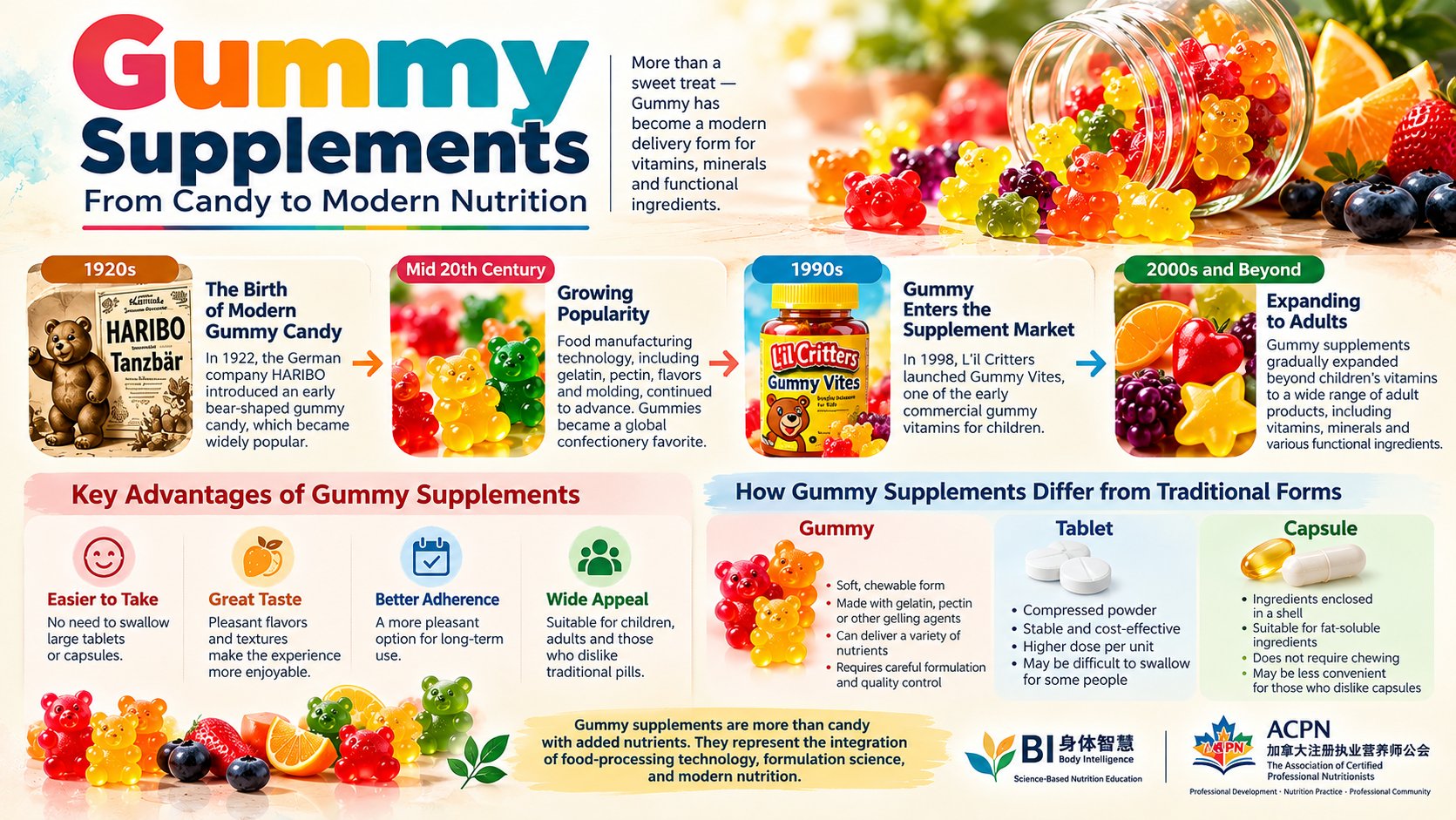
The story of modern gummy bears dates back to the early 20th century. In 1922, the German confectionery company HARIBO introduced an early bear-shaped gummy candy.
As food manufacturing advanced, technologies involving gelatin, pectin, flavoring, and molding continued to improve. Gummies gradually became a widely recognized confectionery product.
During the 1990s, gummies began entering the vitamin supplement market. In 1998, L’il Critters introduced Gummy Vites, an early commercial example of gummy vitamins for children.
The original idea was simple: if some children disliked swallowing tablets, why not offer vitamins in a chewable, more enjoyable form?
Over time, gummy supplements expanded beyond children’s vitamins and entered the adult nutrition market.
What Makes Gummy Supplements Different?
Traditional tablets are generally manufactured by compressing powdered ingredients, while capsules enclose ingredients within a protective shell.
Gummy supplements use gelatin, pectin, or other gelling agents to create a soft, chewable structure that carries nutritional ingredients.
One of their most noticeable advantages is convenience. Gummies do not require swallowing a whole tablet or capsule, making them an appealing alternative for people who dislike large pills.
Their pleasant flavors and textures may also improve the overall supplement-taking experience.
However, the science behind gummy supplements goes far beyond making them taste good.
The Science and Challenges of Gummy Formulation
Once nutritional ingredients are incorporated into gummies, manufacturers must consider several important factors, including processing temperatures, moisture content, acidity, ingredient distribution, dosage uniformity, and shelf-life stability.
Some vitamins are sensitive to heat, light, and oxygen. Certain minerals can affect taste and texture, while fat-soluble ingredients may require specialized formulation techniques to achieve appropriate dispersion.
A well-formulated gummy supplement must therefore provide more than an enjoyable taste. It also requires reliable manufacturing processes, accurate ingredient content, and effective quality control.
Importantly, gummies are not automatically absorbed better than tablets or capsules. Nutrient absorption depends on the ingredient itself, the formulation, and individual digestive and physiological conditions.
A New Direction in Nutritional Supplement Design
Today, gummies have expanded from children’s multivitamins into a diverse category of adult dietary supplements.
Their development reflects a broader shift in the nutrition industry.
Manufacturers are increasingly considering not only which nutrients to provide, but also how conveniently people can take them and how reliably those nutrients can be delivered throughout a product’s shelf life.
Gummy supplements are more than candy with added nutrients. They represent the integration of food-processing technology, formulation science, and modern nutrition.
Science & Education: BI 身体智慧 (Body Intelligence)
AI-assisted Research & Illustration: BI × GPT
Professional Review: 林存默(Thomas Lin)
Professional Community: ACPN — The Association of Certified Professional Nutritionists (加拿大注册执业营养师公会)
This article is for science and health education only and does not replace professional medical advice, diagnosis, or treatment.
#GummySupplements #DietarySupplements #NutritionScience #SupplementFormulation #FunctionalNutrition #BodyIntelligence #ACPN