
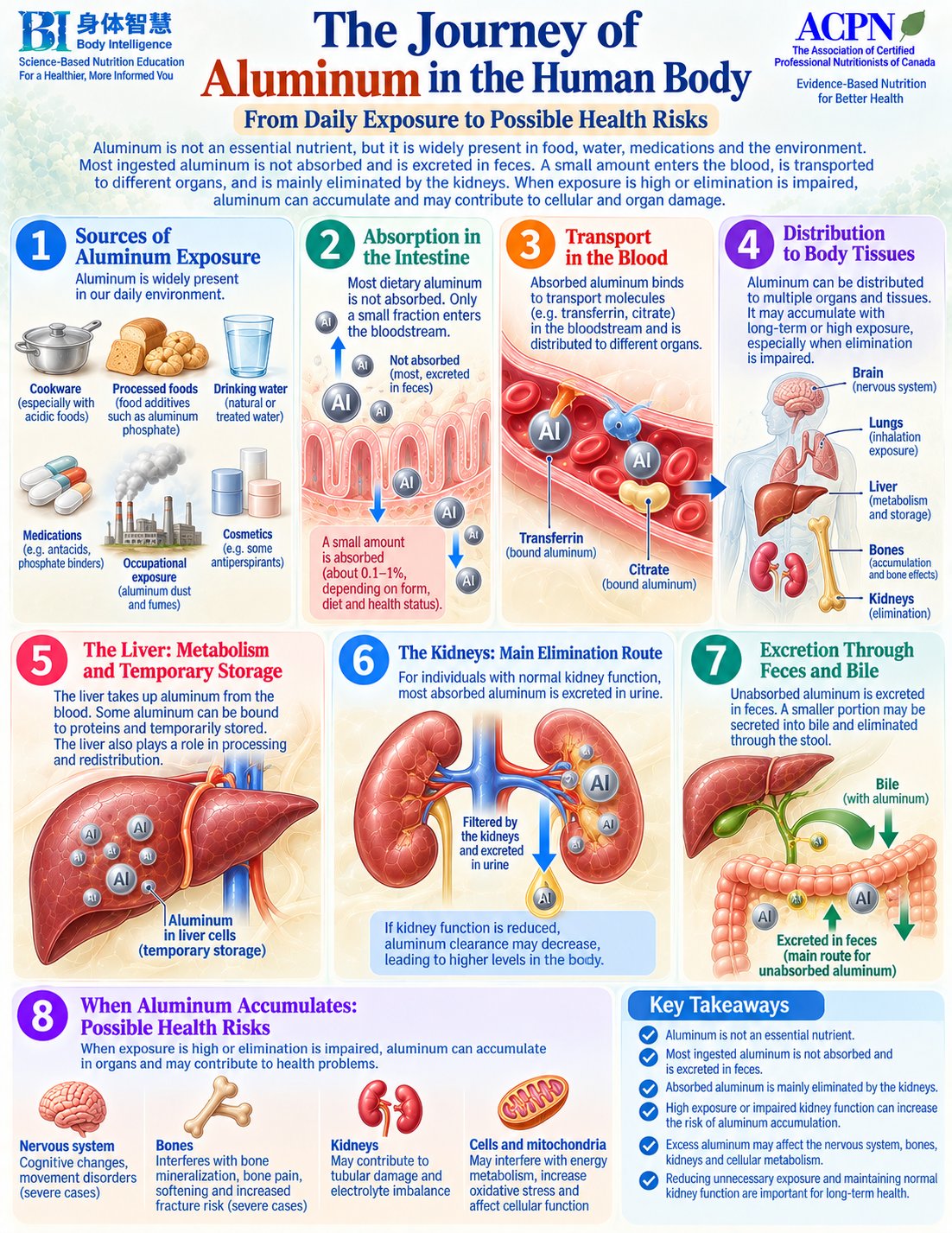
From everyday exposure and kidney excretion to the nervous system, bones, and cellular metabolism
When people think of heavy metals, lead, mercury, and cadmium usually come to mind — aluminum is rarely discussed seriously.
In fact, aluminum is widespread in the natural environment and may also be present in food, drinking water, certain food additives, medications, and industrial settings.
Unlike iron, zinc, and copper, aluminum is not a known essential nutrient for the human body.
But that does not mean every contact with aluminum causes poisoning.
What truly needs to be understood is: how aluminum enters the body, how it is excreted, and under what conditions it may become a tissue burden.
1. Where does aluminum go after entering the body?
Aluminum can enter the human body through the digestive tract, the respiratory tract, and certain medical routes.
Most aluminum in an ordinary diet is not absorbed by the intestines — it is excreted in the stool.
The small amount that is absorbed enters the bloodstream, where it can bind to molecules such as transferrin and citrate and be transported through the body.
For people with normal kidney function, aluminum that enters the blood is mainly excreted by the kidneys.
So the body handles aluminum through two key steps:
The gut limits absorption → the kidneys clear what has been absorbed.
When exposure is high, lasts a long time, or kidney clearance declines, the risk of aluminum accumulation may increase.
2. Why are the kidneys an important line of defense against aluminum exposure?
The kidneys are responsible for clearing a substantial share of the aluminum that enters the bloodstream.
If kidney function declines markedly, the body’s ability to clear aluminum may also decline.
Historically, some patients on dialysis developed severe aluminum-related toxicity, including encephalopathy and bone disease.
Those cases were linked to aluminum contamination of dialysis fluid at the time, as well as the use of aluminum-containing medications.
With improved dialysis water treatment and clinical management, such problems have declined substantially.
But the clinical lesson remains:
The risk from aluminum depends not only on how much is taken in, but on whether the body can clear it effectively.
3. Why might aluminum damage the nervous system?
The nervous system is a major focus of aluminum toxicity research.
Under severe aluminum exposure or accumulation, neurological dysfunction may occur, including cognitive changes, speech abnormalities, impaired motor coordination, and even encephalopathy.
At the cellular level, experimental studies have found that higher aluminum exposure may interfere with multiple processes in nerve cells.
First, redox balance.
Aluminum does not readily undergo redox cycling under physiological conditions the way copper and iron do, but it may indirectly increase oxidative stress by affecting iron homeostasis, antioxidant systems, and cell signaling.
Second, intracellular calcium signaling and protein homeostasis.
These systems are involved in neurotransmitter release, cell communication, and normal neuronal function.
In addition, some experimental studies have observed associations between aluminum exposure and neuroinflammation, mitochondrial dysfunction, and cell injury.
But an important distinction must be made:
Neurotoxic mechanisms observed in the laboratory are not the same as saying aluminum in an ordinary diet causes the same degree of nerve damage.
There is also currently no reliable evidence that everyday aluminum exposure is a direct cause of Alzheimer’s disease.
4. What is the relationship between aluminum and mitochondria?
Mitochondria convert the energy from oxidized nutrients into ATP.
Unlike copper, aluminum has no confirmed normal role as a mitochondrial cofactor.
Experimental studies have found that under certain exposure conditions, aluminum may interfere with mitochondrial function, including electron transport, membrane potential, redox status, and cellular energy metabolism.
When mitochondrial function is severely disrupted, ATP production may fall, and the cell’s ability to maintain normal function may be compromised.
For nerve cells, which have high energy demands, such changes deserve particular study.
However, the mechanistic evidence comes mainly from cell and animal experiments and cannot be directly extrapolated to conclude that ordinary dietary aluminum intake causes clinically meaningful ATP deficiency in people.
5. Why might aluminum accumulation affect bones?
Bone is a clinically significant target tissue for aluminum toxicity.
Aluminum can accumulate in bone tissue and interfere with normal bone mineralization.
In cases of severe exposure — especially historical cases in patients with kidney failure — aluminum-related bone disease could present as osteomalacia, bone pain, and increased fracture risk.
Bone health depends on calcium, phosphorus, vitamin D, and normal bone formation and mineralization.
Aluminum accumulation may disrupt this complex system.
So aluminum-related bone injury is not simply a matter of calcium being “squeezed out” of bone — it involves abnormal bone-cell activity and dysregulated mineralization.
6. Does aluminum affect iron and other mineral metabolism?
Aluminum can bind to certain biomolecules and, under experimental conditions, influence mineral-related processes.
For example, aluminum binds to transferrin, so aluminum transport is connected to iron metabolism research.
Some studies have also observed that aluminum exposure may affect iron homeostasis, oxidative stress, and certain enzyme systems.
But this does not mean ordinary aluminum exposure inevitably causes iron, magnesium, or calcium deficiency.
Interactions between metals are influenced by concentration, chemical form, duration of exposure, and the physiological environment.
Mineral interactions are an important clue for understanding toxicity mechanisms, but they cannot replace assessment of a person’s actual nutritional status.
7. Which aluminum exposures deserve special attention?
The risks differ greatly by exposure source.
Aluminum in everyday food and drinking water usually enters through the digestive tract, with a low absorption rate.
Certain aluminum-containing antacids and phosphate binders may deliver higher aluminum intake — a particular concern for people with impaired kidney function.
Aluminum dust and fumes in industrial settings involve respiratory exposure and require occupational hygiene protection.
In addition, some aluminum salts are used as adjuvants in vaccines; their dose, chemical form, and route of administration differ from food or occupational exposure, so risk cannot be judged on the word “aluminum” alone. Approved vaccines containing aluminum adjuvants have long-term safety monitoring data.
Whether aluminum cookware increases aluminum migration also depends on food acidity, cooking time, and the condition of the cookware surface.
So evaluating aluminum exposure requires looking beyond whether a product “contains aluminum” — the actual exposure dose and the route into the body must be considered.
8. How can you tell whether the body carries an aluminum burden?
Fatigue, poor concentration, poor sleep, or worsening memory are not specific signs of aluminum overload.
Aluminum-related testing must be interpreted together with exposure history, kidney function, and clinical context.
Blood or urine aluminum testing may be useful in specific occupational-exposure or clinical-poisoning evaluations, but the results do not simply represent aluminum stored in all tissues.
Hair mineral testing also cannot be used alone to diagnose aluminum poisoning.
Particular attention must be paid to the limitations of sample contamination, testing methods, and result interpretation.
People with suspected significant aluminum exposure or abnormal kidney function should undergo professional medical evaluation to determine whether further testing is needed.
9. Can dietary fiber help manage aluminum exposure?
This is a direction worth watching in functional nutrition — but evidence levels must be kept distinct.
A healthy intestinal barrier limits most dietary aluminum from entering the bloodstream.
Dietary fiber supports normal bowel movements, gut microbiota, and gut function.
The metal-binding capacity of certain polysaccharides has also drawn interest in experimental research.
But there is currently insufficient human clinical evidence that simply increasing ordinary dietary fiber intake can effectively remove aluminum already accumulated in the brain, bones, or other tissues.
So dietary fiber can be an important part of everyday nutrition management, yet it should not be promoted as a proven “aluminum detox therapy.”
The truly important foundational steps remain identifying unnecessary sources of exposure and maintaining healthy kidneys and overall health.
10. What does aluminum toxicity teach us about health management?
Copper, iron, zinc, and other elements are essential nutrients, but excessive intake can also cause harm.
Aluminum is different.
It has no confirmed essential nutritional role, yet it can be toxic under certain conditions of high exposure or impaired clearance.
So when discussing aluminum, we should neither treat all contact as dangerous nor ignore the risks to vulnerable groups just because dietary aluminum absorption is low.
What truly deserves attention is the chain:
Exposure sources → routes of entry → gut absorption → blood transport → kidney clearance → tissue accumulation → cellular and organ injury.
From this perspective, aluminum exposure is a classic example of how environmental factors interact with human metabolism, organ function, and clearance capacity.
The value of health management lies not in manufacturing fear of a metal, but in identifying real exposures, understanding physiological mechanisms, and acting in line with the evidence.
This topic is part of ACPN’s ongoing science-education work. 林存默 (Thomas Lin), Vice President of ACPN — The Association of Certified Professional Nutritionists (加拿大注册执业营养师公会), reviews our nutrition-science content to keep it aligned with the evidence.
Science & Education: BI 身体智慧 (Body Intelligence)
AI-assisted Research & Illustration: BI × GPT
Professional Review: 林存默 (Thomas Lin)
Professional Community: ACPN — The Association of Certified Professional Nutritionists (加拿大注册执业营养师公会)
This article is for science and nutrition education only and does not replace medical diagnosis, occupational exposure assessment, or individualized treatment advice.
#Aluminum #AluminumToxicity #HeavyMetals #MetalExposure #NervousSystem #Mitochondria #KidneyHealth #BoneHealth #EnvironmentalHealth #DietaryFiber #FunctionalNutrition #ScienceNutrition #ACPN