
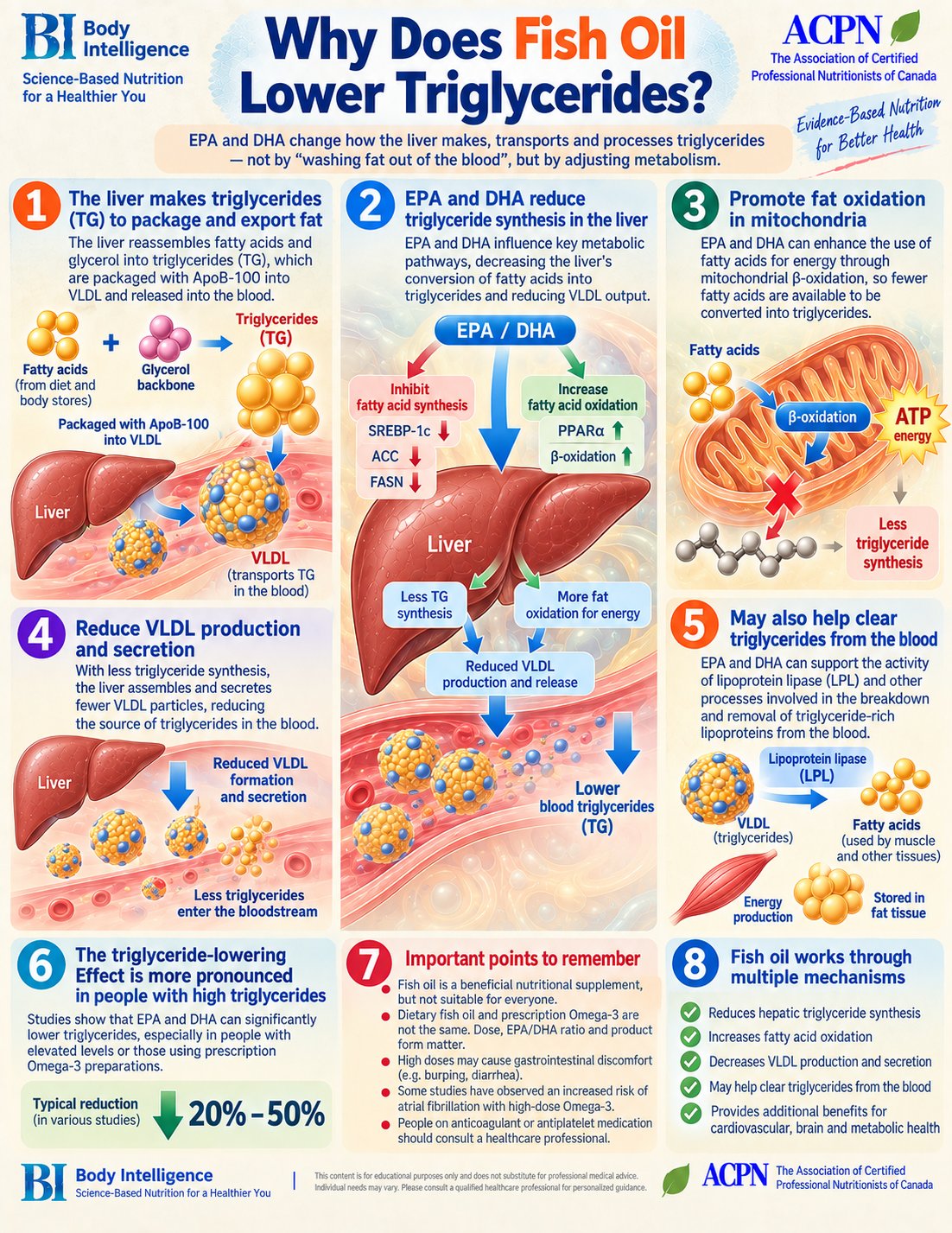
Why Does Fish Oil Lower Triglycerides?
Fish oil is widely associated with cardiovascular health, but one of its most established metabolic effects is its ability to lower elevated blood triglycerides.
The key components responsible for this effect are the long-chain omega-3 fatty acids EPA (eicosapentaenoic acid) and DHA (docosahexaenoic acid).
But how do EPA and DHA actually lower triglycerides?
The answer begins in the liver.
The Liver Is a Major Player in Triglyceride Metabolism
Triglycerides are not simply fats that come directly from food and remain in the bloodstream.
The liver continuously receives fatty acids from the diet, adipose tissue, and its own metabolic pathways. These fatty acids can be oxidized for energy or assembled into triglycerides.
Triglycerides produced in the liver are packaged together with ApoB-100 and other lipids into very-low-density lipoproteins (VLDL).
VLDL particles are then released into the circulation, where they transport triglycerides to peripheral tissues.
This creates an important metabolic pathway:
Fatty acids → hepatic triglyceride synthesis → VLDL assembly → VLDL secretion → circulating triglycerides
EPA and DHA can influence several points along this pathway.
1. EPA and DHA Reduce Hepatic Triglyceride Synthesis
Omega-3 fatty acids influence multiple pathways involved in hepatic lipid metabolism.
EPA and DHA can reduce the availability of fatty acids for triglyceride synthesis and influence transcriptional regulators involved in lipogenesis.
The result is relatively straightforward:
Less hepatic triglyceride synthesis → less triglyceride available for VLDL production
This is one of the central mechanisms behind the triglyceride-lowering effect of omega-3 fatty acids.
2. More Fatty Acids Can Be Directed Toward Oxidation
The liver has another option for fatty acids: instead of packaging them into triglycerides, it can oxidize them for energy.
EPA and DHA influence lipid-regulating pathways, including those associated with PPARα, that favor fatty-acid oxidation.
Conceptually, this shifts metabolism away from:
Fatty acids → triglycerides → VLDL
and toward:
Fatty acids → β-oxidation → energy production
This metabolic shift reduces the pool of fatty acids available for triglyceride synthesis.
3. VLDL Production and Secretion Decline
When the liver has less triglyceride available for packaging, fewer triglyceride-rich VLDL particles need to be produced and secreted.
This is particularly important because VLDL is one of the major vehicles transporting endogenous triglycerides through the bloodstream.
The pathway can therefore be summarized as:
EPA/DHA → lower hepatic TG synthesis → lower VLDL-TG secretion → lower circulating triglycerides
4. Omega-3 May Also Influence Triglyceride Clearance
The effect is not limited to production.
EPA and DHA may also influence the metabolism and clearance of triglyceride-rich lipoproteins, including processes involving lipoprotein lipase (LPL).
LPL helps hydrolyze triglycerides carried in circulating lipoproteins, allowing fatty acids to be taken up and used or stored by tissues.
Therefore, the triglyceride-lowering effect of omega-3 fatty acids may involve both sides of the equation:
less triglyceride entering the circulation and more efficient processing of triglyceride-rich particles.
Why Is the Effect More Noticeable When Triglycerides Are High?
The triglyceride-lowering effect of EPA and DHA is generally more clinically relevant in individuals with elevated triglyceride levels, particularly when sufficiently high doses of omega-3 fatty acids are used.
This is also why it is important to distinguish ordinary dietary fish-oil supplements from prescription omega-3 preparations used for the management of severe hypertriglyceridemia.
The amount of EPA and DHA—not simply the number of milligrams of “fish oil” printed on the front of a bottle—matters.
EPA-to-DHA ratio, formulation, dose, baseline triglyceride level, medications, and individual metabolic status can all influence the response.
Fish Oil Does Not “Wash Fat Out of the Blood”
A useful way to understand fish oil is to move away from the idea that it somehow removes fat already circulating in the bloodstream.
Its effects begin much further upstream.
EPA and DHA influence how the liver decides what to do with fatty acids:
Should they be converted into triglycerides and exported as VLDL—or directed toward other metabolic pathways, including oxidation?
That distinction explains much of the triglyceride-lowering effect of omega-3 fatty acids.
The Metabolic Pathway in One Line
EPA/DHA → ↓ hepatic triglyceride synthesis + ↑ fatty-acid oxidation + ↓ VLDL-TG secretion + changes in triglyceride-rich lipoprotein metabolism → ↓ circulating triglycerides
Understanding this pathway also illustrates a broader principle in nutritional science: nutrients do not simply “add” something to the body. They can influence the metabolic decisions cells and organs make every day.
—
CCPH — Canadian College of Performance Health
ACPN — The Association of Certified Professional Nutritionists
This article is intended for science-based nutrition education and does not replace medical diagnosis, treatment, or individualized nutrition advice. Individuals with elevated triglycerides, cardiovascular disease, medical conditions, or those taking medications should consult an appropriate healthcare professional before using high-dose omega-3 products.
—
Science & Education: BI 身体智慧 (Body Intelligence)
AI-assisted Research & Illustration: BI × GPT
Professional Review: 林存默(Thomas Lin)
Professional Community: ACPN — The Association of Certified Professional Nutritionists (加拿大注册执业营养师公会)