
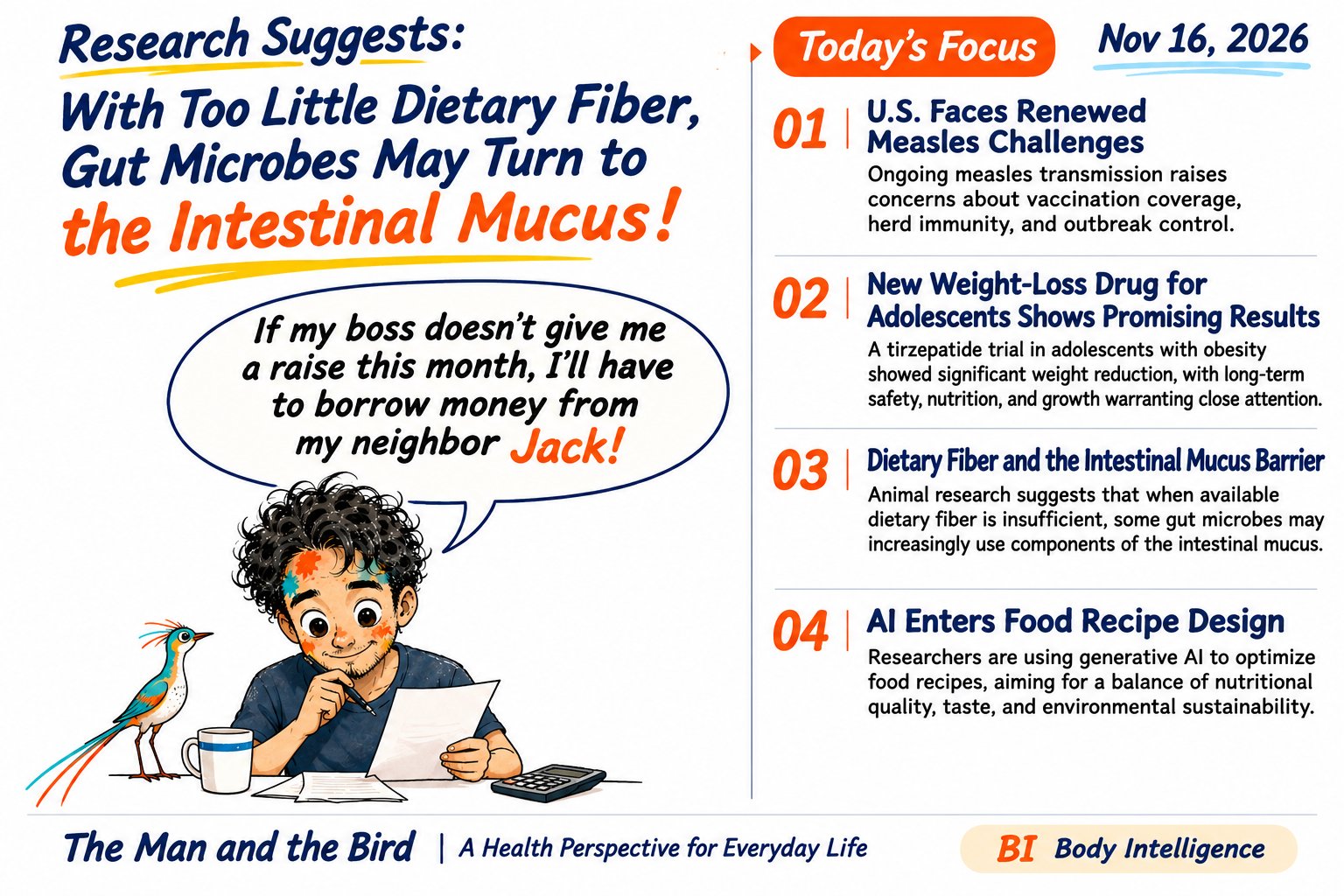
When Dietary Fiber Is Scarce, Could Gut Microbes Turn to the Intestinal Mucus Layer?
Today’s edition of The Man and the Bird explores four developments in health science: measles prevention in the United States, weight-management medications for adolescents, the relationship between dietary fiber and the intestinal mucus barrier, and artificial intelligence in food formulation.
Among these topics, one particularly interesting research direction concerns how gut microorganisms respond when their preferred nutritional resources become limited.
Animal studies suggest that when fermentable dietary fiber is insufficient, certain gut microorganisms may increasingly utilize components of the intestinal mucus layer.
This finding raises important questions about the relationship between diet, microbial metabolism, and intestinal barrier function.
01 | Measles Prevention Faces Renewed Challenges in the United States
Ongoing measles transmission in the United States has renewed concerns about vaccination coverage, community immunity, and public health preparedness.
Measles is a highly contagious viral infection that spreads through the air.
Common symptoms include fever, cough, and rash, but serious complications such as pneumonia and encephalitis can also occur.
Vaccination remains the most effective strategy for preventing measles and reducing its transmission.
When vaccination coverage declines, communities may become more vulnerable to outbreaks.
This illustrates an important principle of public health: protecting individuals and protecting communities are closely connected.
Measles prevention is therefore not simply a matter of treating individual infections. It also depends on maintaining effective vaccination programs, surveillance systems, and outbreak-response capabilities.
02 | A New Generation of Weight-Management Medication for Adolescents
Tirzepatide is a medication that acts on two hormonal pathways: glucose-dependent insulinotropic polypeptide (GIP) and glucagon-like peptide-1 (GLP-1) receptors.
These pathways participate in appetite regulation, glucose metabolism, and gastrointestinal function.
Recent clinical research involving adolescents with obesity has reported substantial improvements in weight-related outcomes.
However, evaluating weight-management treatments in adolescents requires a broader perspective than simply measuring weight loss.
Adolescence is a critical period for skeletal growth, muscle development, sexual maturation, and long-term metabolic health.
Potential treatment benefits must therefore be considered alongside nutritional adequacy, body composition, gastrointestinal adverse effects, growth patterns, and long-term safety.
Adequate protein, vitamins, minerals, and overall energy intake remain important during treatment.
For adolescents who meet appropriate medical criteria, pharmacological treatment may be one component of a comprehensive obesity-management program.
The goal should not be weight reduction alone, but improved metabolic health while supporting normal growth and development.
Medical assessment and ongoing clinical monitoring are essential.
03 | Dietary Fiber and the Intestinal Mucus Barrier: What Happens When Microbes Run Out of Preferred Nutrients?
This is today’s particularly interesting topic from a functional nutrition perspective.
The human intestine contains a complex community of microorganisms.
Some of these microorganisms can ferment dietary fibers that human digestive enzymes cannot break down.
During fermentation, microbial communities produce metabolites, including short-chain fatty acids such as acetate, propionate, and butyrate.
These compounds participate in several physiological processes.
Butyrate, for example, serves as an important energy source for many colonocytes, the epithelial cells lining the colon.
Short-chain fatty acids also contribute to intestinal signaling, metabolic regulation, and aspects of immune function.
But what happens when fermentable dietary fiber becomes scarce?
Experimental animal research suggests that certain microorganisms capable of degrading mucus-associated carbohydrates may increasingly utilize components of the host’s intestinal mucus layer.
The intestinal mucus layer is composed largely of mucins, specialized glycoproteins that help form a protective interface between intestinal microorganisms and the epithelial surface.
This layer performs several important functions.
It helps lubricate the intestinal tract, supports the organization of microbial communities, and contributes to the separation of microorganisms from intestinal epithelial cells.
Under normal physiological conditions, mucus is continuously produced and renewed.
However, when the balance between mucus production and degradation is disrupted, intestinal barrier integrity may be affected.
This does not mean that all gut bacteria attack the mucus layer whenever dietary fiber intake decreases.
Nor does it mean that occasionally eating fewer vegetables automatically damages the intestinal barrier.
Microbial behavior depends on multiple factors, including microbial composition, available nutrients, host mucus production, and the surrounding intestinal environment.
Some microorganisms naturally utilize mucus-derived compounds as part of normal microbial ecology.
The important scientific question is whether changes in nutrient availability alter microbial activity enough to disrupt the balance between mucus degradation and renewal.
The broader implication is that diet influences not only which nutrients the human body receives, but also which resources intestinal microorganisms use for their own metabolism.
This provides another reason to consider dietary diversity when discussing gut health.
Vegetables, fruits, legumes, whole grains, nuts, and seeds provide different types of dietary fiber and other compounds that can influence microbial activity.
However, fiber tolerance varies among individuals, particularly those with certain gastrointestinal conditions.
Increasing fiber intake should therefore be approached according to individual needs and digestive tolerance.
Importantly, the experimental findings discussed here should not be interpreted as direct proof that a particular level of fiber intake prevents intestinal mucus degradation in humans.
Further human research is needed.
04 | Artificial Intelligence Enters Food Formulation and Recipe Development
Artificial intelligence is increasingly moving beyond data analysis into practical product development.
Researchers are exploring how generative AI can assist in designing food formulations by analyzing ingredient combinations, recipe databases, nutritional characteristics, and sustainability considerations.
The goal is not simply to create new recipes.
It is to explore whether food products can be optimized across multiple dimensions, including nutritional quality, taste, ingredient selection, and environmental impact.
Traditional food formulation involves repeated adjustments, laboratory analysis, sensory evaluation, and manufacturing tests.
AI may help researchers identify promising ingredient combinations more efficiently and reduce some early-stage experimentation.
For example, a formulation model might suggest alternatives that improve nutrient composition while maintaining acceptable flavor and texture.
However, an AI-generated recipe is not automatically nutritionally adequate, safe, or commercially feasible.
Real-world validation remains essential.
Food scientists must still evaluate ingredient interactions, processing stability, nutritional composition, microbial safety, sensory quality, and regulatory requirements.
For functional nutrition product development, AI may become a valuable supporting tool.
But it cannot replace scientific expertise, quality control, or evidence-based nutritional evaluation.
AI can accelerate formulation research. It cannot eliminate the need for scientific validation.
Today’s Health Perspective | Nutrition, Biological Resources, and System-Level Health
Although today’s four topics involve different scientific fields, they highlight an important theme:
Health is influenced by interactions among biological systems, environmental conditions, and available resources.
Measles prevention depends on both individual immunity and community-level protection.
Adolescent weight management requires balancing metabolic benefits with growth and nutritional needs.
Gut microbial metabolism responds to changes in available dietary substrates.
And artificial intelligence may help optimize food development, while still requiring human scientific judgment.
The dietary fiber research is particularly interesting because it illustrates that the human body does not function in isolation.
The food we consume provides nutrients not only for human cells but also for the microorganisms living within our gastrointestinal tract.
These microorganisms, in turn, produce metabolites and interact with the intestinal environment.
Understanding these relationships is an important part of modern nutritional science.
However, responsible interpretation requires distinguishing between different levels of scientific evidence.
Animal experiments can reveal potential biological mechanisms, but they do not automatically establish human clinical outcomes.
Observational associations do not necessarily demonstrate causation.
Promising technologies and treatments require appropriate validation before their benefits can be considered established.
The future of health management will involve increasingly sophisticated tools, more biological data, and a deeper understanding of interconnected physiological systems.
But better health decisions depend on more than collecting information.
They require understanding how biological mechanisms operate, what the evidence supports, and where scientific uncertainty remains.
Better health management begins with better understanding—not simply more data.
— BI Body Intelligence
Science & Education: BI Body Intelligence
Professional Review: Thomas Lin
Professional Community: ACPN — The Association of Certified Professional Nutritionists
Disclaimer: This article is for health education purposes only and does not constitute medical diagnosis or treatment advice.