
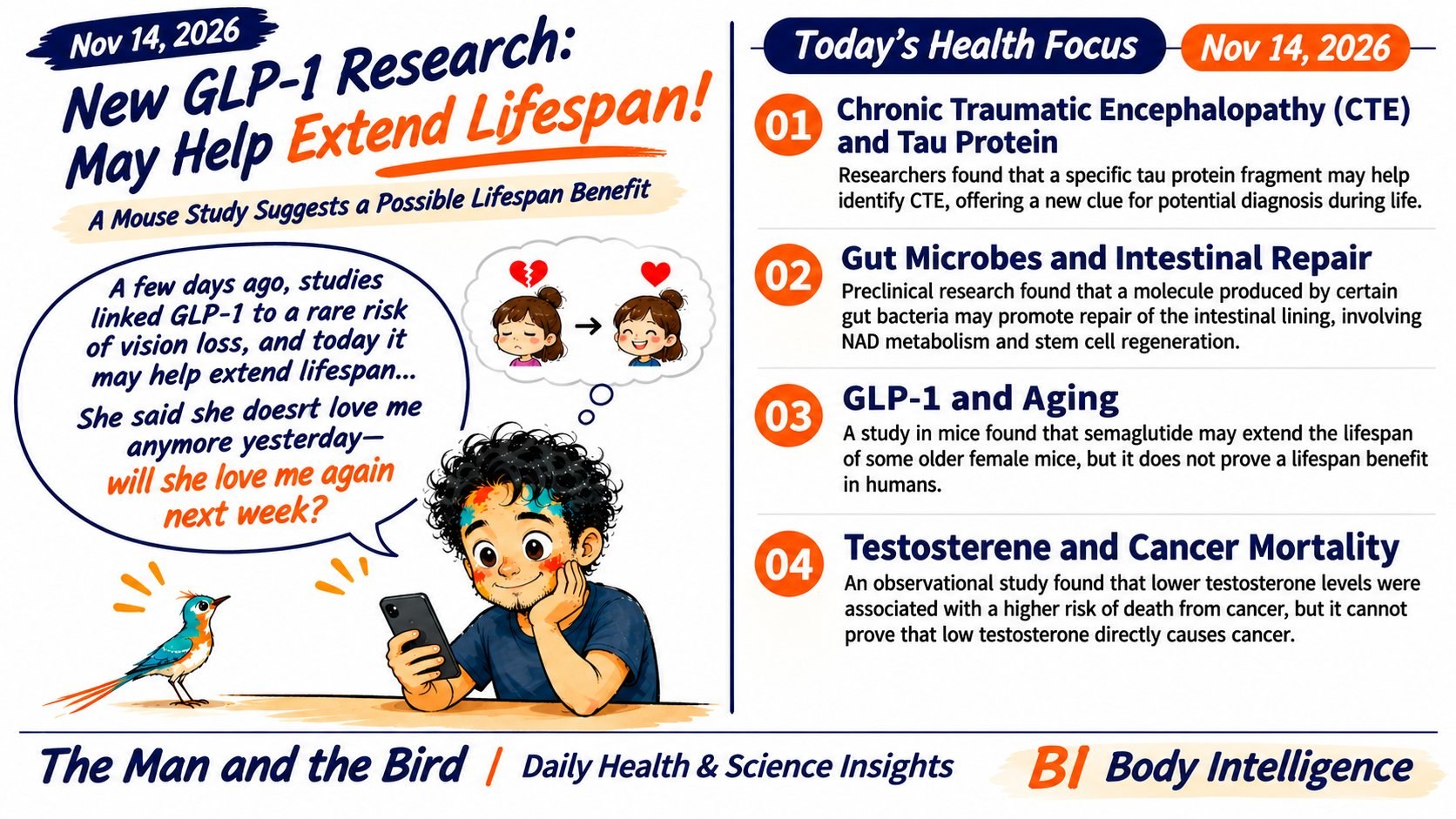
From Brain Injury to Gut Repair: Four Developments in Health Science
Today’s health research highlights explore four important areas: chronic traumatic encephalopathy, gut microbiome–mediated tissue repair, GLP-1 medications and aging, and the relationship between testosterone levels and cancer mortality.
These studies offer new insights into biological markers, cellular metabolism, drug mechanisms, and population health. However, their findings represent different levels of scientific evidence, and their clinical implications remain uncertain.
01 | Chronic Traumatic Encephalopathy: Can It Be Identified During Life?
Chronic traumatic encephalopathy (CTE) is a neurodegenerative condition associated with repeated head impacts, particularly among some individuals with a history of contact sports.
Currently, definitive diagnosis generally requires examination of brain tissue after death.
Recent research has identified a specific tau protein fragment, known as eMTBR-tau243, as a potential biomarker for CTE.
Tau proteins normally help maintain the internal structure of nerve cells. However, abnormal changes and accumulation of tau are associated with several neurodegenerative diseases.
Researchers hope that identifying specific tau fragments may eventually help distinguish CTE from other neurological conditions and support diagnosis during life.
However, the available evidence remains preliminary. Study samples are limited, and the ability of this biomarker to identify early-stage CTE has not been adequately established.
02 | Gut Microbes and Intestinal Repair: A New Metabolic Connection
The gut microbiome does much more than participate in food digestion.
Intestinal microorganisms produce a wide range of biologically active metabolites that can influence cellular signaling, metabolism, and tissue function.
Recent preclinical research suggests that N-methyl nicotinamide (N-MNA), a molecule produced by certain gut bacteria, may promote intestinal epithelial repair.
The findings involve nicotinamide adenine dinucleotide (NAD) metabolism, cellular regeneration, and mechanisms involved in maintaining the intestinal lining.
The intestinal epithelium serves as a critical physiological barrier. It must absorb nutrients while helping regulate interactions between the body and the contents of the digestive tract.
These findings suggest that microbial metabolites may contribute directly to tissue repair, extending our understanding of the microbiome beyond digestion and nutrient metabolism.
However, the research is primarily based on cellular and animal models.
It does not establish that a particular probiotic or nutritional supplement can treat intestinal injury in humans.
03 | GLP-1 and Aging: Could Semaglutide Influence Lifespan?
GLP-1 receptor agonists have attracted considerable attention for their established roles in blood glucose regulation and weight management in appropriate patient populations.
Recent animal research suggests that semaglutide may extend lifespan in certain older female mice, accompanied by changes in inflammation and measures of physical function.
These findings raise an important question:
Could GLP-1–related medications influence biological aging beyond their effects on blood glucose and body weight?
This is an interesting research direction, but the distinction between animal findings and human clinical evidence is essential.
At the same time, other research has identified a possible association between certain GLP-1 medications and a rare eye condition known as non-arteritic anterior ischemic optic neuropathy (NAION).
NAION can cause serious vision loss, although the absolute risk appears low and the relationship requires careful interpretation.
These findings are not necessarily contradictory.
A medication may have beneficial effects on some biological processes while also carrying potential risks.
Importantly, lifespan extension in mice does not demonstrate that semaglutide extends human lifespan.
Scientific evidence must be evaluated according to study design, population, outcomes, and limitations—not simply whether a headline appears positive or negative.
04 | Testosterone Levels and Cancer Mortality: Understanding the Association
Testosterone is an important hormone involved in male reproductive function, muscle maintenance, bone health, red blood cell production, and several metabolic processes.
An observational analysis involving more than 26,000 men reported an association between lower testosterone levels and higher cancer mortality.
However, this finding does not establish that low testosterone directly causes cancer or increases cancer progression.
Testosterone concentrations can be influenced by age, obesity, chronic illness, medication use, nutritional status, and overall physiological health.
In some circumstances, lower testosterone may reflect underlying health conditions rather than act as an independent cause of disease.
This distinction is particularly important when interpreting hormone-related research.
There is currently insufficient evidence to recommend testosterone supplementation for cancer prevention in men with normal testosterone levels.
Clinical decisions regarding testosterone therapy should be based on appropriate medical evaluation, established indications, and individual risk assessment.
Today’s Health Perspective
These four developments share an important scientific theme:
Researchers are moving beyond visible symptoms and isolated measurements to investigate the biological mechanisms underlying health and disease.
Tau protein fragments may help scientists identify patterns of neurodegeneration.
Microbial metabolites may influence intestinal tissue repair.
GLP-1 medications may affect metabolic pathways involved in aging.
And testosterone levels may provide information about broader physiological health.
Each finding contributes another piece to our understanding of the human body.
But three distinctions remain essential:
Association does not establish causation.
Identifying a biological mechanism does not establish an effective treatment.
Positive results in animal experiments do not guarantee benefits in humans.
Progress in health science is not simply about discovering more possibilities. It is about determining, through rigorous research, which findings can ultimately improve human health.
For functional nutrition and health management professionals, understanding these distinctions is fundamental to responsible evidence interpretation.
Building body intelligence means understanding both the complexity of human physiology and the limitations of scientific evidence.
—
Science & Education: BI Body Intelligence
Professional Review: Thomas Lin
Professional Community: ACPN — The Association of Certified Professional Nutritionists
Disclaimer: This article is for health education purposes only and does not constitute medical diagnosis or treatment advice.