
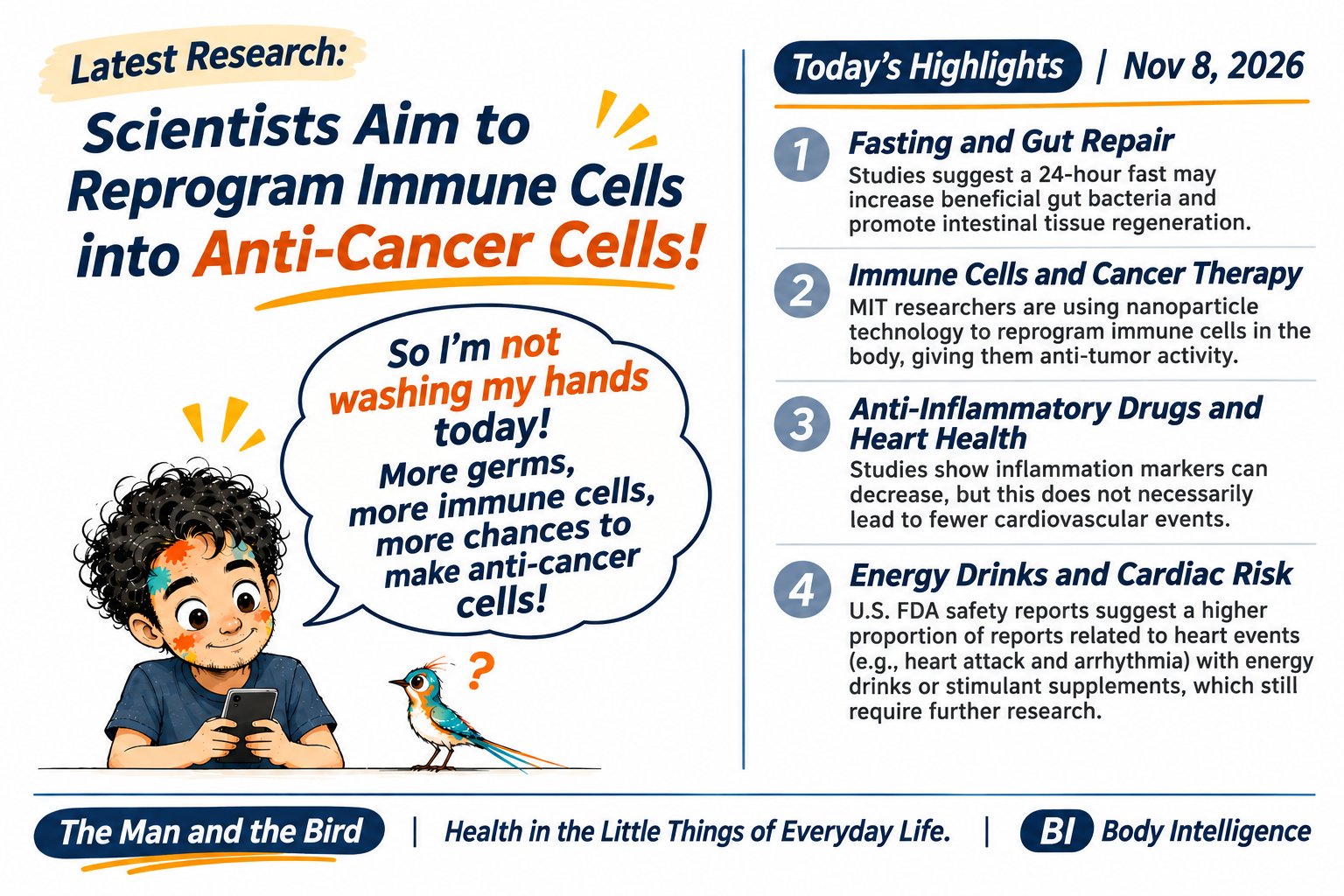
Health Science Update | November 8, 2026
Today’s health science highlights explore four developments involving fasting and intestinal repair, immune cell engineering for cancer treatment, inflammation and cardiovascular health, and potential safety concerns associated with energy drinks.
① Fasting and Intestinal Repair
Recent preclinical research suggests that a 24-hour fast may alter the gut microbiome and support intestinal tissue regeneration through interactions between specific microorganisms and host cells.
Researchers are particularly interested in how gut bacteria, intestinal stem cells, and tissue repair mechanisms interact.
These findings offer new insights into the physiological effects of fasting.
However, the research remains preclinical. It does not establish that fasting for 24 hours can repair intestinal damage in humans.
② Immune Cell Engineering and Cancer Treatment
Researchers at the Massachusetts Institute of Technology (MIT) are exploring nanoparticle technology to reprogram immune cells directly inside the body, potentially enabling them to recognize and attack tumor cells.
Some existing cellular immunotherapies require immune cells to be collected from patients, genetically modified in a laboratory, and then infused back into the body.
The emerging approach aims to perform parts of this engineering process directly within the body, potentially simplifying future treatment procedures.
The technology remains at the preclinical stage and requires substantial further investigation before widespread clinical use.
This research also highlights an important principle of immunology: a stronger immune response is not necessarily a better immune response.
Effective immune protection depends on accurate target recognition, appropriate activation, and precise regulation.
Exposure to ordinary bacteria does not automatically transform immune cells into cancer-fighting cells. Skipping handwashing may instead increase the risk of infection.
③ Anti-Inflammatory Treatment and Cardiovascular Health
Results from the ZEUS clinical trial, presented at the American Heart Association’s Scientific Sessions, illustrate an important distinction in medical research.
The investigational anti-inflammatory medication significantly reduced certain inflammatory biomarkers but did not significantly reduce the major cardiovascular events evaluated in the trial.
This demonstrates that improvements in laboratory measurements do not necessarily translate into better clinical outcomes.
Inflammation plays a complex role in cardiovascular disease, but not every intervention that lowers inflammatory markers produces meaningful cardiovascular benefits.
For effective health management, understanding biological mechanisms is important, but evaluating actual health outcomes is equally essential.
④ Energy Drinks and Cardiovascular Safety
Research presented at the American Heart Association’s Scientific Sessions examined adverse event reports submitted to the U.S. Food and Drug Administration (FDA).
The analysis identified cardiovascular safety signals involving energy drinks and stimulant-containing supplements, including reports of heart attacks and abnormal heart rhythms.
Energy drinks may contain caffeine and other stimulating ingredients, with considerable variation in formulation and serving size.
However, spontaneous adverse event reports cannot establish causation or determine the actual incidence of these events.
The findings highlight the importance of considering ingredients, dosage, individual health conditions, and patterns of consumption when evaluating beverage safety.
Today’s Health Perspective
From gut microorganisms to immune cell engineering, and from inflammatory biomarkers to cardiovascular outcomes, modern medical research continues to reveal the complexity of human physiology.
These developments also remind us that the human body cannot be understood through simple assumptions.
More immune cells do not automatically mean better cancer protection.
Lower inflammatory markers do not necessarily mean fewer cardiovascular events.
Changes in the gut microbiome do not automatically establish improvements in human health.
Meaningful health management requires connecting physiological mechanisms, scientific evidence, individual differences, and measurable health outcomes.
Scientific discoveries create new possibilities. Rigorous validation determines whether those possibilities can translate into meaningful health benefits.
— BI Body Intelligence
Science & Education: BI 身体智慧 (Body Intelligence)
AI-assisted Research & Illustration: BI × GPT
Professional Review: 林存默 (Thomas Lin)
Professional Community: ACPN — The Association of Certified Professional Nutritionists (加拿大注册执业营养师公会)
Disclaimer: This article is for health education purposes only and does not constitute medical diagnosis or treatment advice.