
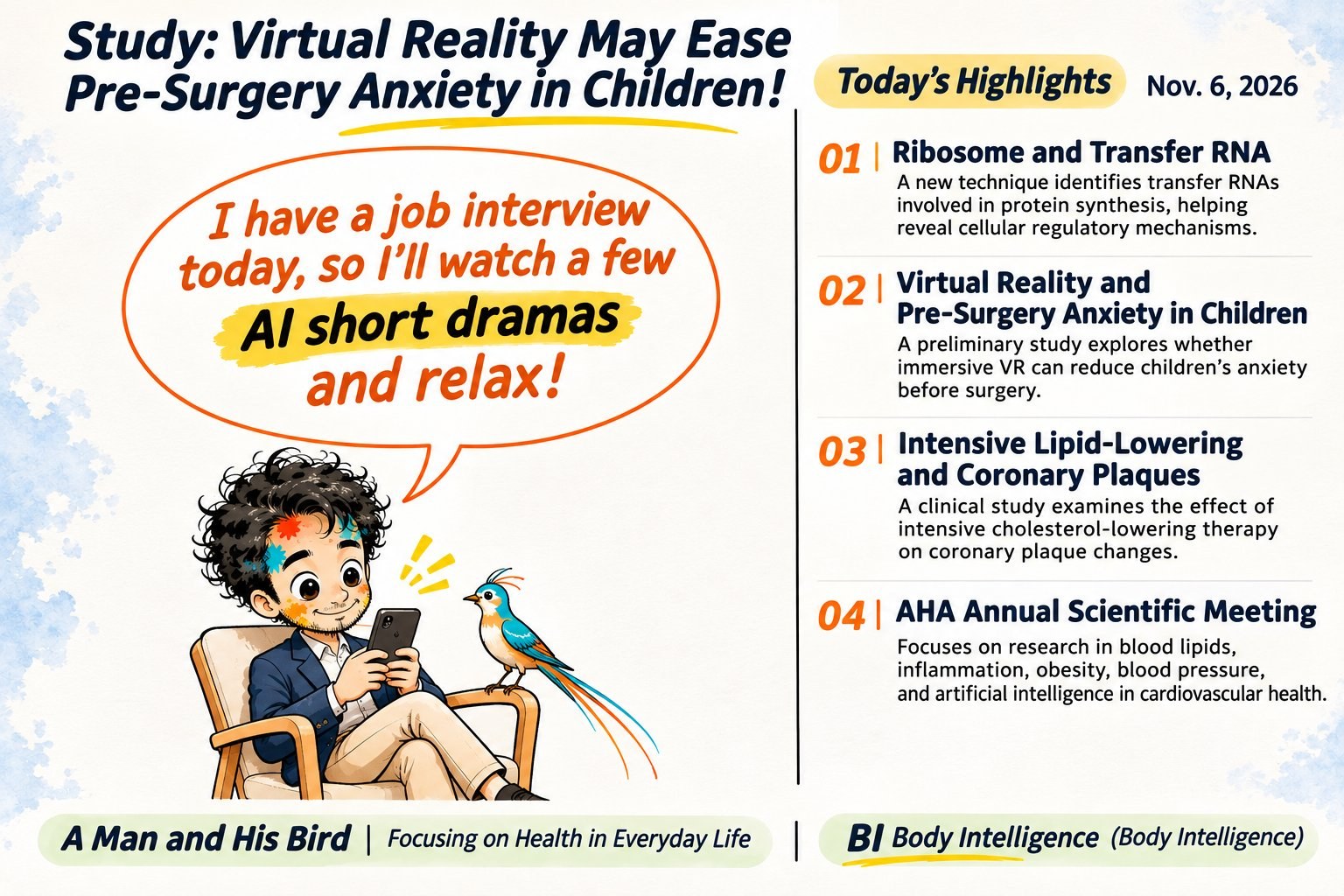
Health Science Update | November 6, 2026
Today, we highlight four developments in medical research and health technology, from cellular protein synthesis to pediatric anxiety, cholesterol management, and cardiovascular science.
① Ribosomes and Transfer RNA: How Do Cells Produce Proteins?
Ribosomes are responsible for protein synthesis, while transfer RNA (tRNA) delivers amino acids during the process.
A new research technique helps identify tRNAs actively involved in protein production, offering insights into how cells regulate protein synthesis under normal conditions, stress, and disease.
② Virtual Reality and Pre-Surgery Anxiety in Children
Children may experience anxiety before surgery due to unfamiliar environments, concerns about pain, and uncertainty.
Preliminary research suggests that immersive virtual reality (VR) experiences may help children relax and reduce certain indicators of preoperative anxiety.
However, larger controlled studies are needed to confirm these benefits. Structured VR interventions should not be confused with watching ordinary short videos.
③ Cholesterol-Lowering Therapy and Coronary Plaques
Cholesterol management involves more than measuring low-density lipoprotein cholesterol (LDL-C).
Clinical research continues to investigate how intensive cholesterol-lowering treatments influence atherosclerotic plaque within coronary arteries.
Changes in plaque measurements and reductions in actual cardiovascular events are different outcomes and must be evaluated separately.
④ American Heart Association Annual Scientific Meeting
The 2026 American Heart Association Scientific Sessions highlight research involving blood lipids, inflammation, obesity, blood pressure management, and artificial intelligence in cardiovascular medicine.
These developments reflect a broader approach to cardiovascular health, integrating metabolic mechanisms, clinical evidence, and individualized care.
Today’s Health Perspective
Health technology is not limited to discovering new medications or medical devices.
It also includes understanding cellular mechanisms more precisely and improving patients’ experiences during medical care.
However, scientific discoveries must be evaluated according to the strength of their evidence, from preliminary observations to controlled clinical trials and established clinical practice.
Scientific discovery deserves attention. Scientific validation matters just as much.
— BI Body Intelligence
Science & Education: BI 身体智慧 (Body Intelligence)
AI-assisted Research & Illustration: BI × GPT
Professional Review: 林存默 (Thomas Lin)
Professional Community: ACPN — The Association of Certified Professional Nutritionists (加拿大注册执业营养师公会)
Disclaimer: This article is for health education purposes only and does not constitute medical diagnosis or treatment advice.