
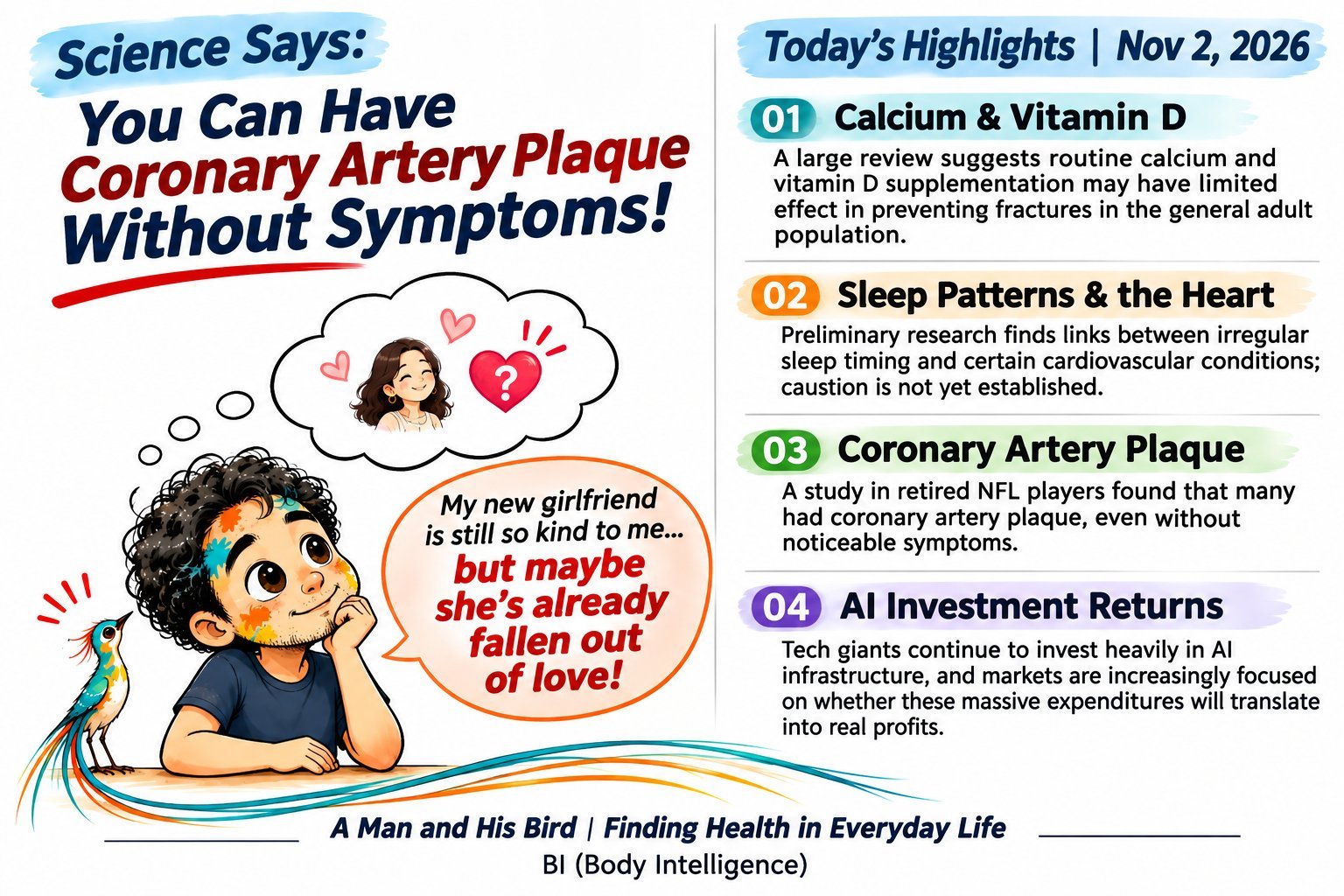
Today’s four developments explore an important question: Does doing more always lead to better outcomes?
① Calcium & Vitamin D: Do Supplements Prevent Fractures?
A systematic review covering 69 clinical trials and more than 150,000 adults suggests that routine calcium and vitamin D supplementation may offer limited benefits in preventing falls and fractures among the general adult population.
This does not mean calcium and vitamin D are unimportant. Individuals with inadequate intake, confirmed deficiencies, or osteoporosis may still require targeted nutritional or medical interventions.
Fracture prevention also involves muscle strength, balance, bone health, and fall-risk management.
② Sleep Regularity & Cardiovascular Health
Preliminary research involving more than 10,000 adults suggests an association between irregular sleep schedules and certain cardiovascular conditions.
The findings highlight an important consideration: Sleep health is not only about how many hours we sleep, but also how consistently we maintain our sleep and wake times.
However, these findings do not establish that irregular sleep directly causes cardiovascular disease.
③ Silent Coronary Artery Plaque: No Symptoms Does Not Mean No Risk
A study involving 200 retired NFL players found coronary artery plaque in nearly 90% of participants, with approximately 40% showing significant coronary artery narrowing. Many reported no noticeable symptoms.
These findings come from a specific athletic population and should not be generalized to all adults.
Coronary atherosclerosis can develop silently over time. Cardiovascular risk assessment should consider blood pressure, cholesterol, glucose metabolism, smoking history, age, and family history.
The absence of chest pain does not necessarily indicate the absence of coronary artery disease.
④ AI Investment: When Will Spending Translate Into Profits?
Major technology companies continue to invest heavily in artificial intelligence infrastructure, including data centers, advanced chips, computing capacity, and electricity supply.
Financial markets are increasingly asking a different question:
Beyond what AI technology can accomplish, can these enormous capital investments generate sustainable revenue and measurable profits?
This does not mean AI growth has reached its limit. It means the industry is facing greater scrutiny of its economic returns.
💡 Today’s Scientific Perspective
These four developments share a common lesson:
More input does not automatically guarantee better outcomes, and the absence of visible problems does not always mean everything is functioning normally.
Taking supplements does not automatically prevent fractures. Getting enough sleep does not make sleep regularity irrelevant. Feeling healthy does not rule out coronary artery plaque. And massive AI investment does not guarantee immediate profitability.
Science helps us identify possibilities. Evidence and professional judgment help determine what actions are appropriate.
Science creates possibilities. Evidence guides decisions.
Science & Education: BI 身体智慧 (Body Intelligence)
AI-assisted Research & Illustration: BI × GPT
Professional Review: 林存默 (Thomas Lin)
Professional Community: ACPN — The Association of Certified Professional Nutritionists (加拿大注册执业营养师公会)
Disclaimer: This article is for health education purposes only and does not constitute medical diagnosis or treatment advice.