
October 31, 2026
Three recent research reports explore connections between food components, immune responses, and the gut microbiome.
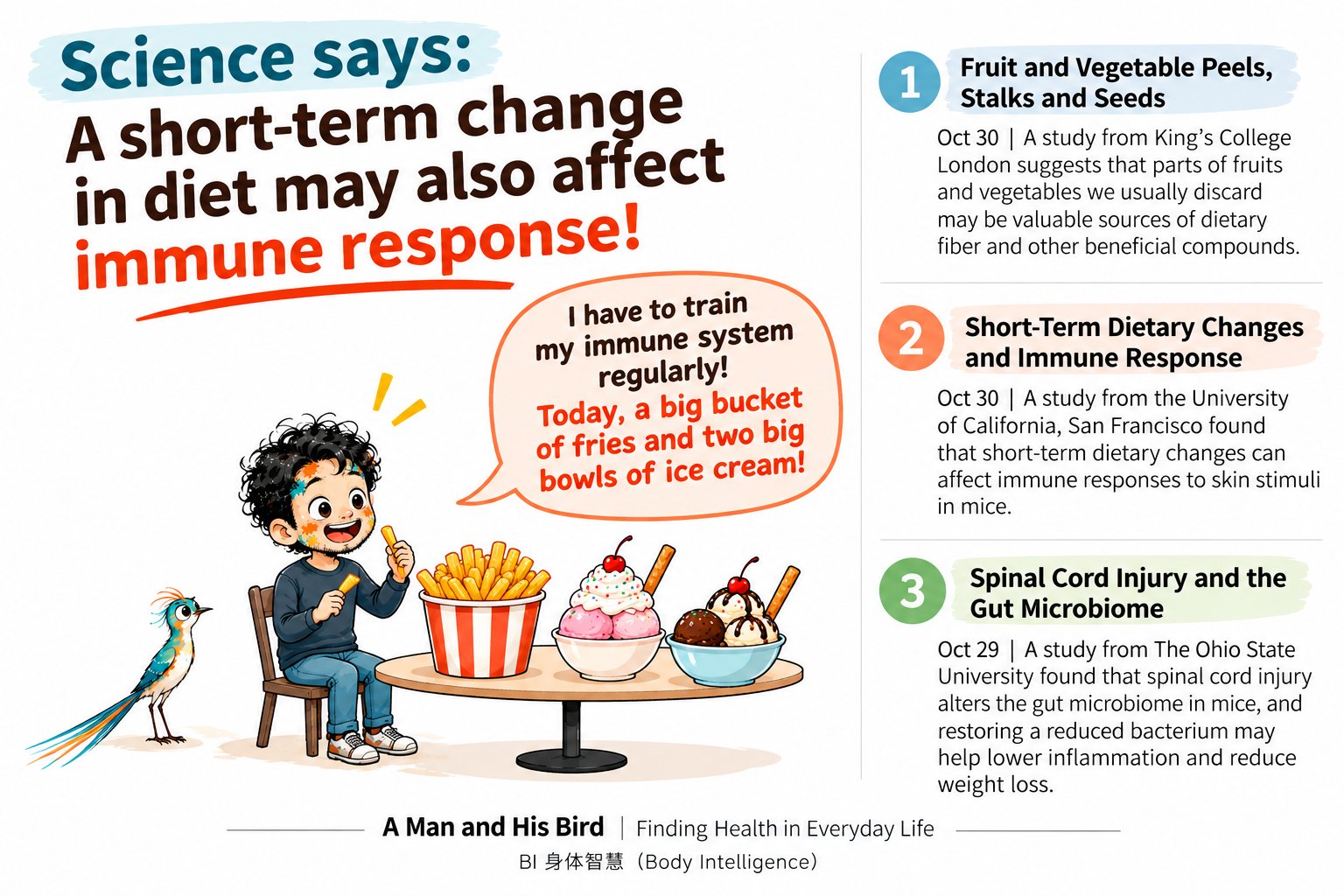
① Fruit Peels, Vegetable Stalks & Seeds: Overlooked Nutritional Resources
Research highlighted by King’s College London on October 30 explored the potential value of fruit and vegetable parts that are commonly discarded.
Peels, stalks, and seeds may contain dietary fiber, polyphenols, and other potentially beneficial plant compounds.
These findings highlight opportunities for improving food utilization and developing nutritious food ingredients.
However, not all discarded plant parts are safe or suitable for consumption. Their nutritional value depends on the specific plant, processing methods, and food safety considerations.
② Short-Term Dietary Changes & Immune Responses
Animal research reported by the University of California, San Francisco on October 30 suggests that short-term dietary changes may influence how the immune system responds to skin-related stimuli in mice.
The findings indicate that certain immune responses may be sensitive to dietary changes over relatively short periods.
Importantly, a change in immune activity does not necessarily mean stronger or healthier immune function.
These results come from animal experiments and do not demonstrate that consuming large quantities of fries, ice cream, or other energy-dense foods can strengthen or “train” the human immune system.
③ Spinal Cord Injury & the Gut Microbiome
Researchers at The Ohio State University reported on October 29 that spinal cord injury can alter gut microbial communities in experimental mice.
Restoring a bacterial species that had declined following injury was associated with improvements in inflammatory responses and reduced weight loss in the animals.
These findings suggest that gut microorganisms may contribute to physiological changes following neurological injury.
However, the research remains preclinical and does not establish a probiotic treatment for people with spinal cord injuries.
Scientific Perspective
These studies illustrate the complex relationships among nutrition, immune regulation, neurological function, and the gut microbiome.
They also highlight an important scientific distinction:
An immune response is not necessarily an improvement in immunity, and a biological change is not automatically a proven health benefit.
Understanding the difference between experimental findings, underlying mechanisms, and clinically demonstrated outcomes is essential for evidence-based health education.
A Man and His Bird | Finding Health in Everyday Life
Science & Education: BI 身体智慧 (Body Intelligence)
AI-assisted Research & Illustration: BI × GPT
Professional Review: 林存默 (Thomas Lin)
Professional Community: ACPN — The Association of Certified Professional Nutritionists (加拿大注册执业营养师公会)
Disclaimer: This article is for health education purposes only and does not constitute medical diagnosis or treatment advice.