
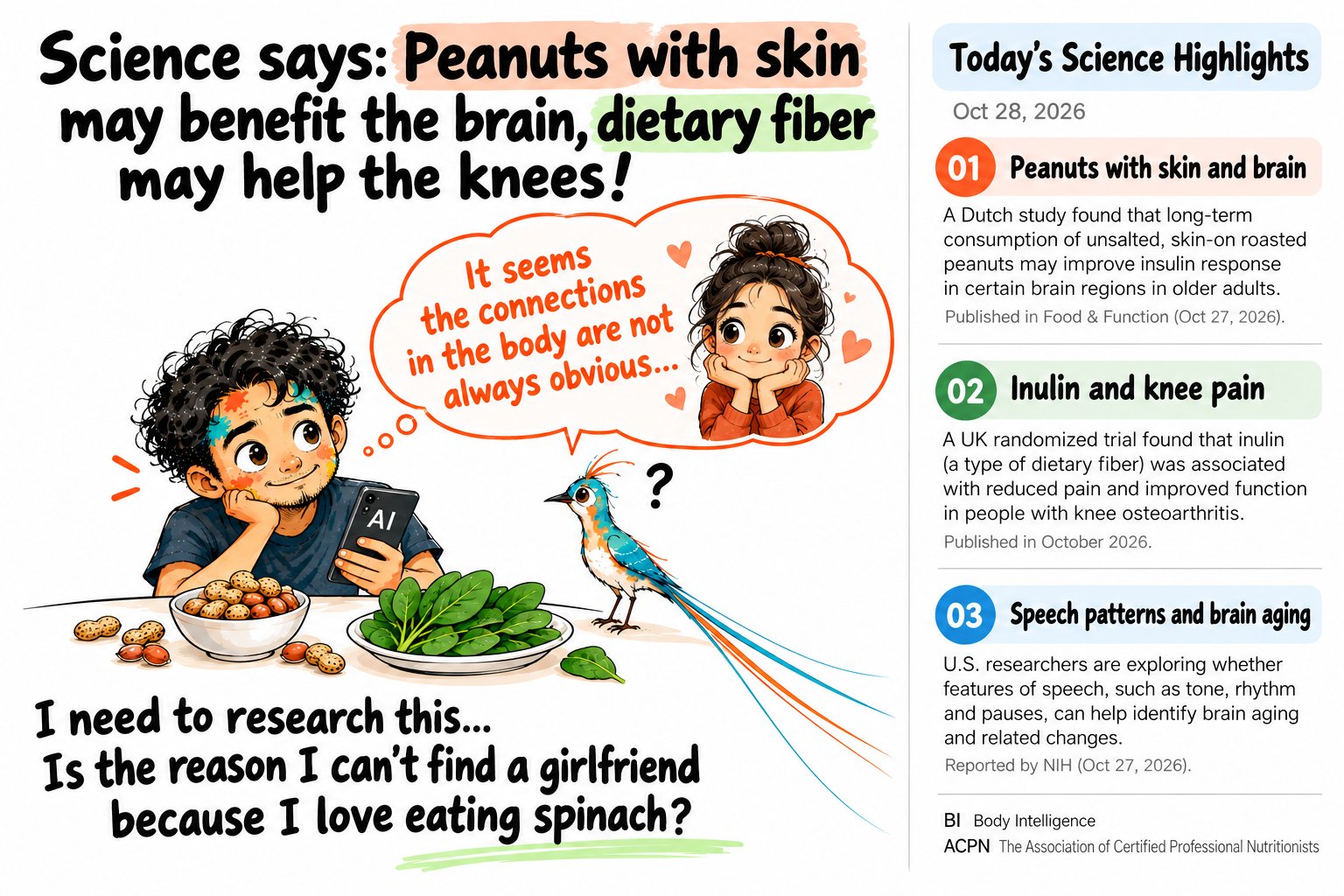
Can peanuts with their skins benefit the brain? Could dietary fiber help relieve knee pain? And can the way we speak reveal signs of brain aging?
Today’s three research stories highlight some surprising connections between nutrition, metabolism, and the nervous system.
🧠 01 | Peanuts and Brain Insulin Sensitivity
Researchers at Maastricht University in the Netherlands found that regular consumption of unsalted, skin-on roasted peanuts may improve insulin responsiveness in certain brain regions of older adults.
Insulin does more than regulate blood glucose. It also plays important roles in brain energy metabolism and neuronal signaling.
These findings suggest that dietary factors may influence brain function through metabolic pathways.
Important limitation: Improved brain insulin responsiveness does not prove better memory or dementia prevention. Peanuts are also calorie-dense and must be avoided by individuals with peanut allergies.
🦵 02 | Inulin, Gut Health, and Knee Pain
Researchers at the University of Nottingham conducted a six-week randomized controlled trial involving 117 people with knee osteoarthritis.
The study found that supplementation with inulin, a prebiotic dietary fiber, was associated with improvements in certain pain and physical function measures.
Researchers also observed changes in the gut hormone GLP-1, suggesting that gut-related metabolic signaling may contribute to pain regulation and physical function.
This offers another perspective on the emerging relationship between the gut and musculoskeletal health.
Important limitation: The study was relatively small and short. It does not demonstrate that inulin repairs cartilage or replaces established osteoarthritis treatments.
🗣️ 03 | Can Speech Patterns Reveal Brain Aging?
The U.S. National Institutes of Health (NIH) recently highlighted research exploring how speech characteristics may provide clues about brain aging and cognitive changes.
Researchers are examining features such as speaking rhythm, pitch, pauses, and language patterns to identify potential signals associated with cognitive function.
Because speech can be recorded conveniently and noninvasively, it may become a useful component of future digital health assessments.
However, speaking slowly, pausing frequently, or occasionally forgetting words does not mean someone has dementia.
Speech-based models require further validation and cannot replace clinical cognitive assessments.
💡 Today’s Reflection | The Connections Within Our Bodies Are Not Always Obvious
We usually associate food with digestion, knees with bones and muscles, and speech with communication.
But the human body is not simply a collection of independent organs.
Dietary components may influence brain metabolism. Gut microorganisms and metabolic signals may affect distant tissues. Speech patterns may reflect changes in nervous system function.
These findings remind us that understanding health requires looking beyond individual organs and considering the body as an interconnected biological system.
Yet discovering a connection is not the same as proving causation. Not every unexpected relationship has a meaningful biological explanation.
The value of science lies in identifying these possibilities, testing them carefully, and distinguishing evidence from speculation.
Better health management begins with understanding mechanisms—not simply following headlines.
Science & Education: BI 身体智慧 (Body Intelligence)
AI-assisted Research & Illustration: BI × GPT
Professional Review: 林存默 (Thomas Lin)
Professional Community: ACPN — The Association of Certified Professional Nutritionists
#HealthScience #FunctionalNutrition #BrainHealth #InsulinSensitivity #DietaryFiber #Inulin #Osteoarthritis #GutMicrobiome #CognitiveHealth #HealthyAging #ACPN