
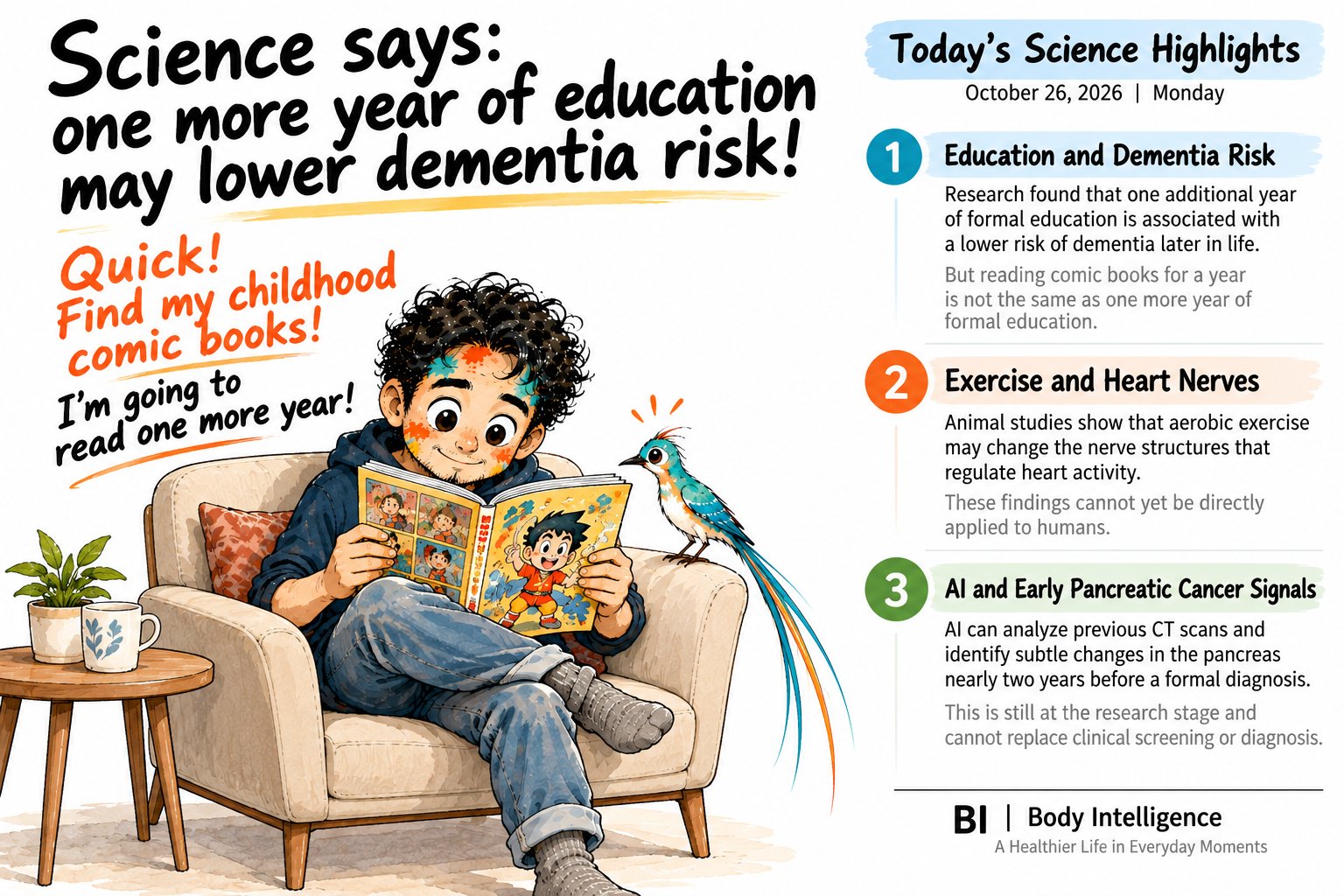
Could one additional year of education lower dementia risk? Can exercise reshape the nerves controlling our hearts? And could AI detect cancer signals before diagnosis?
Today’s three research stories explore how education, physical activity, and artificial intelligence may influence our understanding of long-term health.
01 | One More Year of Education May Reduce Dementia Risk
The U.S. National Institutes of Health (NIH) recently highlighted a study examining the long-term effects of additional education.
Researchers used a 1972 change in the United Kingdom’s compulsory schooling laws to analyze health data from more than 100,000 individuals.
The findings suggest that one additional year of formal education was associated with a lower likelihood of dementia diagnosis decades later, particularly among people with higher genetic risk.
Unlike a conventional observational study, this research used a natural policy change to strengthen the analysis.
However, the findings do not mean that simply reading books for another year in adulthood will produce the same protective effect.
Education may influence cognitive reserve, lifestyle, and socioeconomic conditions through multiple pathways.
02 | Exercise May Reshape the Nerves That Regulate the Heart
We usually associate aerobic exercise with stronger cardiovascular function, improved circulation, and better metabolic health.
Researchers at the University of Bristol found that after 10 weeks of moderate aerobic training, rats developed structural changes in certain sympathetic nerve ganglia involved in regulating heart activity.
Interestingly, the changes differed between the left and right sides.
These findings suggest that exercise may influence cardiovascular health not only through the heart and blood vessels, but also through adaptations in the autonomic nervous system.
Important limitation: This was an animal study. The findings cannot yet be directly applied to humans or used to establish new clinical treatments.
03 | Can AI Detect Early Pancreatic Cancer Signals in Previous CT Scans?
Pancreatic cancer is particularly challenging because early-stage disease often develops without obvious symptoms.
Recent research reports describe an artificial intelligence imaging model called REDMOD, designed to identify subtle pancreatic changes in previously acquired abdominal CT scans.
In the retrospective study, the model identified relevant imaging signals an average of approximately 475 days before formal diagnosis.
The findings suggest that earlier medical images may contain valuable information that conventional interpretation does not always capture.
However, this remains an emerging research approach.
It does not establish AI as a reliable screening tool for the general population, nor does it replace radiologists or established clinical diagnostic procedures.
Today’s Reflection | Health Management Extends Beyond the Present
Education may influence cognitive health decades later.
Exercise may affect neural mechanisms we are only beginning to understand.
AI may uncover early warning signals hidden in medical images from the past.
Science is expanding our ability to understand the human body.
But identifying an association, explaining its biological mechanisms, and applying the findings to individual health decisions are three different steps.
Effective health management is not about changing our lives with every new discovery. It is about learning continuously, understanding the evidence, and making informed, sustainable decisions.
Science & Education: BI 身体智慧 (Body Intelligence)
Professional Review: 林存默 (Thomas Lin)
Professional Community: ACPN — The Association of Certified Professional Nutritionists