
Health Science Today | October 25, 2026
Mediterranean Diet and Mitochondria, Blood Pressure Medication and Cardiovascular Protection, Alcohol Consumption and Long-Term Health Risks
Today, we explore three developments in health science. Although they involve different areas of research, they raise a common question: How do our everyday habits influence long-term health?
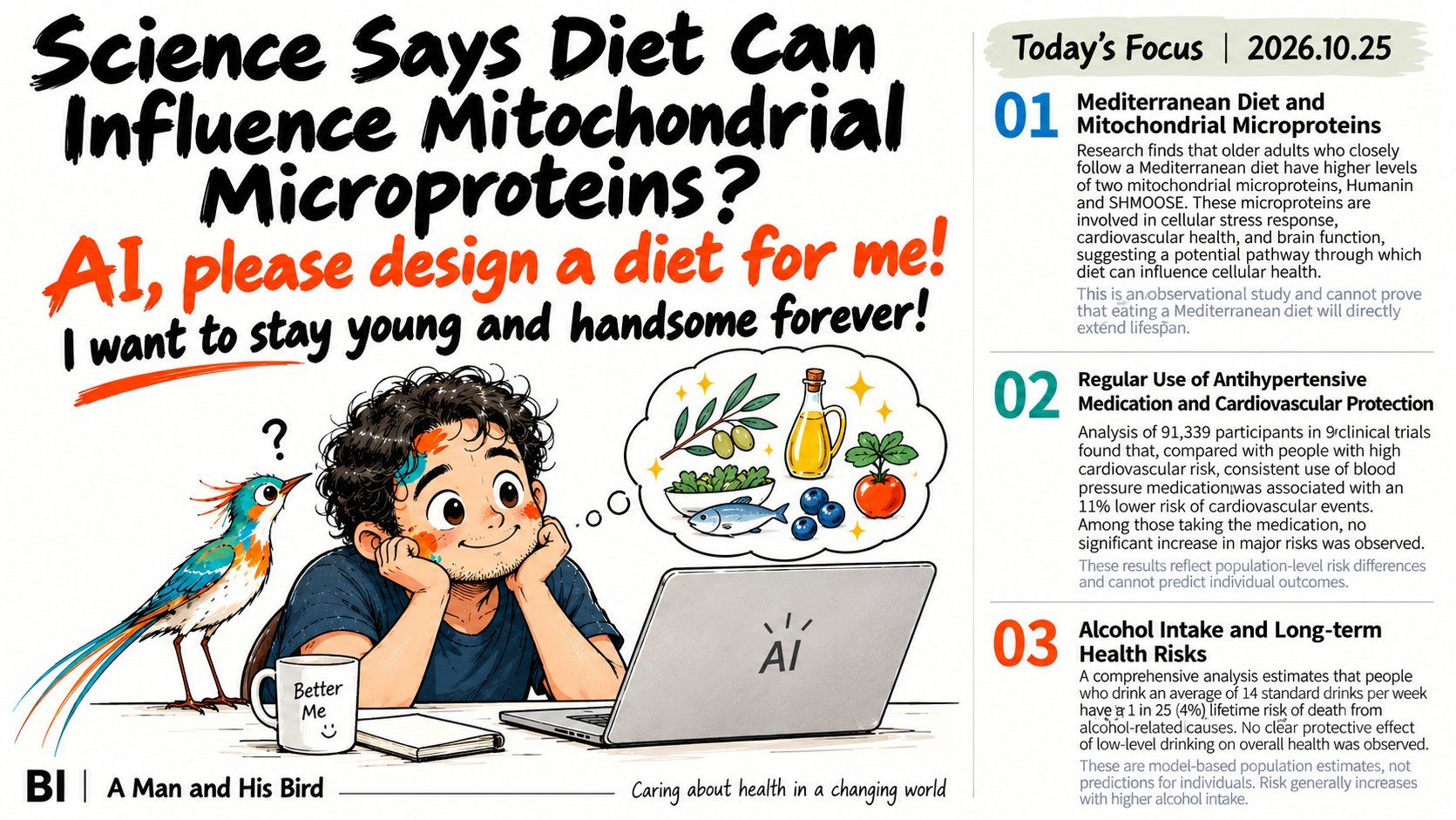
① Can the Mediterranean Diet Influence Mitochondrial Microproteins?
Mitochondria are widely recognized as the energy-producing structures of our cells. However, their biological functions extend far beyond ATP production.
In recent years, scientists have identified small proteins produced from mitochondrial genetic sequences, known as mitochondrial-derived peptides.
Among them, Humanin and SHMOOSE have attracted scientific interest because of their potential involvement in cellular stress responses, metabolic regulation, and neurological function.
A recent study found that older adults who more closely followed a Mediterranean dietary pattern tended to have higher levels of these two mitochondrial microproteins.
The Mediterranean diet generally emphasizes vegetables, fruits, whole grains, legumes, nuts, olive oil, and fish, while limiting certain highly processed foods.
These findings suggest an interesting possibility: long-term dietary patterns may influence not only blood lipids, glucose regulation, and body weight, but also molecular signaling pathways involved in cellular health.
However, the study identified an association between dietary patterns and microprotein levels.
It does not establish that the Mediterranean diet delays aging through these proteins, nor does it demonstrate that scientists have discovered a diet capable of preserving youth.
② Why Is Consistent Blood Pressure Medication So Important?
Managing hypertension involves more than lowering a single blood pressure reading.
The broader objective is to reduce the long-term burden of elevated blood pressure on the heart, brain, kidneys, and vascular system.
An analysis involving 91,339 participants across nine clinical trials found that higher medication adherence was associated with an approximately 11% reduction in the relative risk of major cardiovascular events in the relevant treatment comparisons.
Among participants whose medication adherence was below 80%, a statistically significant corresponding risk reduction was not observed.
Medication adherence refers to how consistently patients follow their prescribed treatment plans.
The protective effects of antihypertensive medications generally depend on sustained blood pressure management rather than occasional medication use.
Importantly, the reported 11% represents a population-level relative risk result. It does not mean every individual will experience the same benefit.
Nor does it mean that missing a single dose eliminates all cardiovascular protection.
The broader lesson is that successful long-term health management requires more than selecting an effective intervention.
It also depends on whether that intervention can be consistently maintained in everyday life.
③ What Are the Long-Term Risks of Drinking 14 Standard Alcoholic Drinks per Week?
The relationship between alcohol consumption and health has been debated for decades, particularly the belief that moderate drinking may offer health benefits.
A recent risk-modeling analysis incorporating research and population data estimated that people consuming an average of 14 standard alcoholic drinks per week may face approximately a 4% lifetime risk of death from alcohol-related causes.
That is roughly one in 25 people at the population level.
The analysis also did not identify clear overall health protection from low levels of alcohol consumption.
Alcohol can affect health through multiple biological pathways, including liver metabolism, blood pressure regulation, sleep quality, inflammatory responses, and the risk of certain cancers.
A standard drink is defined by its pure alcohol content and does not necessarily correspond to an ordinary glass or serving.
The estimated 4% lifetime risk is a population-based model result, not a prediction of any individual’s outcome.
Actual risk depends on multiple factors, including drinking quantity, drinking patterns, age, sex, and overall health.
The findings reinforce the importance of understanding alcohol exposure as a long-term health risk rather than assuming that small amounts necessarily provide protection.
Today’s Scientific Perspective | What Is the Greatest Challenge in Health Management?
These three studies highlight a central challenge in modern health management.
Scientific knowledge continues to evolve. New molecular mechanisms are discovered, and familiar health recommendations are continually examined through new research.
Yesterday, we focused on blood glucose, cholesterol, and calorie balance.
Today, researchers are exploring mitochondrial microproteins and intracellular signaling pathways.
At the same time, many well-established health practices—such as taking prescribed medication consistently, maintaining balanced nutrition, and limiting alcohol consumption—remain difficult to sustain over time.
We should not immediately abandon established habits whenever a new study appears.
But neither should we ignore well-supported health risks simply because science has not answered every question.
Health management is not about chasing a new scientific discovery every day. It is about learning, as evidence evolves, what deserves to change, what should remain consistent, and when our decisions need to be reassessed.
Science helps us understand how the body works.
The greater challenge is translating constantly evolving knowledge into sustainable, individualized decisions about how we live.
In a rapidly changing world, perhaps the most important health skill is not finding one permanent answer, but developing the ability to make informed decisions—and adjust them when better evidence becomes available.
Science & Education: BI 身体智慧 (Body Intelligence)
AI-assisted Research & Illustration: BI × GPT
Professional Review: 林存默 (Thomas Lin)
Professional Community: ACPN — The Association of Certified Professional Nutritionists (加拿大注册执业营养师公会)
Disclaimer: This article is for health education purposes only and does not constitute medical diagnosis or treatment advice.