
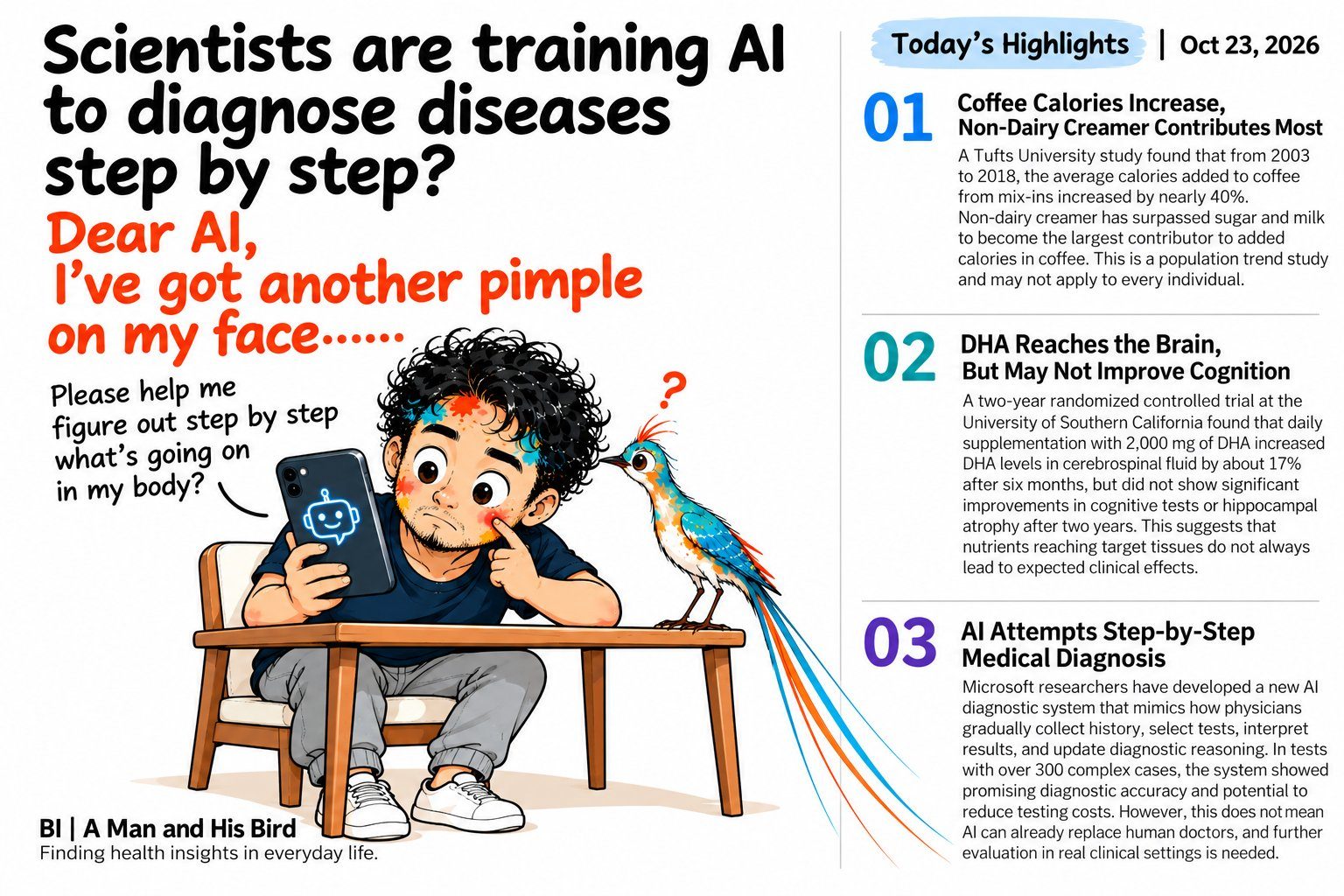
Coffee Calories, DHA and Cognitive Health, and AI-Assisted Medical Diagnosis
Three recent research developments highlight an important question in modern healthcare: How do we distinguish biological mechanisms, measurable changes, and meaningful health outcomes?
Today’s science update examines changing coffee consumption habits, the effects of DHA supplementation on cognitive health, and emerging artificial intelligence systems designed to support clinical reasoning.
1. Coffee Calories Are Rising: The Growing Contribution of Non-Dairy Creamers
Researchers at Tufts University analyzed dietary data from approximately 30,000 American participants to investigate changes in coffee consumption and the ingredients added to coffee.
The analysis found that between 2003 and 2018, the average calories contributed by coffee additives increased by nearly 40%.
One notable finding was the growing contribution of non-dairy creamers, which surpassed sugar and milk as the largest source of added calories in coffee.
Why Does This Matter?
Coffee itself generally contains very few calories when consumed without added ingredients. However, creamers, flavored syrups, sweeteners, and other additions can substantially change its nutritional composition.
Some non-dairy creamers contain added sugars, vegetable oils, or other fat sources. Their calorie content varies considerably depending on the formulation and serving size.
Consumers who focus only on reducing sugar may overlook the calories contributed by other ingredients.
From a nutritional assessment perspective, it is therefore important to evaluate the complete beverage rather than treating coffee as a single, nutritionally uniform product.
What Are the Limitations?
This study describes population-level dietary trends in the United States. It does not mean that every individual’s coffee consumption increased in calories by 40%.
Nor does it establish that all non-dairy creamers have the same nutritional characteristics.
The practical message is straightforward: ingredient composition, portion size, and consumption frequency matter.
2. DHA Reaches the Central Nervous System, but Cognitive Benefits Remain Uncertain
Researchers at the University of Southern California conducted a two-year randomized, double-blind clinical trial involving 365 adults aged 55 to 80 who were considered at elevated risk for Alzheimer’s disease.
The trial investigated the effects of daily supplementation with 2,000 mg of docosahexaenoic acid (DHA), an important omega-3 fatty acid.
After six months, DHA concentrations in cerebrospinal fluid increased by approximately 17% in the supplementation group.
However, after two years, the study did not demonstrate statistically significant improvements in cognitive test results or measures of hippocampal atrophy.
Why Is DHA Important?
DHA is a major structural component of neuronal membranes and is particularly relevant to the brain and retina.
It contributes to membrane organization and participates in processes associated with neuronal signaling and cellular function.
Because DHA has established biological roles in the nervous system, researchers have investigated whether supplementation could help maintain cognitive function or influence neurodegenerative processes.
However, biological importance does not automatically establish clinical effectiveness.
A Critical Distinction: Delivery Is Not the Same as Clinical Benefit
The trial illustrates three separate levels of evidence:
Biological mechanism: DHA contributes to normal neuronal structure and function.
Target-tissue exposure: Supplementation increased DHA concentrations in cerebrospinal fluid, providing evidence of increased central nervous system exposure.
Clinical outcome: The trial did not establish significant improvements in the measured cognitive or hippocampal outcomes over two years.
These findings demonstrate why clinical research must evaluate meaningful health outcomes rather than relying exclusively on biochemical markers.
What Does This Mean for Omega-3 Nutrition?
The findings should not be interpreted as evidence that DHA has no physiological value or that omega-3 fatty acids are ineffective for every health-related purpose.
Instead, they indicate that this particular supplementation strategy did not demonstrate the expected cognitive benefits in the population and conditions studied.
Effects may differ according to baseline nutritional status, age, health conditions, dose, duration, and the specific outcome being measured.
For functional nutrition professionals, this distinction is essential when interpreting research and developing evidence-based recommendations.
3. Artificial Intelligence Is Learning to Approach Medical Diagnosis Step by Step
Microsoft researchers have developed an experimental artificial intelligence diagnostic system designed to imitate aspects of physicians’ sequential clinical reasoning.
Rather than receiving all available information and producing a single answer, the system follows a more structured process.
It can gather clinical history, identify potentially useful investigations, interpret new findings, and revise its diagnostic reasoning as additional information becomes available.
In research testing involving more than 300 complex medical cases, the system demonstrated promising diagnostic performance and the potential to reduce unnecessary testing costs.
From Answer Generation to Clinical Reasoning
Traditional medical AI evaluations have often focused on whether a model can provide the correct answer to a medical question.
However, real clinical practice is rarely a single-question exercise.
Physicians must determine which information is missing, evaluate competing explanations, select appropriate investigations, and reconsider their conclusions as evidence develops.
This process involves uncertainty, prioritization, and ongoing judgment.
The emerging approach to AI-assisted diagnosis attempts to reproduce parts of that decision-making sequence.
What Could This Mean for Healthcare?
If validated in real clinical environments, such systems could potentially support healthcare professionals by helping organize patient information, identify diagnostic possibilities, and improve the selection of investigations.
They may also contribute to more efficient use of healthcare resources.
However, performance on selected research cases does not establish reliability in everyday clinical practice.
Real patients often present with incomplete information, multiple medical conditions, unusual symptoms, and circumstances that cannot be fully represented in controlled evaluations.
Clinical safety, bias, accountability, privacy, and regulatory oversight remain important considerations.
AI-assisted diagnostic systems should therefore be understood as emerging clinical support technologies, not validated replacements for licensed healthcare professionals.
Today’s Scientific Perspective: Information, Biological Change, and Professional Judgment
These three developments address different aspects of health science, but they share an important underlying principle.
The coffee study demonstrates why nutritional assessment must consider actual ingredients and quantities rather than relying on broad food categories.
The DHA trial demonstrates that delivering a nutrient to a biological target does not guarantee a measurable clinical benefit.
The AI diagnostic research demonstrates that professional healthcare decisions require more than access to information. They depend on the ability to evaluate evidence, recognize uncertainty, and revise conclusions when new findings become available.
Together, these studies reinforce an important direction for modern functional nutrition and health management.
Effective health management is not simply about consuming more nutrients, collecting more health data, or adopting more advanced technologies. It is about understanding how evidence applies to an individual and translating that understanding into appropriate decisions.
Scientific progress provides increasingly sophisticated tools for observing human physiology.
The challenge is to connect those observations with meaningful outcomes while maintaining rigorous standards of evidence and professional responsibility.
Science & Education: BI 身体智慧 (Body Intelligence)
AI-assisted Research & Illustration: BI × GPT
Professional Review: 林存默 (Thomas Lin)
Professional Community: ACPN — The Association of Certified Professional Nutritionists (加拿大注册执业营养师公会)