
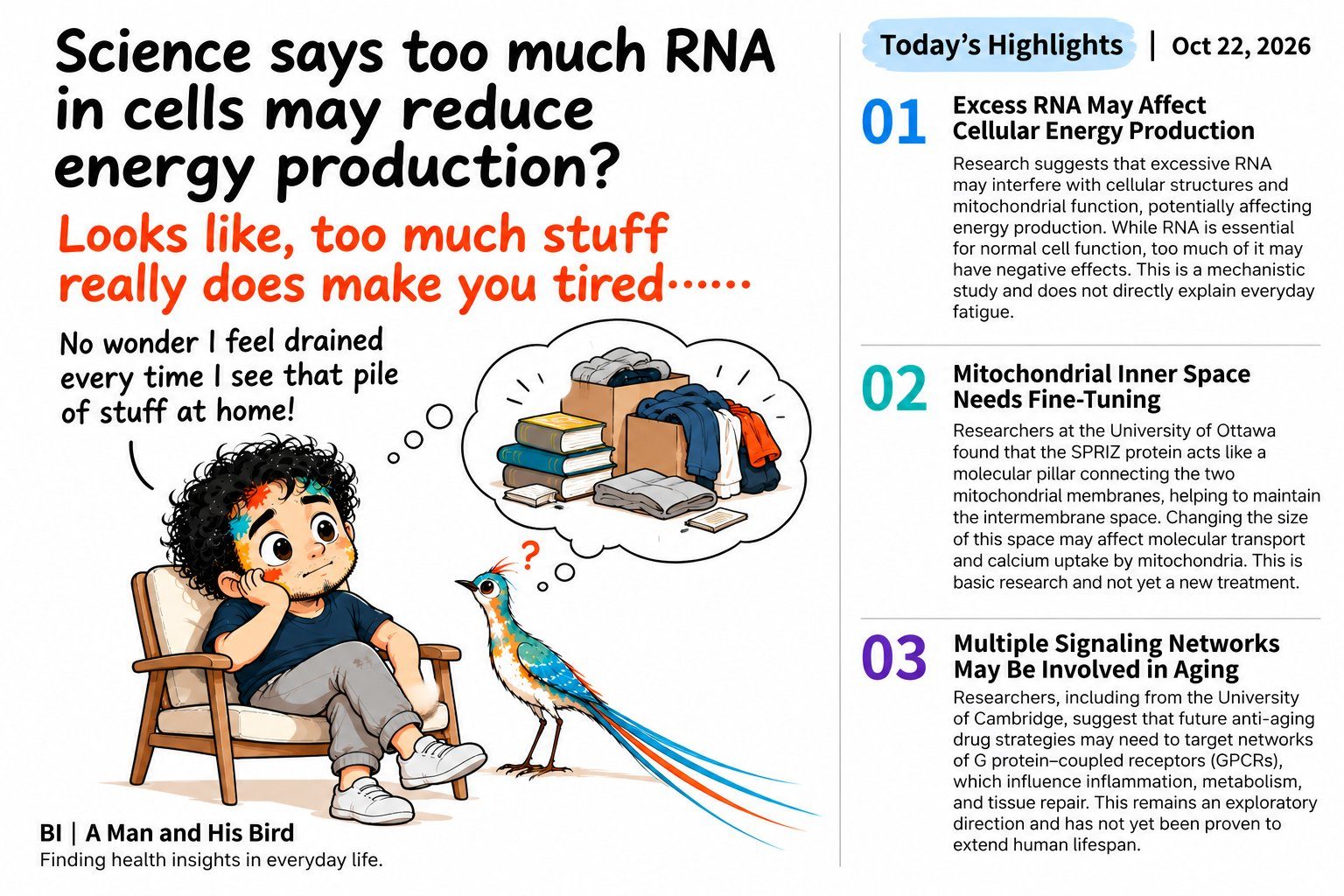
Today, we explore three developments in life science: excessive RNA accumulation and cellular energy production, the structural regulation of mitochondria, and complex signaling networks involved in aging.
① Can Too Much RNA Interfere with Cellular Energy Production?
RNA (ribonucleic acid) is essential for cellular function. It participates in genetic information transfer, protein synthesis, and numerous processes regulating gene expression.
However, more RNA is not necessarily better.
Recent research suggests that abnormal accumulation of certain RNA molecules may disrupt the organization of cellular structures and interfere with mitochondrial function.
Mitochondria play a central role in producing ATP (adenosine triphosphate), the molecule that supplies energy for muscle contraction, nerve signaling, cellular transport, and tissue repair.
These findings suggest that cellular energy metabolism depends not only on nutrient availability and enzyme activity but also on RNA homeostasis and the organization of intracellular structures.
However, this remains fundamental mechanistic research. It does not establish that excessive RNA accumulation is a cause of everyday fatigue.
② Why Does the Space Inside Mitochondria Need Precise Regulation?
Researchers at the University of Ottawa in Canada have identified a protein called SPRIZ that helps maintain the space between the two mitochondrial membranes.
Mitochondria are not simply containers for energy production. They contain distinct structural compartments, including the outer membrane, inner membrane, intermembrane space, and matrix.
These compartments work together to support molecular transport, calcium regulation, and energy metabolism.
The researchers found that SPRIZ may function like a tiny molecular pillar, helping maintain the distance between mitochondrial membranes.
Changes in this spacing may influence how molecules enter mitochondria and how mitochondria take up calcium ions.
Calcium is not only essential for muscle contraction and nerve transmission. It is also an important intracellular signaling molecule involved in mitochondrial metabolic regulation.
This discovery highlights an important principle: mitochondrial function depends on both biochemical reactions and precise structural organization.
However, this remains basic research and has not yet produced a validated treatment for fatigue or metabolic disorders.
③ Could Slowing Aging Require Regulation of Multiple Signaling Networks?
Aging is not caused by a single molecule or a change in one organ. It involves interconnected processes affecting inflammation, metabolism, cellular repair, and tissue function.
Researchers, including scientists associated with the University of Cambridge, have proposed that signaling networks involving G protein-coupled receptors (GPCRs) may represent a promising direction for future anti-aging drug development.
GPCRs are a large family of cell-surface receptors that help cells detect external signals and activate internal regulatory pathways.
Different GPCRs participate in hormonal responses, metabolic regulation, immune activity, and tissue repair.
Researchers suggest that future interventions may need to consider multiple interconnected signaling pathways rather than targeting only one aging-related molecule.
However, this remains an exploratory research direction. There is currently no established evidence that such an approach can extend human lifespan.
Today’s Scientific Perspective
These three research developments highlight a fundamental principle of human physiology:
Normal cellular function depends not simply on the presence of specific molecules, but also on appropriate concentrations, structural integrity, and coordinated signaling.
RNA must remain in balance. Mitochondria require precise structural organization. Cellular signaling networks must respond dynamically to changing physiological conditions.
From a functional nutrition perspective, nutrients provide essential resources for metabolism. However, the body’s ability to utilize these resources also depends on gene expression, cellular architecture, signaling regulation, and overall physiological status.
Understanding human metabolism requires more than asking what nutrients we consume. We must also understand how the body regulates, processes, and utilizes them.
Science & Education: BI 身体智慧 (Body Intelligence)
AI-assisted Research & Illustration: BI × GPT
Professional Review: 林存默(Thomas Lin)
Professional Community: ACPN — The Association of Certified Professional Nutritionists (加拿大注册执业营养师公会)