
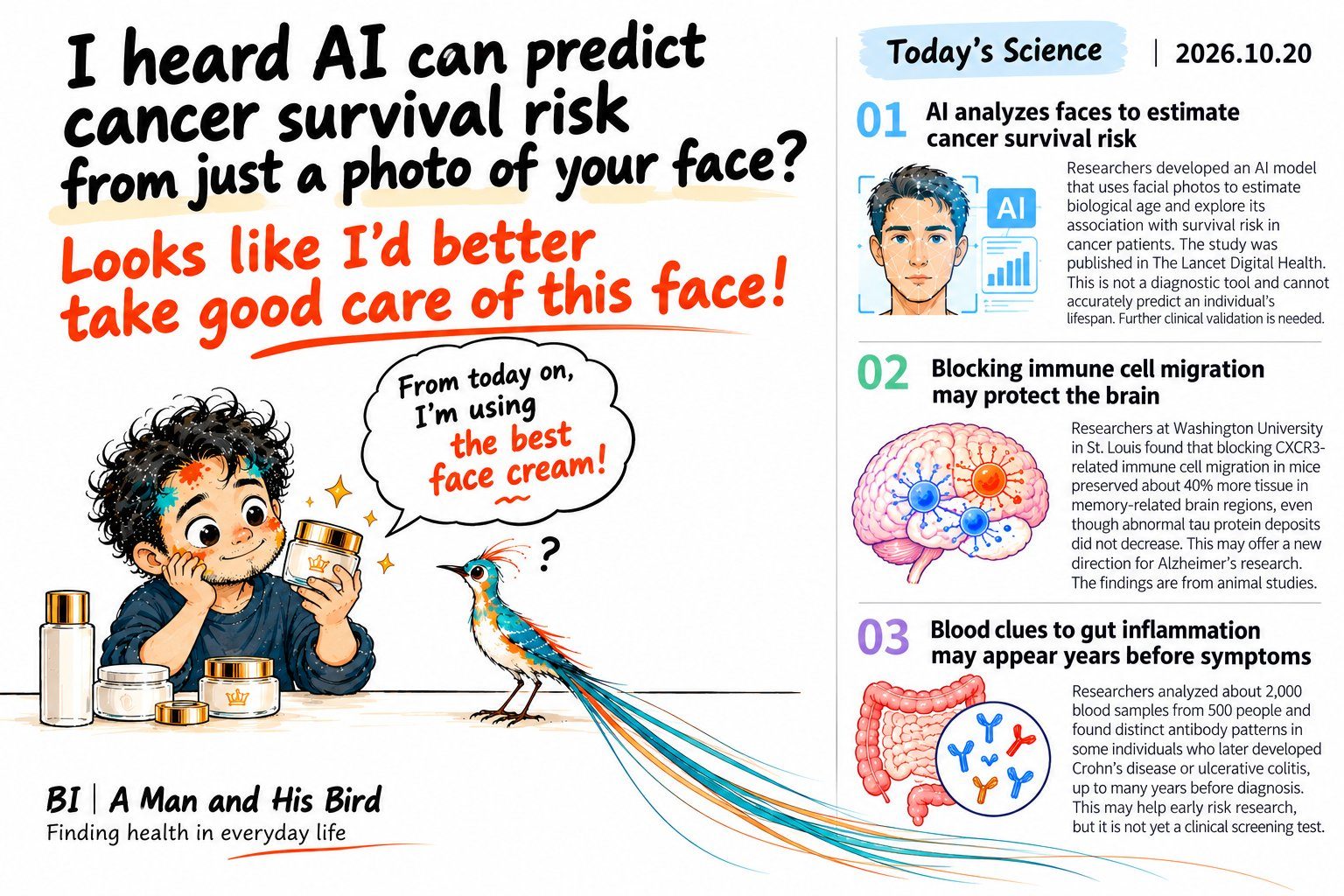
Today, we highlight three developments in medical research: artificial intelligence and cancer survival risk, immune cells and Alzheimer’s-related brain damage, and early immune signals associated with inflammatory bowel disease.
① Can AI Estimate Cancer Survival Risk from a Facial Photograph?
Researchers in the United States have developed an artificial intelligence model that analyzes facial photographs to estimate biological age and investigate its association with survival outcomes in cancer patients.
The significance of this research is not that AI can diagnose cancer from a photograph. Rather, certain facial characteristics may contain information associated with an individual’s overall biological health.
Traditional medical assessment relies on clinical history, physical examinations, imaging, laboratory testing, and pathology. In the future, facial AI analysis may provide supplementary information for evaluating health risks.
However, current findings do not establish that AI can accurately predict an individual patient’s lifespan or replace established clinical assessments.
② Could Brain Damage Be Reduced Without Removing Abnormal Tau Protein?
Alzheimer’s disease research has traditionally focused on the abnormal accumulation of amyloid and tau proteins.
Researchers at Washington University School of Medicine in St. Louis found that blocking immune cell migration associated with CXCR3 reduced certain forms of brain tissue damage in experimental mice.
Interestingly, memory-related brain regions retained more tissue even though abnormal tau protein deposits were not significantly reduced.
These findings suggest that neurodegenerative damage may depend not only on abnormal protein accumulation but also on immune cell activity and neuroinflammation.
However, this remains animal research and does not establish an effective treatment for humans.
③ Could Blood Reveal Signs of Inflammatory Bowel Disease Years Before Diagnosis?
Crohn’s disease and ulcerative colitis are forms of inflammatory bowel disease (IBD) involving abnormal immune regulation in the gastrointestinal tract.
Researchers analyzed approximately 2,000 blood samples from 500 individuals and identified distinct antibody patterns in some people who later developed inflammatory bowel disease.
These immune changes appeared years before clinical diagnosis, suggesting that certain chronic inflammatory diseases may involve a prolonged period of biological changes before symptoms become apparent.
If further validated, these biomarkers could potentially help identify individuals at increased risk.
However, these antibody patterns are not currently established as routine clinical screening or diagnostic tests.
Today’s Scientific Perspective
These three studies share an important theme: researchers are increasingly investigating biological changes that may occur before diseases become clinically apparent.
Facial characteristics, immune cell activity in the brain, and antibody patterns in the blood may provide new clues about underlying physiological processes.
However, discovering a biological association is not the same as developing a reliable diagnostic tool.
The value of personalized health management lies not only in identifying disease but also in understanding how the body changes over time and applying scientifically validated methods of assessment.
—
Science & Education: BI 身体智慧 (Body Intelligence)
AI-assisted Research & Illustration: BI × GPT
Professional Review: 林存默 (Thomas Lin)
Professional Community: ACPN — The Association of Certified Professional Nutritionists
#HealthScience #ArtificialIntelligence #CancerResearch #AlzheimersDisease #Neuroinflammation #GutHealth #PersonalizedHealth #FunctionalNutrition #ACPN