
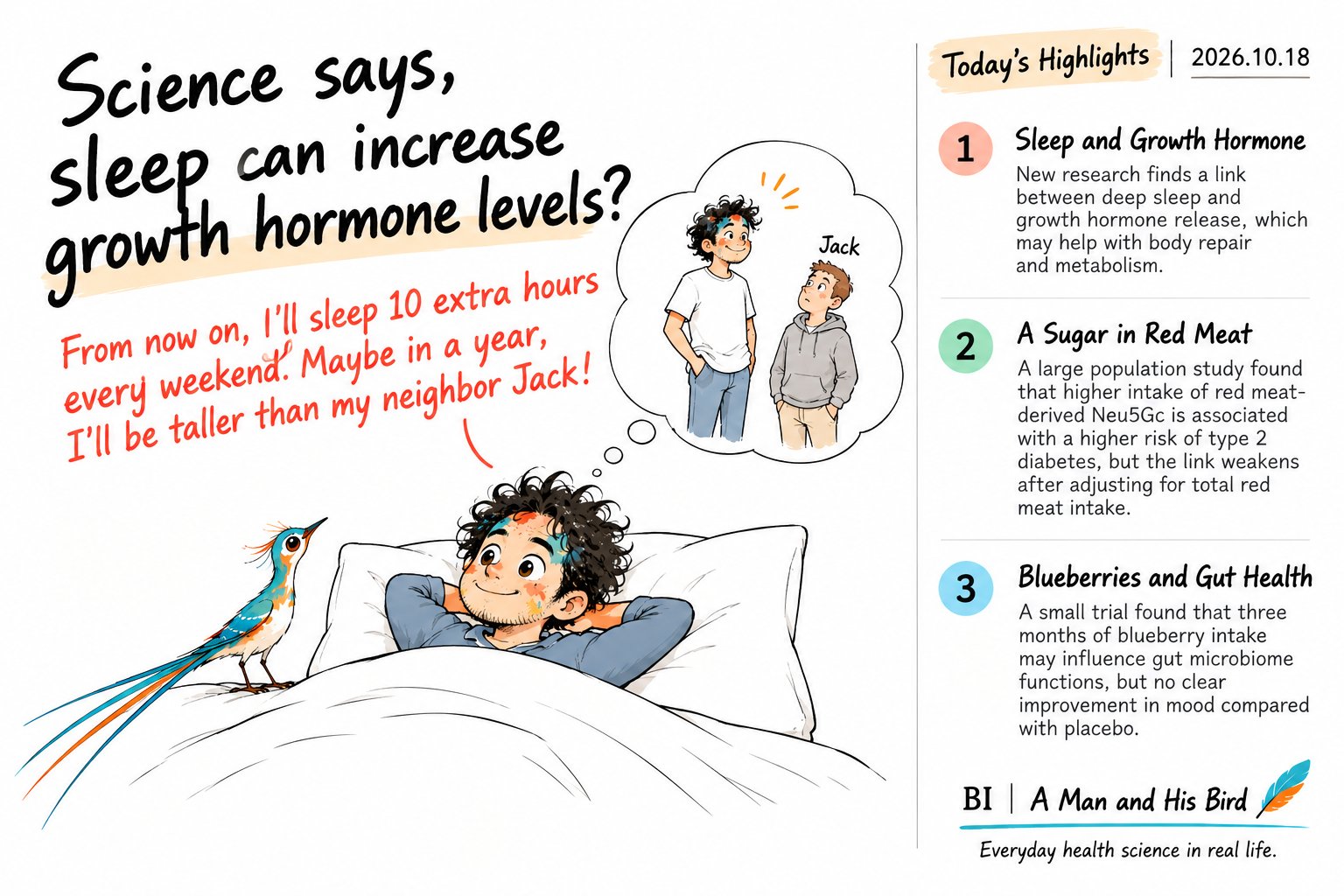
Sleep and Growth Hormone, a Sugar Found in Red Meat, and Blueberries and the Gut Microbiome
Three recent research developments highlight how sleep, diet, and microbial metabolism may influence human health. Each offers new insights, but also raises an important question: how much of the evidence can be translated into practical health recommendations?
1. Deep Sleep and Growth Hormone: How Does Sleep Support the Body?
Growth hormone (GH) is widely associated with childhood growth and development. However, its biological functions extend well into adulthood.
In adults, growth hormone participates in protein metabolism, tissue maintenance, fat metabolism, and other physiological processes.
Recent research has further explored how the brain coordinates deep sleep and growth hormone secretion.
The relationship between slow-wave sleep and pulsatile growth hormone release has been recognized for decades. The newer research contributes to our understanding of the neural mechanisms involved in this relationship.
These findings reinforce the importance of sleep as an active physiological process rather than simply a period of inactivity.
Does sleeping longer mean producing more growth hormone?
Not necessarily.
Growth hormone secretion is influenced by sleep architecture, age, circadian regulation, metabolic conditions, and other factors. Spending more hours in bed does not guarantee a proportional increase in growth hormone secretion.
Furthermore, once the growth plates have closed, additional sleep will not cause adults to grow taller.
The practical message is to prioritize adequate, consistent, high-quality sleep rather than assuming that more sleep always produces greater biological benefits.
2. A Sugar Found in Red Meat: Is Neu5Gc Associated With Type 2 Diabetes?
A large observational study involving nearly 90,000 participants investigated the relationship between dietary intake of N-glycolylneuraminic acid (Neu5Gc) and the risk of developing type 2 diabetes.
Neu5Gc is a type of sialic acid found in certain animal-derived foods, particularly red meat.
Humans do not naturally synthesize Neu5Gc, although small amounts may be incorporated into human tissues through dietary exposure.
The study reported that participants with higher estimated Neu5Gc intake also had a higher observed risk of type 2 diabetes.
However, an important limitation emerged when researchers adjusted for total red meat consumption: the association between Neu5Gc and diabetes risk was no longer statistically significant.
This finding complicates the interpretation.
It suggests that Neu5Gc intake may be associated with broader dietary patterns or other factors related to red meat consumption.
Does this mean Neu5Gc causes diabetes?
No causal relationship has been established.
Observational studies can identify associations, but they cannot independently determine whether a particular dietary compound causes a disease.
It is also important to distinguish Neu5Gc from ordinary dietary sugars such as glucose or sucrose. Although Neu5Gc belongs to a family of sugar-related molecules, its biological properties and metabolic significance are different.
Further research is needed to determine whether Neu5Gc has an independent role in metabolic disease.
3. Blueberries and the Gut Microbiome: What Happens After Three Months?
Blueberries contain dietary fiber and naturally occurring plant compounds, including anthocyanins and other polyphenols.
These compounds have attracted scientific interest because some may interact with the gut microbiome.
A small human trial examined the effects of consuming blueberries over three months in older adults.
Researchers observed changes in certain functional genes associated with gut microorganisms.
These findings suggest that blueberry consumption may influence aspects of microbial function, potentially affecting how gut microorganisms process dietary compounds.
However, changes in microbial genes do not necessarily establish improvements in overall health.
The study also assessed mood-related outcomes.
Although some changes were observed, differences in mood improvement between the blueberry and placebo groups were not statistically significant.
Can blueberries improve depression?
Current evidence from this small trial does not support such a conclusion.
The findings are better understood as preliminary evidence that dietary plant compounds may influence microbial functions.
Larger and more rigorous clinical trials are needed to determine whether these biological changes produce meaningful health benefits.
From Scientific Findings to Practical Health Management
These three research developments illustrate a common challenge in modern health science.
A biological mechanism is not the same as a demonstrated clinical benefit.
A statistical association is not proof of causation.
And a measurable change in a laboratory or microbiome marker does not automatically translate into improved health outcomes.
For health professionals, the important questions include:
– What population was studied?
– Was the research observational, experimental, or clinical?
– What outcomes were actually measured?
– How strong and reproducible is the evidence?
– Can the findings support a practical recommendation?
Understanding these distinctions is essential for responsible, evidence-based health management.
Scientific discoveries expand our understanding of the human body. Their real value emerges when findings are carefully evaluated and translated into appropriate actions.
—
Science & Education: BI 身体智慧 (Body Intelligence)
AI-assisted Research & Illustration: BI × GPT
Professional Review: 林存默(Thomas Lin)
Professional Community: ACPN — The Association of Certified Professional Nutritionists (加拿大注册执业营养师公会)
This article is for science and health education only and does not replace professional medical advice, diagnosis, or treatment.