
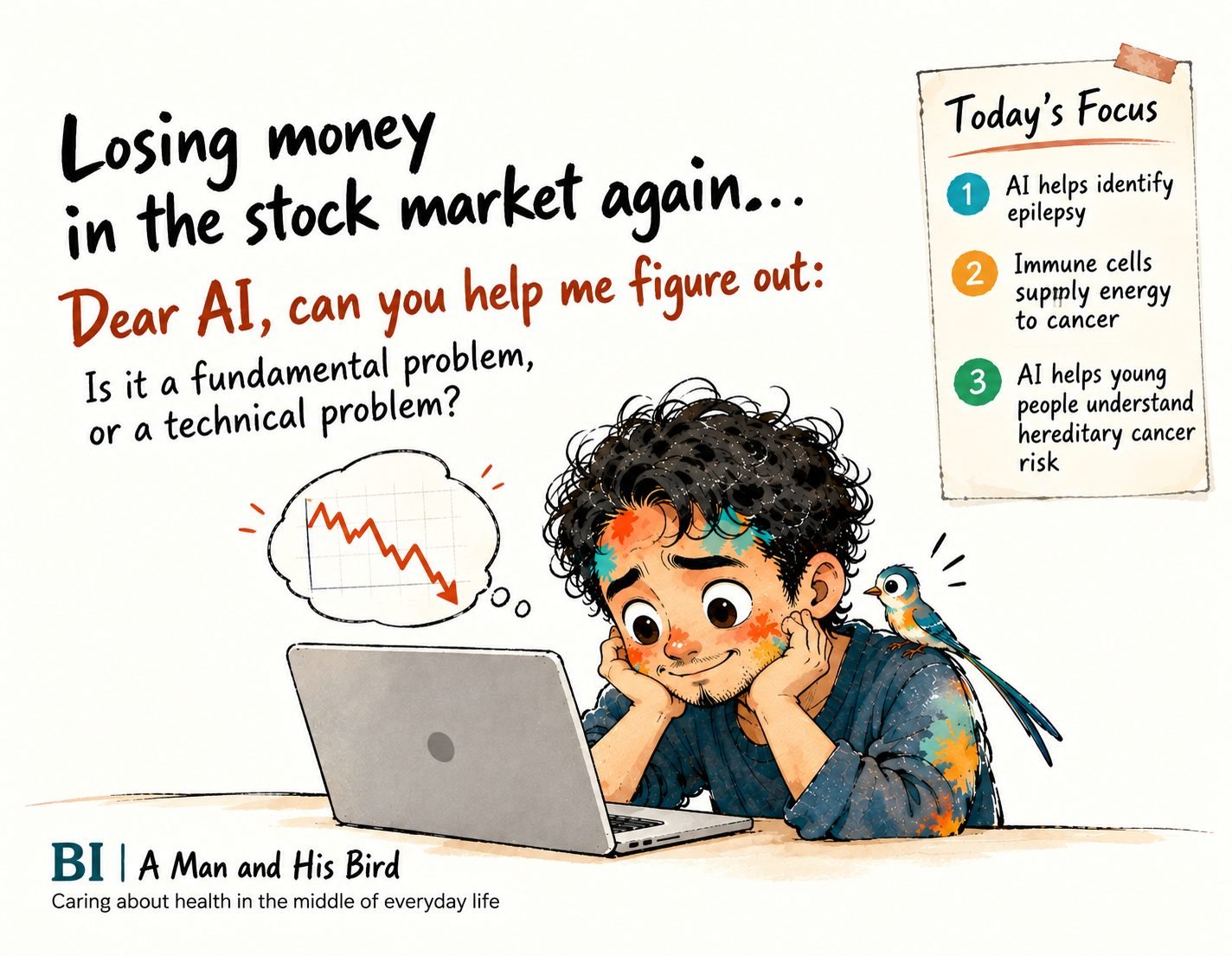
AI Is Changing How We Understand Disease
Health Science Review | October 12, 2026
Three recent studies highlight important developments in health science. Although they address different areas of medicine and human health, they point toward a broader transformation: artificial intelligence is increasingly being used to support disease identification, improve our understanding of biological mechanisms, and help individuals interpret their personal health risks.
The significance of these developments goes beyond technological innovation. They raise an important question about the future of healthcare and health management: How can scientific knowledge become more accessible, understandable, and useful to both professionals and individuals?
1. AI-Assisted Epilepsy Identification: Supporting Complex Clinical Decisions
Epileptic seizures and functional seizures can sometimes produce similar symptoms, even though their underlying mechanisms and clinical management differ.
Distinguishing between these conditions can be challenging, particularly when clinical histories are complex or diagnostic information is incomplete.
Researchers have developed an AI-assisted system capable of analyzing clinical records to help clinicians differentiate between seizure types.
The potential value of this approach lies in its ability to identify relevant patterns across large amounts of medical information and provide additional support for clinical decision-making.
However, the goal is not to replace neurologists or established diagnostic procedures.
The available findings are preliminary. Further prospective studies are needed to determine whether AI-assisted identification consistently improves diagnostic accuracy, patient management, and clinical outcomes in real-world settings.
The broader lesson is that AI may become a valuable analytical partner in situations where human expertise must interpret complex and sometimes ambiguous information.
2. Immune Cells May Supply Nutrients That Support Cancer Growth
Immune cells are commonly understood as part of the body’s defense system, responsible for recognizing and responding to abnormal cells.
However, the relationship between immune cells and cancer is considerably more complex.
Within the tumor microenvironment, certain immune cells can be influenced by cancer cells and may contribute to conditions that support tumor survival.
Recent mechanistic research has identified a particularly interesting metabolic interaction involving tumor-associated macrophages.
In specific breast cancer models, these macrophages can supply ornithine, a molecule that cancer cells may use through downstream metabolic pathways to support proline synthesis.
Proline contributes to cellular metabolism and the production of essential biological materials.
Under certain nutrient-restricted conditions, this metabolic exchange may help cancer cells maintain functions required for survival and growth.
This finding highlights an important principle: cancer metabolism is not determined solely by what happens inside cancer cells.
It also depends on interactions among neighboring cells, nutrient availability, and the metabolic organization of the tumor microenvironment.
From a broader biological perspective, this is an example of metabolic cooperation between different cell populations.
Nevertheless, these findings remain primarily mechanistic and preclinical. They should not be interpreted as evidence that a new treatment has already been established.
Additional research is required to determine which cancer types and patient populations may be affected and whether these metabolic pathways can be targeted safely and effectively.
3. AI May Help Young People Understand Hereditary Cancer Risk
Understanding hereditary cancer risk is not simply a matter of knowing whether a genetic variant is present.
Risk assessment may involve genetic findings, family history, age, individual circumstances, and probabilities that are difficult to interpret without professional guidance.
Even after genetic counseling, individuals may struggle to understand what their estimated risk means for their future health.
A study involving adolescents and young adults explored whether an AI-based conversational tool could improve participants’ understanding of hereditary cancer risk.
The findings suggested that AI-supported communication may help young people develop a more accurate perception of their personal cancer risk without a corresponding increase in measured psychological distress.
This is a promising direction because understanding risk is an important part of informed health decision-making.
However, improved risk comprehension should not be confused with improved long-term health outcomes.
The study was relatively small, and further research is needed to determine whether these tools lead to better decisions, appropriate screening participation, or meaningful improvements in health over time.
AI tools should also complement, rather than replace, qualified genetic counseling and medical evaluation.
The larger opportunity may be to make complex scientific information easier for individuals to understand and apply within their own lives.
Today’s Perspective: From Information to Understanding
Artificial intelligence is often evaluated by how quickly it can answer questions or process information.
But speed alone is not its most important contribution to human health.
A more meaningful possibility is that AI could help healthcare professionals recognize patterns that might otherwise be overlooked, while also helping individuals better understand the biological processes and risks affecting their lives.
The three studies discussed today illustrate different dimensions of that possibility.
AI-assisted seizure identification explores how technology may support clinical interpretation.
Research on immune-cell metabolism demonstrates how new scientific methods can reveal previously underappreciated relationships within the human body.
AI-supported hereditary cancer communication suggests that advanced scientific knowledge may become more understandable and accessible to individuals.
Together, these developments point toward a future in which health knowledge is not merely collected and stored, but increasingly translated into meaningful understanding.
Yet technological capability does not eliminate the need for scientific validation, professional judgment, ethical responsibility, and careful interpretation.
The future of health management should not simply involve having more information. It should involve helping people understand their bodies more deeply and make better-informed decisions.
Science & Education:
BI Body Intelligence
AI-assisted Research & Illustration:
BI × GPT
Professional Review:
Thomas Lin
Professional Community:
ACPN — The Association of Certified Professional Nutritionists
This article is for science and health education only and does not replace professional medical advice, diagnosis, or treatment.
#BodyIntelligence #ArtificialIntelligence #HealthManagement #CancerResearch #Epilepsy #FunctionalNutrition #ACPN