
Health Technology Today | Three Scientific Research Updates
October 10, 2026
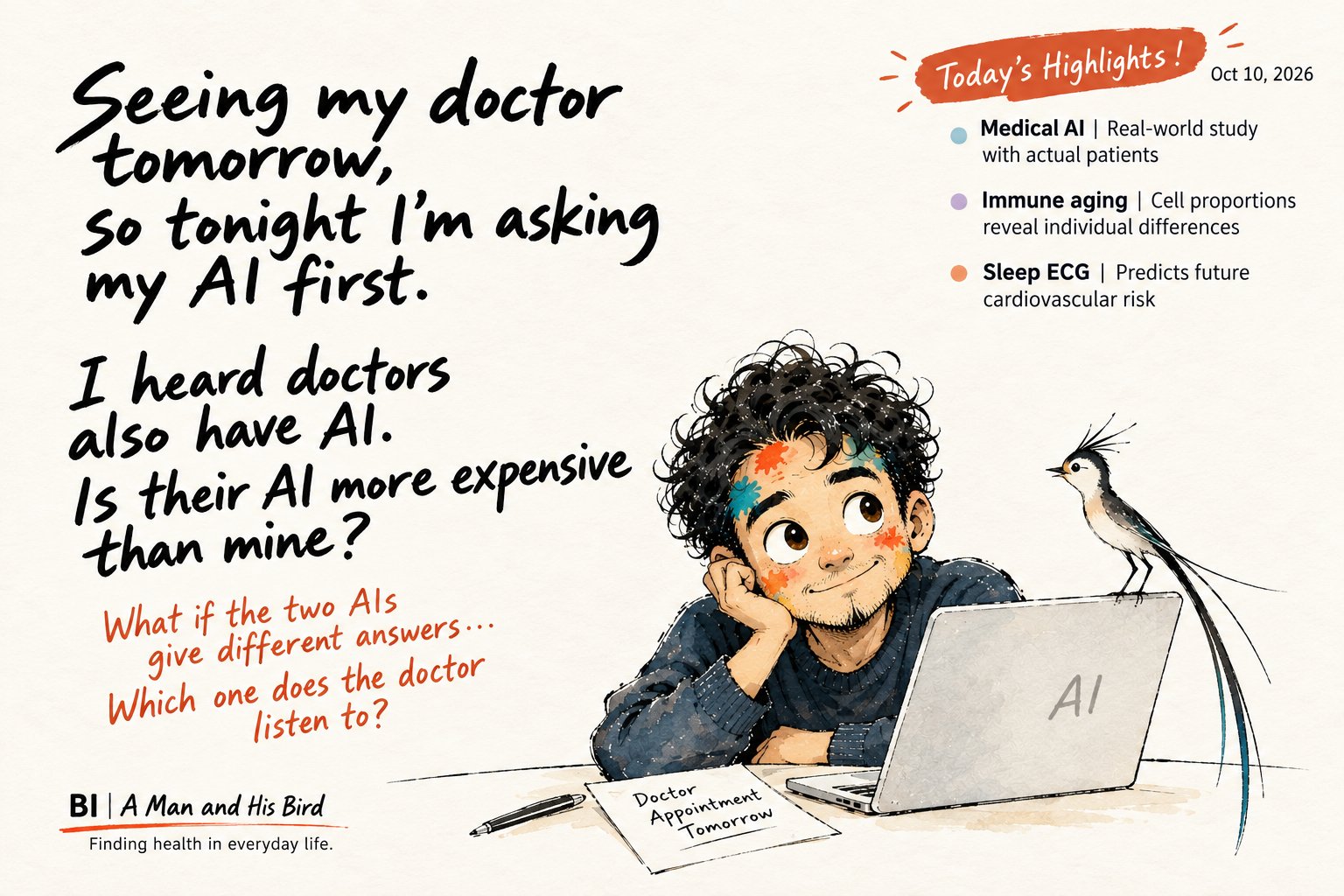
1. Medical AI Enters Real-World Patient Research
A recent prospective real-world study published in The Lancet, conducted by researchers at Beth Israel Deaconess Medical Center, evaluated the safety and practical value of conversational artificial intelligence in patient interactions before clinical appointments.
The study enrolled 114 patients, of whom 98 completed both an AI conversation and a subsequent clinical visit.
Under real-time physician supervision, none of the 98 completed conversations triggered a safety-related termination. Physicians identified one instance of AI hallucination and provided additional clinical clarification in five conversations.
Among 44 cases in which physicians reviewed AI-generated records or summaries, 75% reported that the information helped them prepare for patient visits.
The findings suggest that conversational AI may support patient communication and clinical information collection. However, its ability to perform independent clinical diagnosis and its impact on patient health outcomes require further investigation.
2. Immune Cell Research Reveals Individual Differences in Aging
Researchers at the University of Washington published a study in Immunity examining the relationship between distinct memory T-cell populations and immune aging.
The researchers identified associations between the relative proportions of two memory T-cell populations with different granzyme expression patterns and characteristics related to healthy aging and disease risk.
These findings provide new insights into how the immune system changes with age. They also suggest that individuals of the same chronological age may exhibit different immune cell compositions and aging characteristics.
At present, these findings remain primarily relevant to scientific research and cannot be directly used to diagnose an individual’s immune age or predict disease risk in clinical practice.
3. Overnight ECG Signals May Help Predict Cardiovascular Risk
A study supported by the U.S. National Institutes of Health (NIH), published in SLEEP, investigated the potential of combining overnight electrocardiogram (ECG) recordings, sleep-stage information, and deep learning to predict future adverse cardiovascular events.
By integrating cardiac electrical activity recorded during sleep with AI-based analysis, researchers found that these signals could provide predictive information beyond traditional cardiovascular risk factors.
The findings suggest that sleep monitoring data may have applications beyond identifying sleep disorders, potentially contributing to cardiovascular risk assessment and stratification.
However, further validation is needed before such approaches can be widely adopted in clinical practice. They are not substitutes for established cardiovascular diagnostic procedures or clinical risk assessment.
Science & Education: BI 身体智慧 (Body Intelligence)
AI-assisted Research & Illustration: BI × GPT
Professional Review: 林存默(Thomas Lin)
Professional Community: ACPN — The Association of Certified Professional Nutritionists (加拿大注册执业营养师公会)
This article is for educational purposes only and does not constitute medical advice. Please consult a qualified healthcare professional for personal health concerns.