
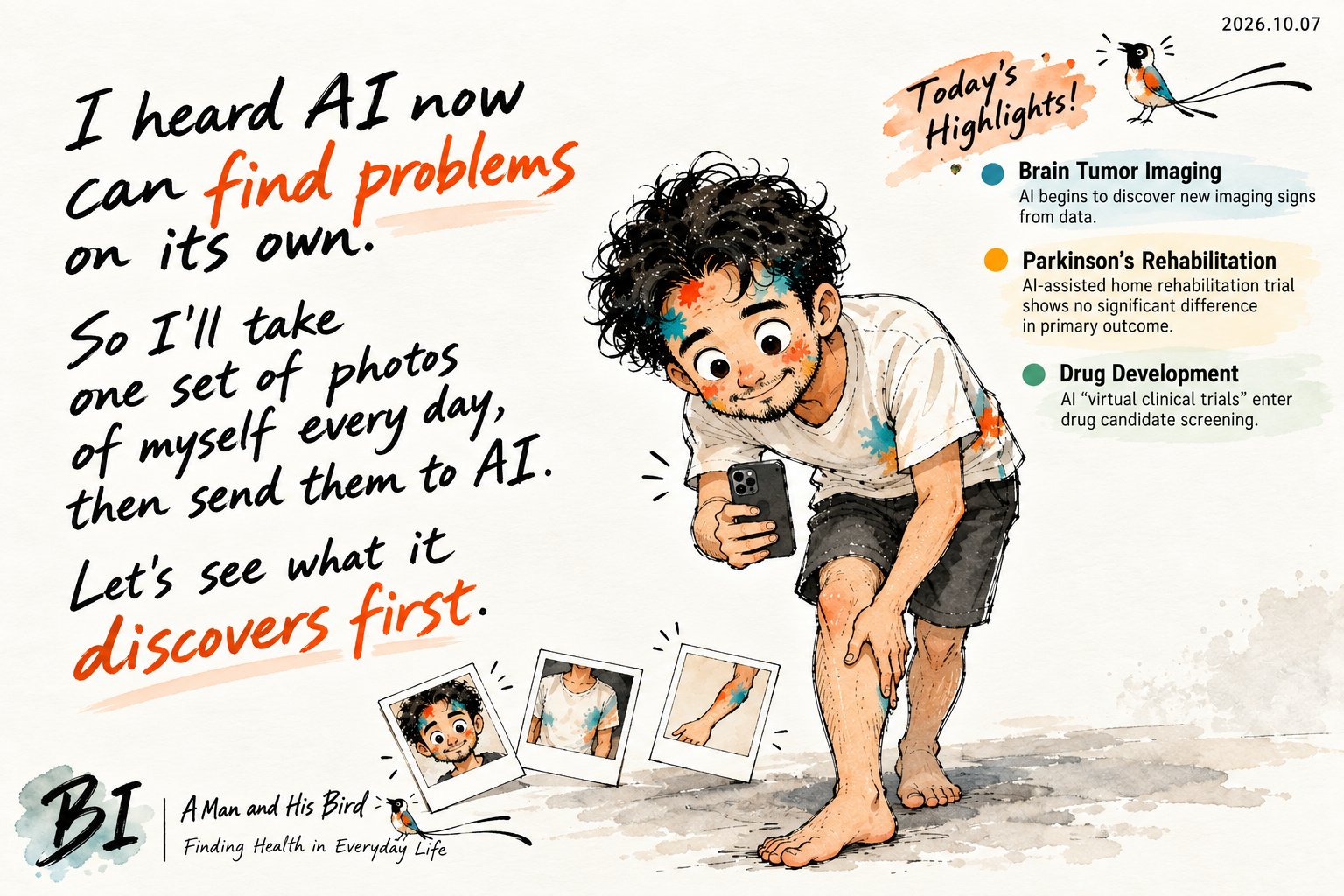
Today in Health Technology | AI Is Moving from “Answering Questions” to “Discovering Questions”
For the past several years, one of the most common roles of medical AI has been answering questions already defined by humans:
Is there an abnormality in this image?
Is this lesion more likely benign or malignant?
Which risk category does this patient belong to?
Now, another direction is beginning to emerge: AI is not only answering questions. It is starting to search for patterns that humans may not have explicitly identified.
A recent study published in npj Digital Medicine explored whether agentic AI could analyze large numbers of quantitative imaging features, identify potentially meaningful patterns, and translate them into visual signs that radiologists could recognize and evaluate.
The researchers initially analyzed 106 cases of supratentorial glioblastoma (GBM) and generated several candidate imaging signs. One of these, the “cauliflower sign,” was subsequently evaluated by two radiologists in an additional dataset of 50 glioblastomas and 50 brain metastases, achieving an average AUC of approximately 0.75.
That number alone does not establish a new clinical diagnostic method.
What is more interesting is the change in the direction of discovery.
Traditionally:
Clinicians observe → identify imaging features → AI learns those features.
A different pathway is now becoming possible:
AI analyzes data → identifies candidate patterns → translates them into human-interpretable features → clinicians validate them.
This suggests that AI may gradually evolve from a pattern-recognition tool into a tool that can also assist scientific discovery.
The evidence boundaries remain important.
This was a relatively small study. The candidate imaging signs require validation in larger, independent, multicenter datasets, and an AUC of approximately 0.75 is far from sufficient for an AI system to independently perform diagnosis.
It would therefore be premature to say that “AI has discovered a new way to diagnose brain cancer.”
A more accurate interpretation is:
AI may be helping researchers generate new medical hypotheses that humans can then test.
That distinction matters.
As medical AI develops, we may need to ask not only:
Can AI correctly answer the questions clinicians ask?
But also:
Can AI find meaningful patterns in data that humans have not yet noticed—and turn them into questions worth investigating?
If those discoveries can eventually be independently reproduced and shown to change diagnosis, treatment, or patient management, AI’s role may extend beyond improving efficiency.
It may begin to participate in the process through which medical knowledge itself is created.
——
Science & Education: BI 身体智慧 (Body Intelligence)
AI-assisted Research & Illustration: BI × GPT
Professional Review: 林存默(Thomas Lin)
Professional Community: ACPN — The Association of Certified Professional Nutritionists (加拿大注册执业营养师公会)
This article is intended for science-based health technology education and does not provide medical advice. Consult a qualified healthcare professional for medical decisions.