
The Deep Generalist: Why Interdisciplinary Learning Is Hard—and Why It May Become Rewarding
ACPN × CCPH Professional Education
Professional Review: Thomas Lin (林存默)
“Deep generalist” is becoming an increasingly relevant idea in an age when artificial intelligence can provide rapid access to specialized information.
A deep generalist is not simply someone who knows a little about many subjects. The more useful definition is someone who develops meaningful depth in key areas while also building enough knowledge across disciplines to recognize connections, transfer ideas, and approach complex problems from multiple perspectives.
But this raises a more interesting question:
Why is becoming a deep generalist so difficult?
Part of the answer may lie in how the human brain learns.
The Cognitive Cost of Entering a New Field
Moving from a familiar domain into an unfamiliar one is not simply a matter of adding more information.
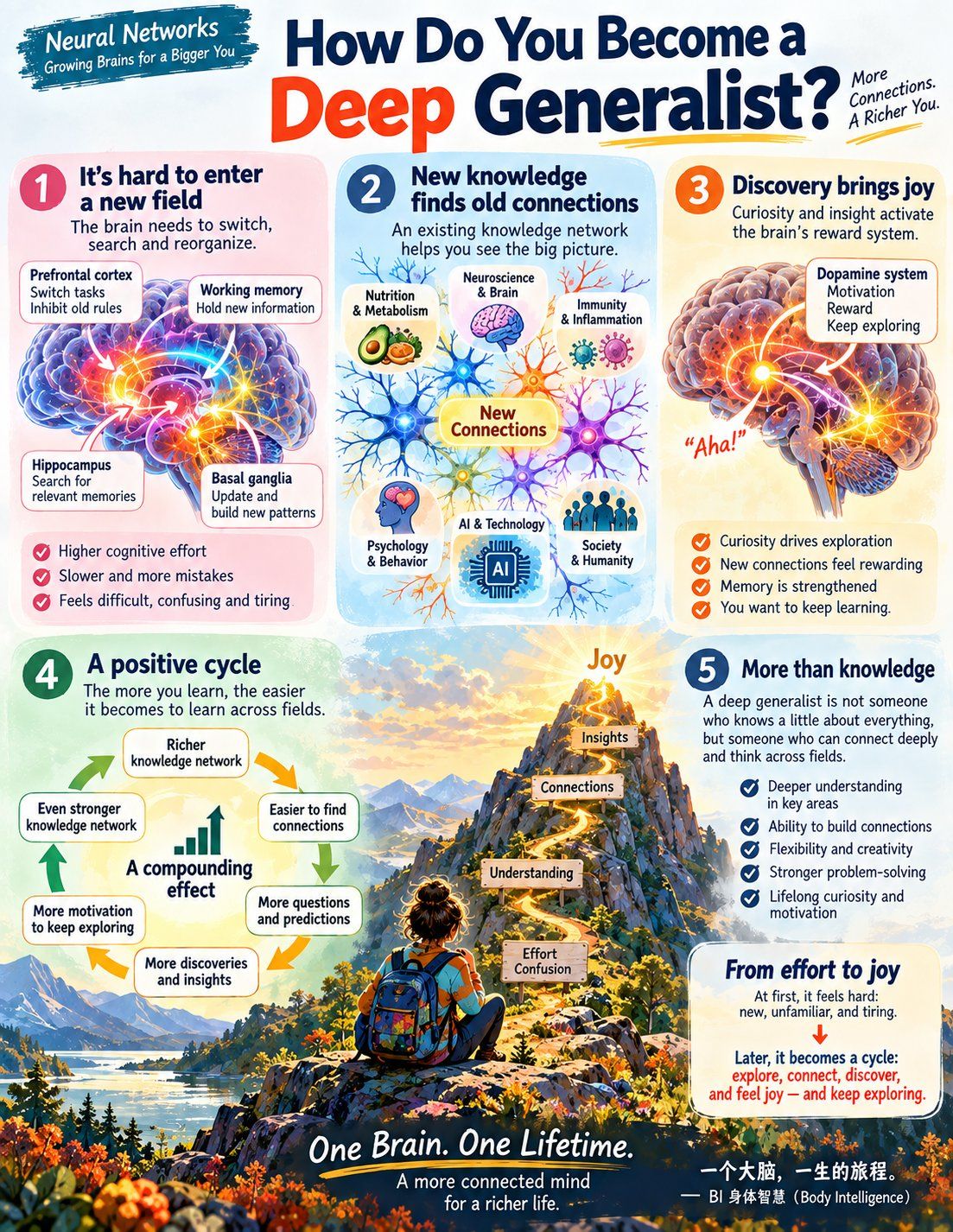
The brain must shift its current task state, maintain unfamiliar information in working memory, retrieve potentially relevant knowledge from long-term memory, inhibit irrelevant responses, and continuously determine which previous concepts may apply to the new problem.
In a familiar field, many of these processes become relatively efficient.
An experienced nutrition professional, for example, may see elevated triglycerides and rapidly connect them with hepatic lipid metabolism, VLDL production, insulin resistance, dietary patterns, alcohol intake, and possible interventions.
In an unfamiliar field, those connections may not yet exist.
Every concept must first be understood, held in mind, compared with previous knowledge, and placed within a developing framework.
This helps explain why crossing into a new discipline can feel slow, confusing, and cognitively demanding.
The challenge is not necessarily a lack of intelligence or curiosity.
The brain may simply have fewer existing pathways through which the new information can be organized and interpreted.
When New Knowledge Begins to Find Old Knowledge
Something important happens as knowledge accumulates.
Imagine a health professional who already understands nutrition, metabolism, and immunology and then begins studying neuroscience.
The term “neuroinflammation” may initially be unfamiliar. But soon it can begin activating existing concepts:
Inflammation → immune signaling → cytokines → microglia → blood-brain barrier → metabolism → neurological disease
New knowledge is no longer isolated.
It begins to find places within an existing knowledge structure.
This is where interdisciplinary learning may become increasingly powerful. The learner is no longer building every concept from the ground up. Existing knowledge can provide frameworks, analogies, questions, and possible mechanisms through which unfamiliar information can be interpreted.
The knowledge network becomes richer—and potentially more useful.
From Cognitive Cost to Cognitive Reward
There is another side to learning that deserves attention.
The brain does not only experience cognitive effort. Learning can also become intrinsically rewarding.
Research on curiosity, information seeking, memory, and insight suggests that discovering desired information and resolving uncertainty interact with neural systems involved in motivation, reward, and memory. Dopamine participates in several of these processes, although it would be inaccurate to reduce them to the popular equation:
dopamine = pleasure.
What matters is that acquiring information can itself have value.
Consider the familiar experience of suddenly realizing:
“Now I understand.”
Or:
“I never realized these two things were connected.”
As a person’s knowledge network becomes richer, opportunities for these moments may increase.
A new idea can connect with several existing domains. One connection generates another question. That question leads to another search, another comparison, and sometimes another unexpected insight.
Learning can therefore begin to change from something that is primarily effortful into something that is also rewarding.
The Cognitive Compounding Effect
This suggests a useful conceptual framework:
More knowledge
→ More possible connections
→ Better questions and predictions
→ More discoveries and insights
→ Greater motivation to explore
→ More learning
→ A richer knowledge network
We might call this the cognitive compounding effect of the deep generalist.
This should not be mistaken for an established neuroscientific model of a “deep generalist brain.” Deep generalism itself is not a defined neuroscientific category.
Rather, it is a conceptual framework that brings together established areas of research—including cognitive control, working memory, memory retrieval, knowledge structures, curiosity, learning, motivation, and cognitive flexibility—to help explain why interdisciplinary expertise may initially be difficult to develop but increasingly productive once a sufficiently connected knowledge base begins to form.
Why This Matters for Health Professionals
Modern health problems rarely remain inside one discipline.
Consider metabolic health.
Understanding a patient may require knowledge of:
Nutrition ↔ Metabolism ↔ Endocrinology ↔ Immunology ↔ Neuroscience ↔ Sleep ↔ Exercise ↔ Behavior
Artificial intelligence adds another layer.
AI can dramatically accelerate access to information, literature, explanations, and hypotheses. But rapid access to information is not equivalent to professional judgment.
A health professional still needs to ask:
Is this biologically plausible?
What mechanism is being proposed?
What is the quality of the evidence?
Was the research performed in cells, animals, healthy adults, patients, or children?
Does an association demonstrate causation?
Can evidence from one population legitimately be transferred to another?
And what information is still missing?
These questions require more than information retrieval.
They require a connected professional knowledge network.
Specialist or Generalist? Perhaps Both.
The future health professional may therefore need to be both a specialist and a deep generalist:
Deep enough to understand mechanisms.
Broad enough to recognize connections.
Curious enough to cross disciplinary boundaries.
And disciplined enough to recognize the limits of evidence.
Artificial intelligence may make specialized information increasingly accessible.
That does not make human knowledge networks irrelevant.
It may make them even more important.
Because the real value of knowledge is not simply how much information we possess.
It is whether different pieces of knowledge can find one another, challenge one another, illuminate one another, and help us ask better questions.
Perhaps this is the deeper journey of becoming a deep generalist.
At first:
Unfamiliarity → Effort → Confusion
Eventually, for some learners:
Curiosity → Connection → Discovery → Motivation → More Curiosity
When discovery itself becomes rewarding, learning is no longer simply a task to complete.
It becomes a reason to continue exploring.
One Brain. One Lifetime.
A more connected mind for a richer life.
— BI 身体智慧 (Body Intelligence)
Professional Education | ACPN × CCPH
Professional Review: Thomas Lin (林存默)
—
Science & Education: BI 身体智慧 (Body Intelligence)
AI-assisted Research & Illustration: BI × GPT
Professional Community: ACPN — The Association of Certified Professional Nutritionists (加拿大注册执业营养师公会)
This article is intended for science-based professional education and does not replace professional judgment or individualized advice.