
When we talk about AI in medicine, the discussion often focuses on one question:
How accurate is the AI?
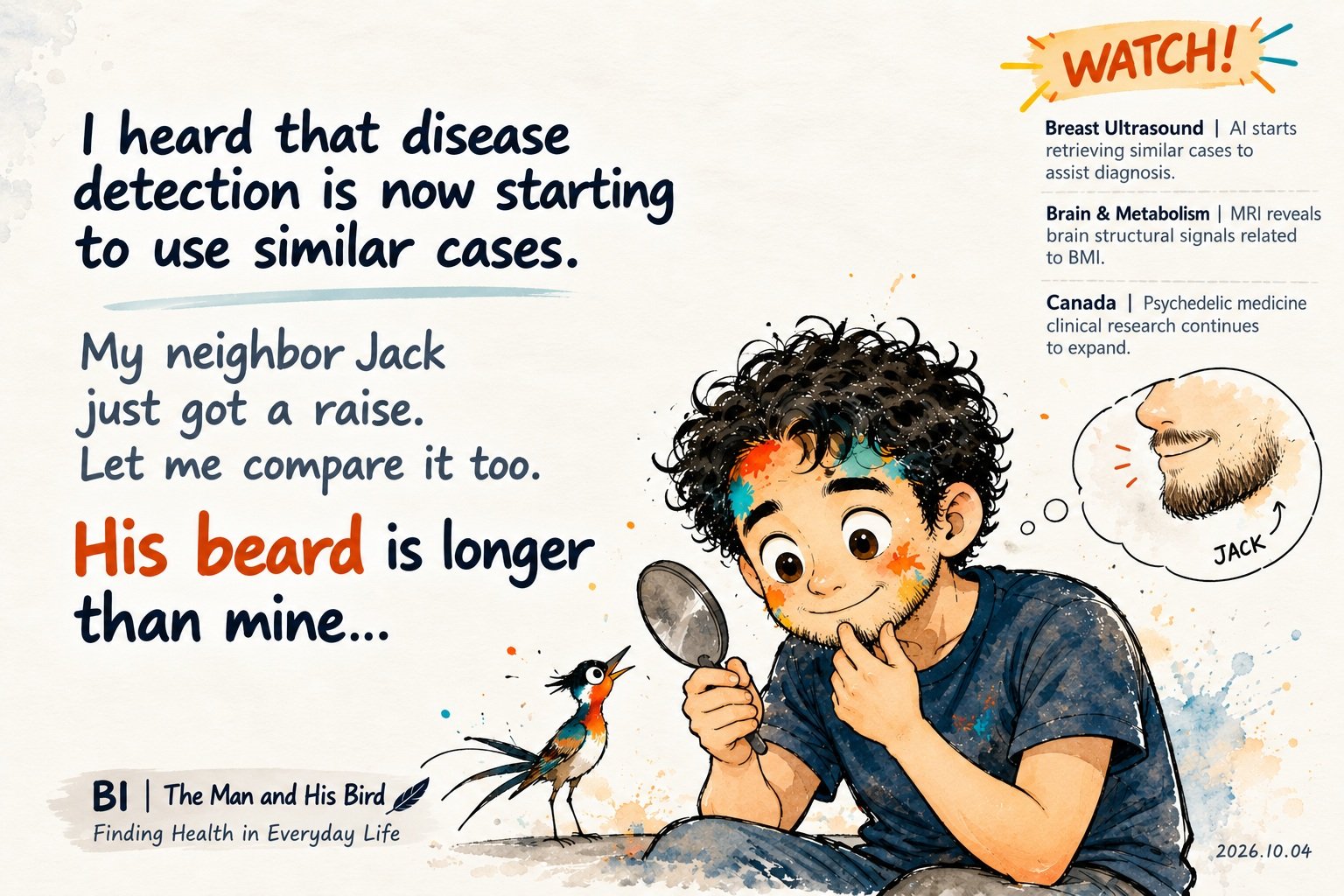
A new study in breast ultrasound suggests another direction may be equally important: instead of simply producing an answer, AI may help clinicians by retrieving similar previous cases and showing the imaging features behind its reasoning.
Breast Ultrasound | From Prediction to Similar-Case Retrieval
A study published in npj Digital Medicine on October 3 introduced an AI system called B-RAD for breast ultrasound assessment.
Rather than functioning purely as a black-box classifier, the system retrieves similar cases and evaluates clinically relevant imaging characteristics, including lesion location, margins and posterior acoustic features, to support BI-RADS assessment.
The study included 8,311 breast ultrasound images from 11 cohorts across seven countries, with external validation and a reader study involving physicians.
In one independent institutional cohort, the system achieved an AUROC of 0.952 for biopsy triage. Under the study conditions, AI assistance also improved diagnostic performance and agreement among participating clinicians.
What makes this particularly interesting is not simply the performance number.
The broader idea is that medical AI may increasingly move from:
“Here is my prediction.”
toward:
“Here is my prediction, here are similar cases, and here are the features that contributed to my reasoning.”
That could make AI-generated recommendations easier for clinicians to examine, challenge and integrate into clinical decision-making.
The evidence boundary remains important. This is a multinational validation study, not evidence that B-RAD has become a routine clinical breast-ultrasound diagnostic system.
Brain & Metabolism | BMI-Related Information May Extend Beyond the Scale
Another study published in npj Digital Medicine examined whether structural brain MRI contains patterns associated with body mass index.
Using data from six independent population cohorts, researchers applied deep learning to identify brain structural signatures associated with BMI.
The findings suggest that these MRI-derived patterns can also track changes in BMI over time, with notable signals involving white-matter regions in areas including the cerebellum, corpus callosum and brainstem.
This does not mean that a brain MRI can now be used as a clinical test for obesity or metabolic disease.
Instead, the study adds to evidence that metabolic status may be associated with biological changes across multiple organs and systems—including the brain.
Association should also not be interpreted as causation.
Canada | Psychedelic Medicine Research Continues to Enter Formal Clinical Research
In Hamilton, Ontario, St. Joseph’s Healthcare is expanding research through its Centre for Health Innovation and Research in Psychedelics.
Current research directions include psilocybin in chronic musculoskeletal pain, opioid-use reduction and other clinical applications.
The important development is not that psychedelic medicines have suddenly become established treatments.
Rather, questions that were once largely outside mainstream medicine are increasingly being investigated through structured clinical trials, defined outcomes, ethics oversight and formal research programs.
The Bigger Question for Medical AI
Of today’s developments, the breast-ultrasound study raises an especially important question.
For AI to become genuinely useful in clinical medicine, it may not be enough for a system to say:
“I calculated the answer.”
Clinicians may increasingly need to ask:
Why did you reach this conclusion?
Which previous cases resemble this patient?
Can I examine the evidence behind your recommendation?
The next generation of medical AI may therefore be defined not only by greater intelligence.
It may also need to become more interpretable, more verifiable, and easier for clinicians to use responsibly.
Science & Education:
BI 身体智慧(Body Intelligence)
AI-assisted Research & Illustration:
BI × GPT
Professional Review:
林存默(Thomas Lin)
Professional Community:
ACPN — The Association of Certified Professional Nutritionists
For educational purposes only. This article does not constitute medical advice, diagnosis, or treatment.