
When most people hear “potassium,” they think of bananas and muscle cramps. In reality, potassium is one of the most important ions in the human body — about 98% of it lives inside your cells, quietly keeping every cell membrane, nerve signal, and heartbeat working as it should. It is far more than just “the anti-cramp mineral.”
1. Maintains cell membrane potential
The Na+/K+-ATPase — the sodium-potassium pump — continuously spends ATP to pump 3 Na+ out of the cell and 2 K+ in. This builds and maintains the ion gradient across the cell membrane (high Na+ outside, high K+ inside), the electrical foundation that nerve, muscle, and heart cells all depend on. (The pump itself needs Mg2+ to work.)
2. Transmits nerve impulses
When a neuron fires an action potential, Na+ rushes in and K+ flows out afterward. K+ then helps the membrane potential recover, so nerve signals can fire continuously and accurately.
3. Powers muscle contraction and relaxation
Both contraction and relaxation of muscle cells depend on normal shifts in membrane potential. Blood potassium that is too low or too high changes muscle excitability — leading to weakness, cramps, and related problems.
4. Keeps the heart’s electrical rhythm
The repolarization of cardiac action potentials depends heavily on K+ channels, which maintain a regular heartbeat. Abnormal blood potassium can disturb the heart’s electrical activity and rhythm — a far more serious concern than an ordinary cramp.
5. Helps regulate blood pressure
Potassium promotes sodium excretion: while sodium (Na+) retains water and raises blood pressure, potassium (K+) promotes sodium excretion and helps maintain healthy blood pressure. Higher dietary potassium intake is associated with healthier blood pressure levels. Potassium never works alone — it regulates fluid volume and vascular tone together with sodium.
6. The kidneys are the command center of potassium balance
The kidneys adjust potassium reabsorption and excretion according to the body’s needs, with excess K+ leaving in urine. Aldosterone is a key regulatory hormone — it increases renal potassium excretion.
7. Hormones redistribute potassium
Insulin, for example, drives K+ into cells and lowers blood potassium. So blood potassium depends not only on “how much you ate,” but on how potassium is redistributed between the blood and the cells.
8. Works hand in hand with magnesium
The Na+/K+ pump needs ATP, and ATP cannot be properly utilized without magnesium (Mg2+). Magnesium and potassium together maintain cell membrane potential and the normal function of nerves, muscles, and the heart.
Most potassium is inside cells — blood potassium is only a tiny fraction
About 98% of the body’s potassium is intracellular; only about 2% is in the blood (kept within a very narrow range). So a normal blood potassium reading does not necessarily mean the body’s potassium reserves are adequate.
When to be cautious
- People with impaired kidney function, whose ability to excrete potassium is reduced.
- People taking ACE inhibitors, ARBs, potassium-sparing diuretics, or similar medications, which may raise potassium levels.
- Severe sweating, vomiting, or use of certain diuretics, which can cause potassium loss.
- Potassium supplementation should never be pursued blindly at high doses — base it on individual health status and professional guidance.
Common potassium-rich foods
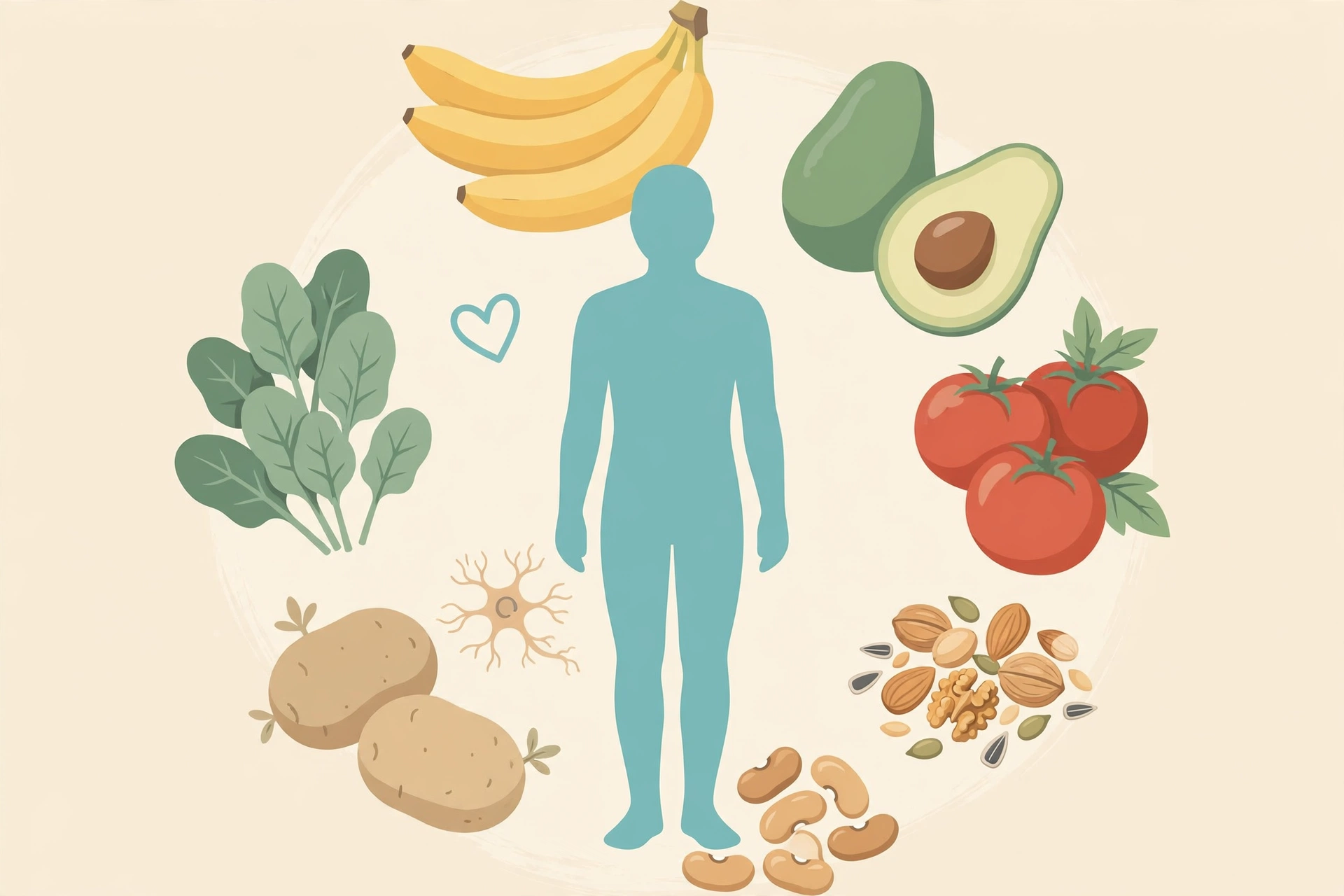
Bananas, potatoes, dark leafy greens (such as spinach), beans, avocado, tomatoes, and nuts and seeds.
Science & Education: BI 身体智慧 (Body Intelligence)
AI-assisted Research & Illustration: BI × GPT
Professional Review: 林存默 (Thomas Lin)
Professional Community: ACPN — The Association of Certified Professional Nutritionists (加拿大注册执业营养师公会)
This article is for nutrition science education only and does not replace professional medical advice. Individual conditions vary; please consult a physician or professional nutritionist with health concerns.